

Writer: Farine Clarke
Director: Sean Turner
The show blurb for Farine Clarke’s Heartsink tells us the writer practised as a GP for a while before a near-death experience woke her up to her own mortality, so one supposes she knows a thing or two about how doctors deal with becoming gravely ill patients. One imagines, like the rest of us, each in their own unique way. It is a shame, then, that one cannot help but feel we have met GP Dr Jeffrey Longford, the gruff, knight-in-sour-armour medical protagonist of the piece, a fair few times before.
Behind Dr Jeffrey’s carapace of clinical detachment, prickly cynicism, and intellectual superiority lies a kind-hearted rough diamond determined to go the extra mile for even the most difficult of patients – or ‘heartsinks’ as they are known in the medical establishment. The always watchable Aden Gillett brings some heavyweight stage gravitas to the role, but there are times when the 85-minute piece feels like an extended take on TV’s Doc Martin, set in an NHS in which everyone has oodles of time to listen to everyone else’s erudite opinions.
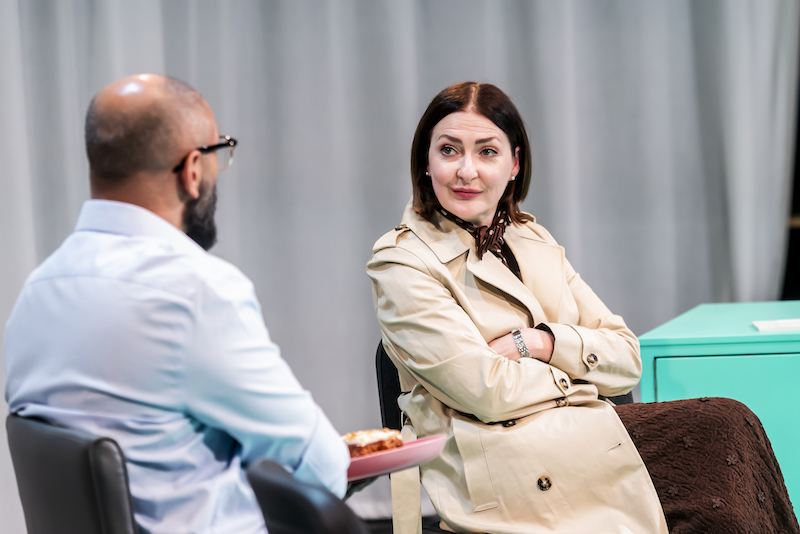
Glasses perched on his brow, stethoscope around his neck, the much-loved rural doctor, “clever to the point of genius”, Jeffrey, keeps patients in his surgery waiting for hours, but they apparently don’t mind because they all adore him, just as they adored his GP father before him. Chief among the roster of loyal, grateful, waiting-room heartsinks is Irish hypochondriac witch Cara (Kathy Kiera Clarke shines, too, in an impeccable cast), who has an uncanny ability to make carrot cake and spot impending death. Dr Jeffrey indulges Cara’s belief that something must be wrong with her, though the tests say otherwise, by booking her an appointment every week and giving her way more time than her allotted 10 minutes, because, well, that is the kind of curmudgeon-with-a-heart-of-gold he is.
Dr Jeffrey’s younger colleague, Dr Roofi (Vikash Bhai), actually took the empathy module (aka “the sucking-up course”) at medical school, but still idolises his status-conscious, blunt-speaking older associate because he is wise and has the aforementioned heart of gold. There is usually a younger, more optimistic foil in medical dramas, there to peel back the layers of the senior physician’s hard-bitten personality, and Bhai makes a decent fist of the role, even if the character struggles to move beyond trope territory.
Dr Roofi and Dr Jeffrey meander around a discussion of Cara (“the patient was heartsink, the cake was heart-lifting”) and how great it would be if computers had never entered general practice, before getting to the meat and potatoes of the business. Dr Jeffrey has incurable cancer, “I didn’t know there were so many tumour markers”, he says, as he peruses his test results and faces up to a crash course in being on the other side of the consulting desk.
Suddenly attuned to the need to stop labelling individuals as “a cancer patient” in favour of “a patient with cancer”, Dr Jeffrey finds himself on regular treatment visits to the cancer ward of the local hospital. There, he strikes up an unlikely bond with early-twentysomething Suzie (Megan Marszal), who has done the obvious thing for Cambridge graduates with first-class degrees in Philosophy: become a hospital receptionist.
Dr Jeffrey takes umbrage at Suzie’s determination to call him, variously, “my lovely”, “my pet”, “poppet”, and “sweetie” rather than addressing him formally as Dr Jeffrey Longford. Suzie is really a foil here, speaking truth to power and bringing the good doctor down a peg or two, thereby revealing his inner humanity. “You’re a controlling fucking shit”, she tells him at one point, which he is, though she doesn’t really mean it when she says it. Everyone here is too nice for that. “Kindness is in your blood”, she assures him later on, as if the audience has failed to grasp the message after 85 or so minutes.
Complications arise when the previously anti-Dignitas Dr Jeffrey mulls over “getting his ducks in a row”, by which he means taking a one-way flight to Switzerland to shorten the inevitable. Clarke raises the thorny theme of decision-making around assisted dying, but the discussions between various pairs of characters on the subject feel too by-the-book and impersonal to reach any conclusion. The ending feels as inevitable as many of the preceding discussions.
Director Sean Turner is not in any particular hurry with a piece that seems a little too comfortable to stick to well-worn tropes, and the play only really takes dramatic flight when the surprising psychology behind Cara’s hypochondria emerges. Top-notch performances aside, one never really gets beneath the surface in Heartsink.
Runs until 10 May 2026
