

Writer and Director: Olivia Revans
It’s 2013 in a catholic girls’ school in Liverpool. There are two bezzy mates (Erin Riley and Freya Jones) in sixth form, navigating adolescent sexuality and not knowing what they are going to do and problem families and eating disorders and a whole raft of stuff. There’s a young, single, good-looking, sardonic English teacher (Louie Threlfall) navigating Ofsted and pupils with crushes and trying to make the curriculum work and actually caring about his duty of care. And there’s a Twitter account full of ‘banter’ and accusations. We are on a journey to find out if this play revolves around the slaughter of a lamb or the laughter of lambs.
It’s a heady mix of teenage trauma and distress, carried along by sharp dialogue and a recognisably accurate impression of teacherly techniques for getting pupils to talk about The Crucible instead of who got off with who at the weekend. As John Proctor is the Villain love sweeps the West End, it is intriguing to see some of the same themes investigated in this contemporaneous piece of writing.
This is a rich, flashy, well-acted, well-written play. Its problem is, in part, the wealth of topics it touches upon, and its comparative failure to address any of them with much consequence. There is an underlying presumption, for instance, that there is a creepy sexual component in the teacher’s interest in his pupils. It’s a problem that is alluded to often, that has a couple of key dramatic scenes, and that has significant plot relevance. It just doesn’t really receive the play’s attention. Too many other problems intrude.
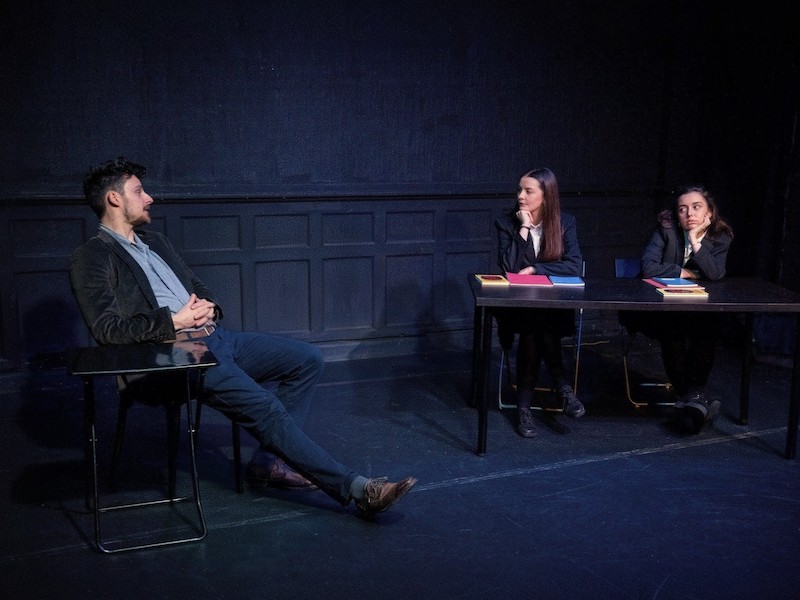
The primary downside of the show, however, is the resolutely dull stage picture – two pupils’ desks left, one teacher’s desk right, a cavernous space in front that isn’t really anywhere, and static blocking that fails to utilise the space for anything resembling dynamic action. There is a weird sequence of moments involving Crucible-originated witchcraft and a ‘poppet’ that gives the girls control of the teacher. It should be consequential, but it isn’t. There is some interesting discourse on the meaning of the word ‘weird’, which gives food for thought, but that is talky. Talky is done well, action less so.
There is a play to be written exploring the connection between adolescent sexuality, witchcraft, and male dominance that could focus on a sixth-form classroom discussing The Crucible and Macbeth. There’s lots of material there, and it’s all interesting. Writer Olivia Revans has become entangled in the wealth of that material, set off down too many paths, and has not quite got to the end of any of them. Lacklustre direction by the writer herself fails to illuminate or limit any of the choices. The end result is writing of considerable promise, ably brought to life by a good set of actors, but ultimately failing to capitalise on any of the topics that are introduced. There are big topics in play, but the lessons drawn are a tad inconsequential.
Reviewed on 17 April 2026
