

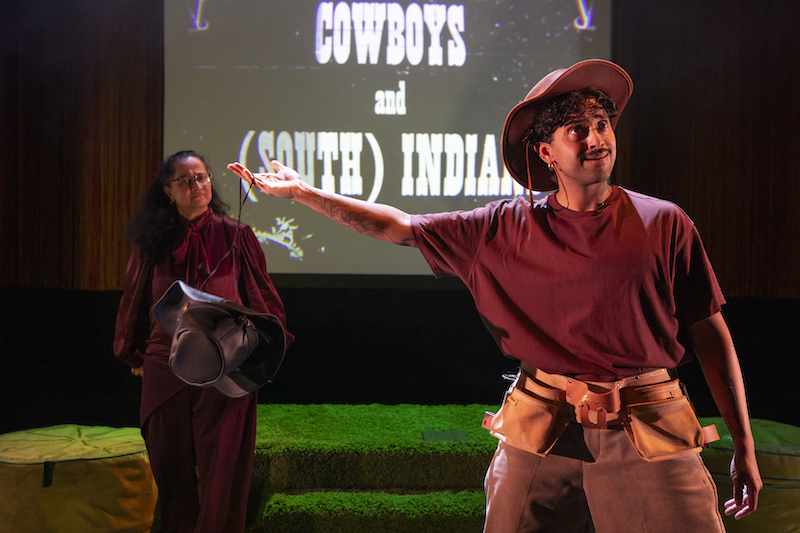
Writer: Krishna Istha
Co-creator: Geetha Shankar
Director: Milli Bhatia
Second Trimester is a deeply personal work performed by Krishna Istha and Geetha Shankar as they draw on Geetha’s lived experience to illuminate her initial reluctance toward her trans son’s decision to become pregnant. Early on, we are told that Geetha, unlike Krishna, is not a trained performer and that she can take a three-minute break at regular intervals if needed. This framing quietly establishes the stakes of the piece as what unfolds is not just performance, but an act of real-time vulnerability.
The show opens with a playful Would You Rather game, an effective device that quickly endears us to their dynamic, while also alluding towards Geetha’s untold past, where the protective instinct of a mother withholds her own story to shield her child.
Formally, the piece mirrors the intensity of Geetha’s story through its use of Bollywood-inspired structures, characters and aesthetics. Video design plays a key role here with live camera work and green screen techniques creating fleeting cinematic images, while never losing the intimacy of these two storytellers. The story is divided into seasons and episodes as if watching a series online, and effectively jumps between the 1980s to today and between India, the USA and London.
The writing is economical and direct, allowing moments to land with clarity. At times, this simplicity risks flattening the complexity of the themes and relationships at play, but it also serves a purpose in foregrounding Geetha’s disarming honesty. Her unfamiliarity with performance becomes an asset, lending the piece a sweetness and authenticity. There is a gentle, tender humour throughout, rooted both in Krishna and Geetha’s performances as well as their endearing relationship.
The ending reframes the piece with an unexpected yet empathetic revelation about Geetha’s reluctance. What begins as a story about Krishna’s decision ultimately becomes something broader as it becomes a reflection on how profoundly our familial histories shape our responses to life’s most pivotal choices.
Runs until 25 April 2026
