

Writer: Sylvia Milo
Director: Isaac Byrne
Sylvia Milo brings to life the extraordinary story of Mozart’s older sister, Maria Anna Mozart – Nannerl, as she was familiarly known. A musical prodigy from an early age, she performed and later composed to enormous acclaim. She adored Wolfie – as she called Wolfgang Amadeus – and Leopold, their father, arranged concert tours with the pair across Europe.
But, as Milo stresses in this sensitive, fascinating recreation of her life, contemporary attitudes on what was considered suitable for a young woman performer soon curb her opportunities. Certain instruments are deemed improper for a young lady to play, for instance. And only women of very high standing in society – Marianna Martines, the Viennese-born composer, pianist and singer, is mentioned – can maintain a career in music. Too old to be considered a prodigy, Nannerl is left at home while Leopold arranges concert tours for Wolfgang Amadeus alone. It is made clear to her that her fate is to become a wife and mother once a suitably well-off husband is found.
What lifts The Other Mozart far above a mere biographical piece is first and foremost Milo’s astonishing performance. Her evocative portrayal of Nannerl as a child fully convinces, managing to avoid the self-consciousness actors tend to bring to such roles. When her father won’t allow her to learn harpsichord until she’s older – it might ruin her technique, he claims – she finds a way of making rhythmic sounds with her porcelain tea cup and saucer, a delicate suggestion of her innate musicality.
Milo’s sound world, beautifully suggested by Nathan Davis’s sound design and music by him and Phyllis Chen, offers a host of little sounds. Bells and pipes hint at Papageno’s magic instruments, for example, and there are runs of simple notes played on a miniature harpsichord which Nannerl holds up.
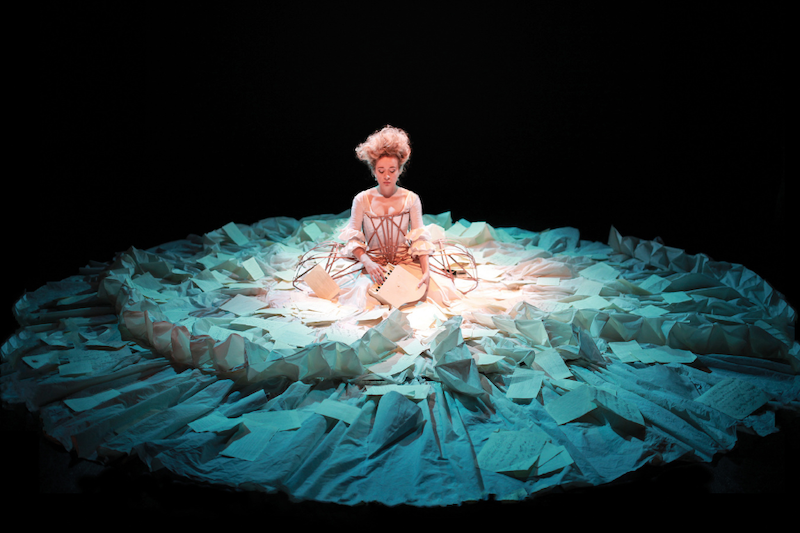
Visually, The Other Mozart is arresting, with most of the stage dominated by the flowing material of a dress by costume designers Magdalena Dabrowska and Miodrag Guberinic. At the centre sits a metallic structure suggesting an eighteenth-century panniered corset. Milo, wearing cotton underthings and a wonderfully Mozartian shock of wild hair, sometimes sinks down into the panniers, sometimes stands free, the corsetry brilliantly symbolising patriarchal restrictions. Janice Orlandi’s period style movement direction is also central to Milo’s depiction of Nannerl. She remains restrained and graceful throughout, mainly employing a range of simple arm movements.
Pieces of paper litter the stage, which Nannerl snatches up to read to herself. There are snippets of glowing reviews she herself garnered as a child performer. Later, often separated from Wolfgang, she traces their relationship through his letters. The fact that her own letters to him no longer exist allows Milo, as writer, to create a convincing voice as the maturing Nannerl.
We probably all know the outlines of Mozart’s story, so Milo needs only to sketch these lightly. What is brilliant is the invented scenes – the one in which the appalled Nannerl meets her brother’s new wife Constanza, for instance, and is forced to listen to them in the neighbouring bedroom is a comic masterpiece.
The Other Mozart is a gem, Sylvia Milo’s writing and performance astonishing, and Isaac Byrne’s direction brilliant.
Runs until 18 April 2026
The Reviews Hub Star Rating
-
10
