

Writer: Andrea Levy
Adapter: Helen Edmundson
Director: Matthew Xia
This adaptation of Andrea Levy’s 2004 novel, Small Island, is a powerful tale of the struggles of real people during and shortly after World War 2, how we were encouraged to dream and how reality compared. The book was a critical and popular success, winning three awards for its depiction of life during and after the Second World War.
Before the interval, we meet the families and characters of the story. In Jamaica, there’s Hortense, a serious child, raised alongside her cousin, Michael, in a very god-fearing household. Michael is mischievous, and he and Hortense often play together until he falls from grace and heeds the call from the Mother Country to fight fascism in Europe. Also in Jamaica is Gilbert, a cheery, simple soul who dreams of being a lawyer. He is besotted by the image of a Britain that needs new blood that was projected and switches the focus of his dreams there – if only he could find a way of paying the £28 10s fare.
In Britain, there’s Queenie, desperate to get away from Lincolnshire and her family’s pig farm. She jumps at the chance to work in her aunt’s shop in London, where she meets Bernard, a tightly laced bank clerk who offers her a step up the ladder.
And so Hortense and Queenie find themselves trying to better themselves through marriages of convenience with Gilbert and Bernard. But the reality they encounter after the interval in Postwar London threatens to derail their lives.
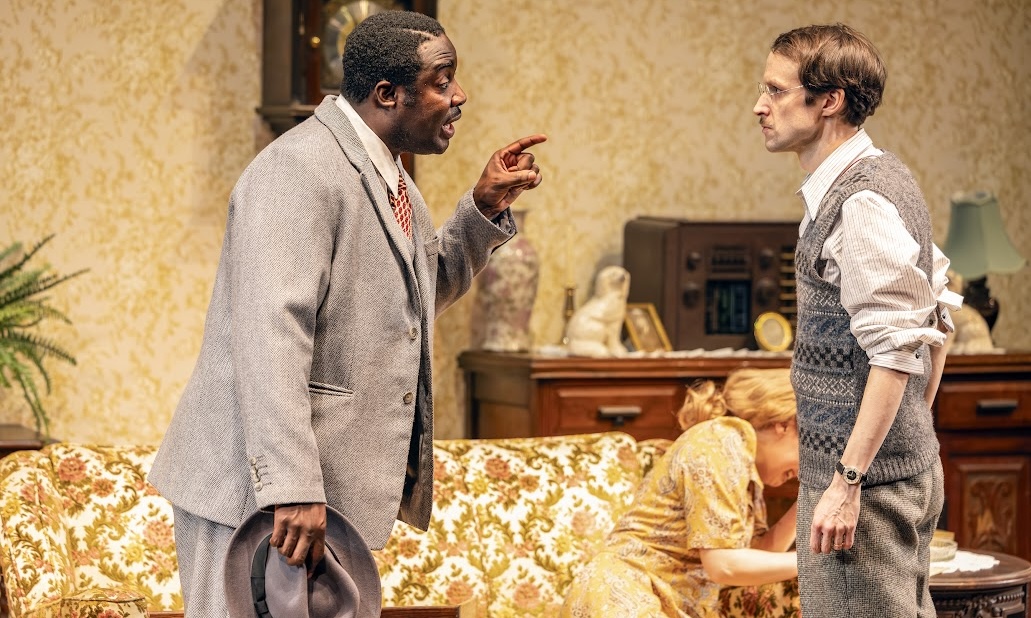
What is most striking is the creative consistency through all areas of this production, under the sure hand of Director Matthew Xia. Helen Edmundson’s script is incredibly well-balanced, offering moments of genuine laugh-out-loud humour that help to leaven the situations in which the characters find themselves. In the first act, Simon Kenny’s open set, supported by projections from Video Designer Gino Ricardo Green and Luke Bacchus’ soundscape, makes the most of the Rep’s large stage to give a feeling that anything is possible, that boundaries barely exist if you can dream; in act two, the characters are coping with the consequences of their actions and the whole is more restrained, more claustrophobic. Pretty minimal sets are replaced by the finicky detail of everyday life.
The main characters – chiefly Hortense and Queenie – also act as narrators at times, breaking the fourth wall to give us their take on other characters and themselves. Ciarán Cunningham’s lighting design enhances that, switching from warm tones to a cold blue spotlight, isolating the narrator.
It’s impossible to tell this story without acknowledging the casual racism that was prevalent at the time, and the story does not shy away, with moments that are truly shocking – and causing incredulous gasps of indignation to burst involuntarily from the audience as those attitudes surface on stage. What is also shocking, of course, is the realisation that despite Small Island being set in its own historic time capsule, one can easily imagine much of the story being enacted in our towns and cities now.
The production stands firmly on the shoulders of its central characters and, thanks to the skills of Casting Director Lucy Casson, these foundations are solid. Each character is believable; one can’t help but empathise with their struggles even when they appear to be their own worst enemy.
Anna Crichlow’s Hortense is earnest and serious-minded. We meet her first as she is working in the local school, dreaming of becoming a schoolteacher herself. Her joy when she spends time with cousin Michael (played as a youngster by Jordan Laviniere and as a grown man by Rhys Stephenson) is apparent, as is her upset when he leaves Jamaica to join the RAF. Later, her reaction to the reality of life as a black couple in postwar London is clearly portrayed.
Both Laviniere and Stephenson embody Michael’s mischievous nature, while Stephenson also shows the progression of his character as he grows up serving the mother country.
Daniel Ward brings us Gilbert, a man of simple pleasures. His journey from idealistic young man and aspiring lawyer to postal worker, despised for no reason other than his skin colour and patois, is well drawn. And maybe he’ll make a good lawyer: his powerful speech to Bernard towards the end of the play has the auditorium tense and silent.
Mark Arends brings us the stitched-up Bernard, a man who cannot speak his feelings and whose tone-deaf response to Gilbert’s speech is brilliantly delivered. He is perhaps the most difficult character with whom to empathise, the product of all that goes on around him – the loss of his mother before the events of the play and his father’s return from the Great War, shellshocked and barely able to function, are key elements. But that’s only the start, as his one chance of belonging to something bigger than himself when he joins up turns out to affect him more than we can know. Arends is superb in the role, making us able to have some understanding of his drivers even as his actions seem chaotic.
Paul Hawkyard brings the non-verbal Arthur, Bernard’s father, to glorious uncertain, tic-ridden life. It would be easy to make the portrayal of someone who has experienced things few can begin to understand into a comical caricature, but Xia and Hawkyard ensure that does not happen; Hawkyard’s Arthur is a quivering, fully three-dimensional character.
Bronté Barbé is an elemental force as Queenie, coping with demands she never imagined she would find herself having to deal with. It’s powerful, salt-of-the-earth stuff, and we can totally understand each and every one of her decisions. Her dreams are altogether more down-to-earth, and Barbé brings an earthy realism to the portrayal. Her character arc is a powerful one, with her scenes at the end being especially heartrending.
Sharply observed and emotionally resonant, Small Island balances humour with quiet devastation, letting personal stories carry real historical weight. Faultlessly directed and superbly cast, it entertains, unsettles, and lingers — a production that will stay in the memory long after the curtain falls.
Runs until 18 April 2026 and on tour
The Reviews Hub Star Rating
-
10
