

Writer: Agatha Christie
Adaptor: Ken Ludwig
Director: Lucy Bailey
Written 90 years ago, Agatha Christie’s Death on the Nile is one of the best-known books by an author whose work continues to be adapted for stage, TV and film. For this reason, when a new adaptation is being developed, a big problem writers and directors have to face, is that large sections of the audience will already know who died and who did it before the boat has even set sail. Of those who don’t, many will soon remember, and perhaps only a handful will either be seeing it for the first time or have no recollection of the outcome.
So, how do you create an enthralling murder mystery from such well-known material? The answer lies in how you bring the characters and the setting to life, alongside how far you acknowledge or reject other adaptations of the story. It’s a fine balancing act, and one that this production treads with great success for the most part.
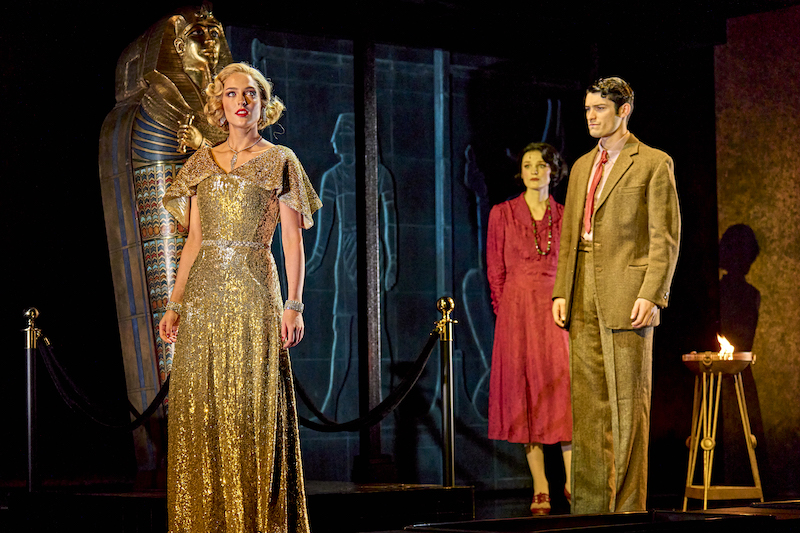
The play opens on a dark stage, as Hercule Poirot, the Belgian Detective, introduces the story framing it as something that shines a light on the darker side of the human psyche. From there, he takes us inside a museum where Linnet Ridgeway, is guest of honour for the unveiling of a sarcophagus donated by her late and very wealthy father, before we set sail on a cruise down the Nile where the passengers include Linett’s new husband, Simon Doyle and also Jacqueline De Bellefort, the woman who due to marry him until she introduced him to her.
The first act builds up to the inevitable murder, establishing characters and motives, while Act 2 sees Poirot interrogating the suspects and then gathering them all together in one room before revealing the murderer and showing where the template for every episode of Death in Paradise came from.
Ken Ludwig’s adaptation takes the spine of the story from the novel but omits, amalgamates or reimagines several of the supporting characters as he offers up a range of people with different reasons to dislike Linnet. While this works in replacing or updating stereotypes that are no longer recognisable, it also means that it is less of a question of who is going to be killed as it is of when they will be killed. The reduced body count also means that many of the red herrings that can keep the intrigue levels high also disappear.
Of course, this doesn’t matter if you already know whodunnit, and the success of the production is not dependent on how hard it is to solve the mystery. Instead, it is dependent on how believable each of the characters are as murder suspects, and on how likeable and recognisable Poirot is. In this respect, it is a great success as the vanities and vulnerabilities of all the key players are brought out under Lucy Bailey’s direction.
Mark Hadfield’s Poirot is closer to the Peter Ustinov template of the original film than it is to either David Suchet or Kenneth Branagh’s portrayal. This works exceptionally well in setting the mood of the production, steering it into lighter waters and away from darker subplots and back stories.
Terence Wilton, as Septimus Troy, a classically trained actor now reduced to playing cowboys in low budget westerns, channels Ian McKellen and Brian Cox into a superbly eccentric performance. As failed writer turned potentially failed actress, Glynis Barber gives a similar over the top depiction of the excesses of Salome Otterbourne, while Nicholas Prasad as the doctor Ramses Praed has a nervousness that would make his patients equally worried about the outcome of any consultation.
The least developed characters are Linnet and Simon. While Esme Hough has good lines and moments of hysteria that she delivers to strong effect as Jaqueline, the spurned lover vowing to haunt the newly married couple, Simon is largely anonymous as a character, giving Nye Occomore little to play with. Linnet attracts the scorn of others without ever really being presented as a person in her own right, meaning Libby Alexandra-Cooper is left to play a foreshadowed victim.
Mick Britton’s design allows the action to flow smoothly between locations, with cabins appearing and disappearing, plot lines playing out on an upper and lower decks and insights into what is going on away from where the main story is playing out.
However, with dark colours predominant in the set and Oliver Fenwick’s lighting design also focusing on interiors, without Mic Pool’s sound design it would be easy to imagine the action was taking place inside a prison with cells instead of cabins, and walkways instead of a deck.
All this said, the strength of the script, direction and characterisation from the actors are more than enough to make this an enjoyable and entertaining adaptation of a classic detective story.
Runs until 28 March 2026 | Image: Contributed
