

Writer: Kazuya Konomoto
Director: Baku Kinoshita, Nana Harada, Shintaro Matsui
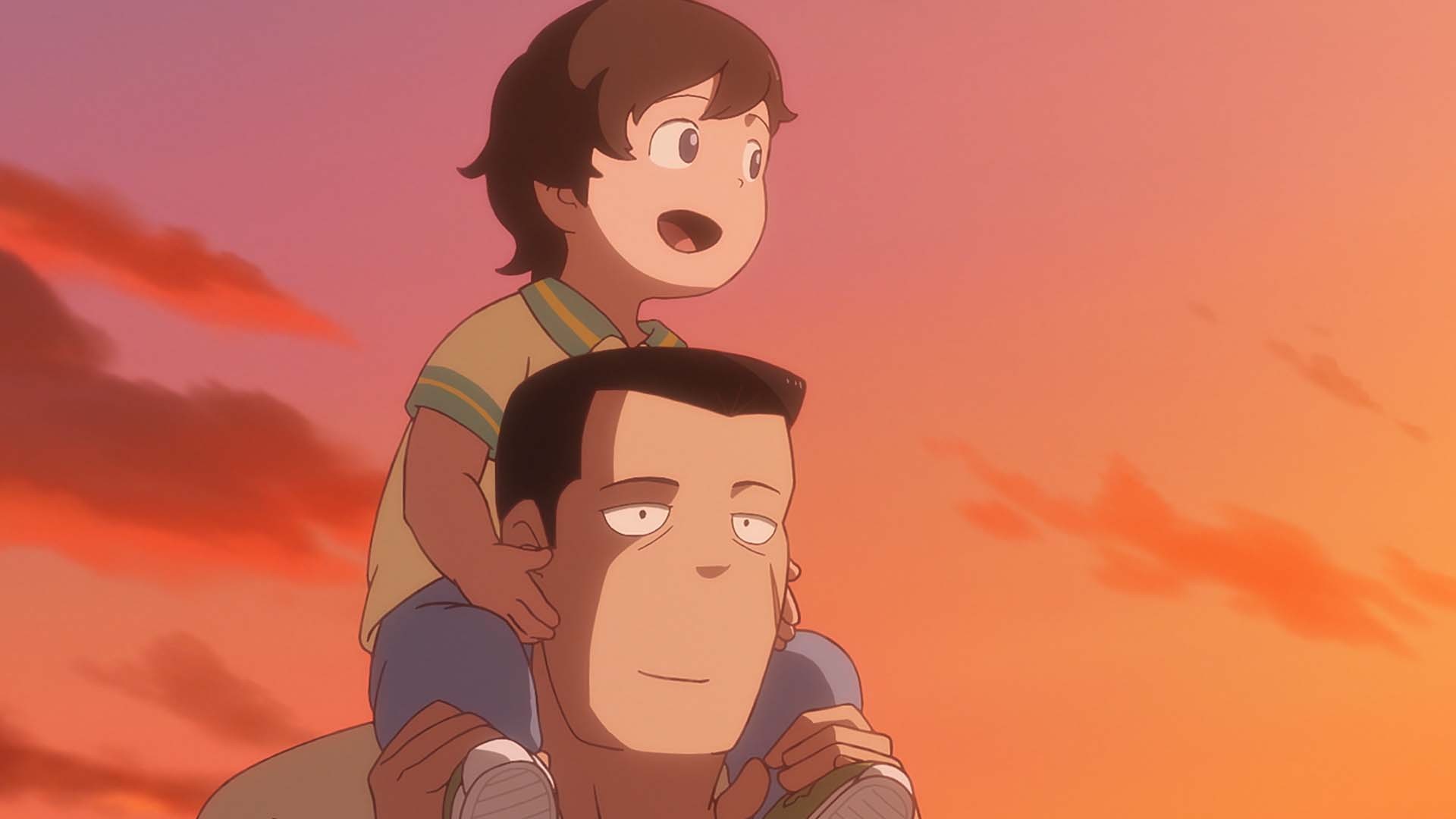
The Last Blossom is an oddly charmless piece of animation. The plot time-switches between protagonist, Minoru, as an old man, after thirty years in prison, and a period when he was young. We learn – because he decides to confide his life story to a talking balsam flower, the eponymous Last Blossom – that he once took in a young pregnant woman, Nana, and they set up home together as friends. Minoru is a supposedly a decent character, but with his sullen silences and his unchanging slab of a face, it’s hard to feel much for him. He obviously loves Nana – the balsam flower figures this out – but is unable to declare this. He’s likewise unable to bond with her son, little Kensuke. In contrast to the various unpleasant male characters – the baddies all have mean-looking eyes and either unattractive stubble or poor fashion choices or both – mother and child are drawn in typical anime style: their huge eyes, tiny mouths and infectious giggle signalling adorable cuteness. But the dialogue between Nana and Minoru is leaden, as is his dialogue with the various bad guys.
We presumably want to know why Minoru has ended up in prison. Luckily an early exchange with the dominant baddie clears this up. ‘What are you doing for money?’ he asks the craven Minoru. “Protection money and peddling,” he replies.
And anything else we might need to know is offered by the singularly annoying flower. For improbable reasons, this mouthy plant is a direct descendant of the one Nana grew on their balcony thirty years before and is now living in a tin can in Minoru’s prison cell. It is much given to berating Minoru for all his past failings. It’s from this flower that we learn Minoru was a yakuza – a member of a criminal gang which once had a stranglehold on Japanese society.
There’s a whole lot of clumsy plotting. First, high on his yakuza earnings protecting and peddling, Minoru lives it up, boozing in nightclubs. Then Nana tells him little Kensuke has an incurable heart condition. His only hope is a heart transplant in the US. But Minoru has frittered away all his earnings and must go cap-in-hand to nasty boss, Tsutsumi. Needless to say, what follows doesn’t go well.
Meanwhile we are reminded that Minoru has an uncanny ability to draw maps. “I’ve got grid paper in my head,” he tells Nana early on. This skill doesn’t seem to do much for him until the very end, when, as we’ve probably guessed, it allows Nana to find the site of buried cash. Also important to the plot is the convoluted reason for his not marrying Nana, the most significant of which is that she can’t – she’s not even a common law wife, someone reminds someone else – visit him in prison over the 30 years. So she doesn’t know where he’s stashed that money.
If it’s a morality tale, it’s an opaque one. And as a piece of animation it’s clumsily drawn and awkwardly edited.
The Last Blossom is in cinemas from 27 March.
The Reviews Hub Star Rating
-
4
