

Writer: Caroline Graham
Adaptor and Director: Guy Unsworth
The world of Midsomer County burst into life in book form in 1987 with writer Caroline Graham’s first Chief Inspector Barnaby novel, The Killings at Badger’s Drift. Immediately successful, it spawned a TV series that started in 1997 and which, with some changes in the principal cast, endures today with a gross of episodes now in the can.
In the TV series there’s a combination of clever plotting, understated humour and whimsy in each episode of this cosiest of cosy murders. And, of course, no-one is ever quite what they seem to be – there are secret pasts and illicit liaisons aplenty in each Midsomer village. Indeed, the county of Midsomer plays its part too, with picturesque Cotswold villages playing house to the most grotesque of motives and murders.
But will it translate to the stage, a very different medium to the printed word or small screen? And will it capture that sense of very English eccentricity that runs through the series?
The answer is a resounding yes. Adaptor Guy Unsworth has created something quite new and suited to the theatre while faithfully evoking the world we’re all familiar with. The whole takes itself just seriously enough with occasional metaphorical knowing winks to the audience.
As we enter, David Woodhead’s quirky set reveals a beautifully crafted model of Badger’s Drift that metamorphoses into the various exteriors while the economic use of trucks and flying elements whisk Barnaby, and us, from place to place. It’s all very slick.
The beginning, when the first incident happens, feels rather darker than one might expect, with music from Max Poppenheim that is full of dark menace. However, we breathe a collective sigh of relief as the other-worldly strains of the Jim Parker’s theremin-based TV theme burst in and we’re introduced to the parade of idiosyncratic characters.
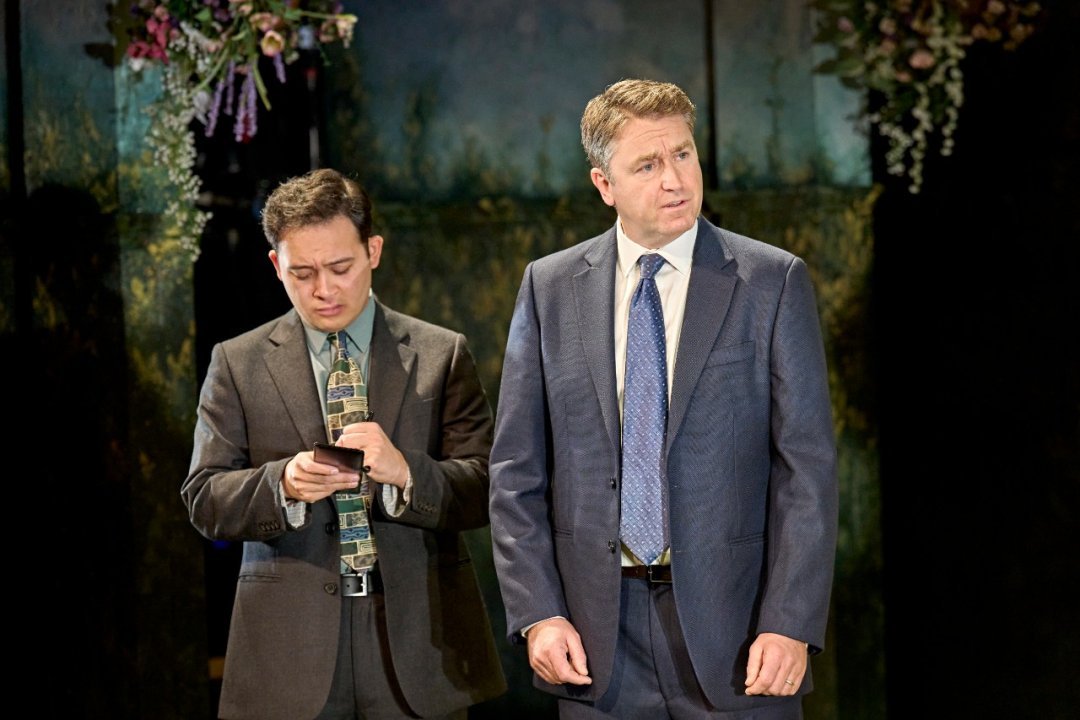
And, it’s quite an array of characters – you need a decent number of suspects after all. One inspired creative decision is to have the majority of actors double- and triple-rolling. Woodhead’s sterling work on the set extends to costume as each character is instantly recognisable, supported, of course, by the cast’s physicality. This multiple rolling must make for some frantic quick changes backstage and adds to the fun as we spot which actor has now arrived as someone else entirely; there’s one especially memorable scene in which two suspects are being interviewed in the station.
Long time viewers of the TV show will, of course, recall Barnaby’s original sidekick, Troy, played by a fresh-faced Daniel Casey. In what must be the ultimate plot twist, Casey appears now in the lead role of Chief Inspector Barnaby, a quite different kettle of fish. Barnaby is largely self-assured, a straightforward sort of bloke, at ease with anyone of any station whose easy manner hides a razor-sharp intellect. Once you’ve got over the feeling that there’s been some sort of face transplant, Casey makes Barnaby both familiar and his own, no mean feat. Alongside him we have James Bradwell as the somewhat naïve Sergeant Troy. Bradwell brings a wide-eyed sense of innocence to Troy as he struggles to make any sense of the residents of Badger’s Drift – as well as Troy’s terrible driving.
John Dougall is a fine slippery GP, among others, showing his discomfort even as he tries to dissemble Barnaby’s questioning. Rupert Sadler remains just the right side of pantomime as the oleaginous Dennis Rainbird, while Julie Legrand goes into full nosy Miss Marple mode as Lucy Bellringer, friend of the (first) deceased, Emily Simpson, alongside a well-judged comic role as the Samaritan called by Emily for advice. Chandrika Chevli positively relishes her roles, as does Nathalie Barclay, who plays both the younger female parts with sincerity.
Fans of the series will see plenty they recognise in this production, while also enjoying the fine stagecraft of all involved. And it absolutely works as a whodunnit – if you don’t already know the story, you’ll struggle to work it out before the final dénouement. A fine addition to the Midsomer canon.
Runs until 14 March 2026 and on tour
