

Choreographer: Sophie Laplane
Director: James Bonas
Composers: Mikael Karlsson and Michael. P. Atkinson
It might be useful to brush up on Tudor dynastic politics before attending this performance by Scottish Ballet in order to recognise the dancer portraying Sir Francis Walsingham, know that he was spymaster to Queen Elizabeth I, and identify the many dancers costumed as cockroaches as his spy network. Without that prior knowledge, things might get somewhat opaque.
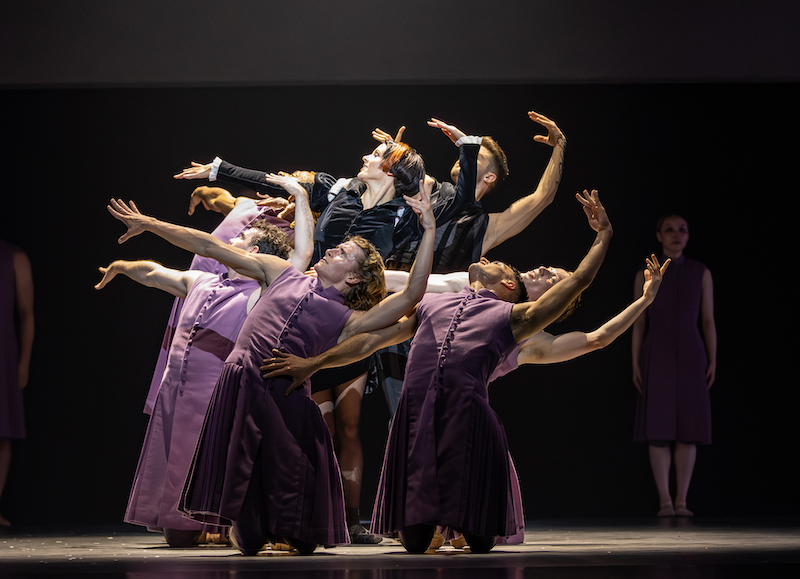
That said, the visual impact of a stage swarming with cockroach-dancers is great and wonderful. Maybe without the prior knowledge, audiences can just enjoy a rich display of excellent dancing and top-notch design? Soutra Gilmour’s brilliantly colour-coded costumes, and her impressive two-tone stage set of walls and doorways and cupboards seamlessly interlocking, combined with Bonnie Beecher’s relentless cones of white top light pinning the dancers into cages, make for a thrilling spectacle within which the dancers can bedazzle.
It is necessary to work out that the old, bald, grotesque figure that opens proceedings (wonderfully danced by Charlotta Öfverholm, wielding her actual age as an element in an unsparing and psychologically astute character study) is the queen on the day of her death, that the figure in the Day-Glo clown suit (called ‘Jester’ on the cast sheet, and interpreted by Kayla-Maree Tarantolo with full-bore physicality and gymnastics) is also a personification of death, and that their presence throughout proceedings is not necessarily visible to the other characters on stage. With these nuggets of information and a smidgin of historical research, most of the proceedings make sense.
The dancing is gorgeous. Mary is portrayed by Roseanna Leney, rocking a costume of sumptuous black and an attitude of pliant, sensuous conformability to the dizzying political context she inhabits. She switches from orchestrator to victim on a dime and makes Mary enormously sympathetic. The Elizabeth with whom she interacts is danced by Harvey Littlefield. There is less dancing involved in this presentation, more of a focus on being tall and stately, and with those attributes, he commands attention every time he is on stage.
The corps de ballet is very busy: being a variety of courtiers, being cockroach spies, being the murderers of Mary’s lover, being the spider (dramatically realised in awesome shadow play and video-scenography by Anouar Brissel) that devours her husband. They make their roles telling and beautiful/creepy, as necessary. The jokey presentation of Mary’s baby James, eventually King James I, is both amusing and effortlessly transformed into a psychologically revealing comparison of the two queens.
The dancing is lovely, the design is lovely, and the orchestra provides its own thrills – lots of effective percussion and isolated timpani, a searing solo cello passage (Mark Bailey and Susan Dance are the credited cellists), and an astute undercurrent of menace as we approach the culmination of Mary’s tragic journey. It’s an integrated performance that combines many elements into a notable piece of dance-theatre.
Sophie Laplane is interviewed in the very useful and informative programme. She says: “What dance is good at is communicating feelings, expression and impressions. It’s not very good at giving information or historical facts.” This neatly sums up both the considerable virtues and the shortcomings of this impressive show. It really needs the information that the programme notes provide to understand what’s going on. It doesn’t need that context to make the sensory thrill of what’s happening before the audience’s eyes a huge treat.
Runs until 8 March 2026
