

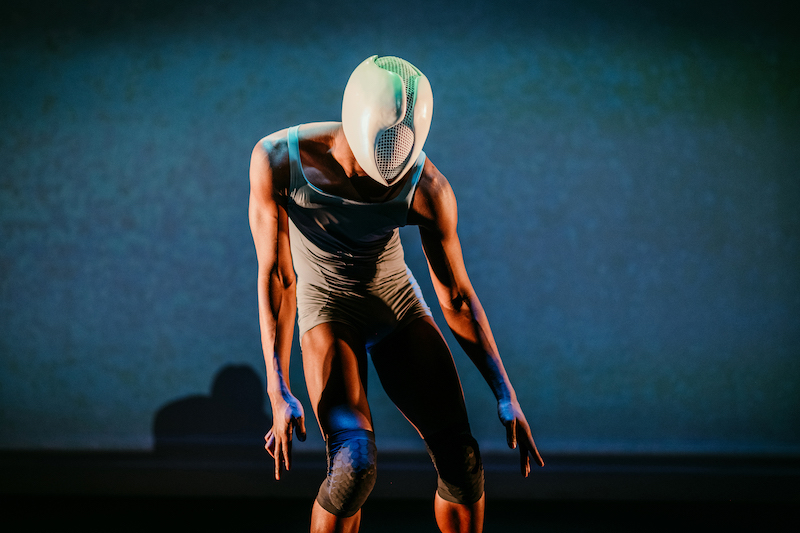
Choreographers: Adrienne Hart with Fukiko Takase, Kelvin Kilonzo, Aoi Nakamura and Makiko Aoyama
Director: Adrienne Hart
The sun brings life, but it also brings death and two thousand million years into the future, the 18th species of humanity on Neptune have evolved into highly specialised beings able to share a mind to solve the problems they face, including reaching back to the audience at the Coronet Theatre, a version of their past selves, to undo some of our mistakes. Adrienna Hart’s Last and First Men is a multimedia experience told through film, narration, masks, music and dance movement, taking a calmly factual perspective on humanity’s perpetual existential doom.
Choreographed by Hart with Fukiko Takase, Kelvin Kilonzo, Aoi Nakamura and Makiko Aoyama, this 65-minute piece is a rare science-fiction dance performance that leans into the animalistic concept and presentation of evolution, absorbing and performing the lifecycle of this future version of us described in Tilda Swinton’s detached narration as fawn, ape, bear-like and elephantine. But the dancers also present as birds with large, crooked wingspans or long-necked creatures walking on webbed feet, and this creative framing grows as the story of this world more fully emerges.
The species, we learn, has a thousand-year childhood followed by another thousand in a refuge for young people where they live all the mistakes of the past until they achieve a calm maturity, and the stretched balletic movement eventually becomes still as the performers (including Takase and Nakamura) learn to contemplate and connect. Across the multiple chapters of Last and First Men, Hart creates many of these pauses, allowing the scale and tone of this future life to form. The advancement of humanity is a familiar trope in this genre, but here facing a new deterioration that undercuts their achievements with our own mortal weaknesses.
A particularly strong segment focuses on human wreckage even in the strongest period of the new age, as a group of ‘navigators’, astronauts exploring beyond the planet, return mentally scrambled and unable to rejoin society, war-wounded represented by a single masked dancer (Kilonzo) moving tentatively, stumbling meaningfully around the stage, the first hint of vulnerability in this master race. Later, the piece responds to the changing power of the sun, the inevitable demise of everyone as the landscape becomes foggy and the movements lethargic, small and desperate – “a star conceives and a star kills.”
Hart’s work is full of atmosphere; the calm of Swinton’s crisp narration is inspired by Olaf Stapledon’s 1930s novel, to which the movement actually responds, the juxtaposition of black-and-white film filled with big monolithic sculptures and tall buildings created by Jóhann Jóhannsson. More could be done with lighting to use colour and shadow more inventively, but this philosophical sci-fi is filled with survival instinct, the possibility for developed humanity, but also the ultimate recognition that the end will come and, to the cosmos, we won’t have mattered at all.
Runs until 28 February 2026
