

Writer: Arthur Miller
Director: Andrew Flynn
There have been some very clever strategies applied to ensure The Crucible at The Gaiety Theatre is a success. Arthur Miller’s allegorical play perfectly captured the zeitgeist of 1950s America under the influence of the ambitious, chaotic and bullying Republican persecutor Senator Joseph McCarthy. Sadly, the playwright’s mid-20th century script which centres around the 17th century witch trials in Salem, Massachusetts, continues to resonate with its audience in 2026. In Act three, Andrew McCarthy as Deputy Governor Danforth, chillingly warns that “… a person is either with this court or he must be counted against it, there be no road between”.
Further to Gaiety Productions choice of play, their selection of actors for this show is very savvy. While director Andrew Flynn will obviously have had a major say in the process, the demographic of this evening’s attendees points me more in the direction of producer, business-woman and Gaiety Theatre co-owner, Caroline Downey and experienced casting director Maureen Hughes.
Anecdotally, 50% of theatre-goers can be characterised as being over 55 years of age and predominantly female. In 1985, the film St. Elmo’s Fire starring Andrew McCarthy (no relation to the Senator – we hope!) and Rob Lowe, among others, became a cultural phenomenon. Young girls at the time were divided in their adulation between McCarthy’s sensitive, bookish character ‘Kevin’ and Lowe’s irrepressible, roguish character ‘Billy’. Notwithstanding McCarthy’s considerable achievements as an actor, director and writer since, given the conversations going on all around me this evening, there can be no doubt that his loyal and affectionate fandom thrives.
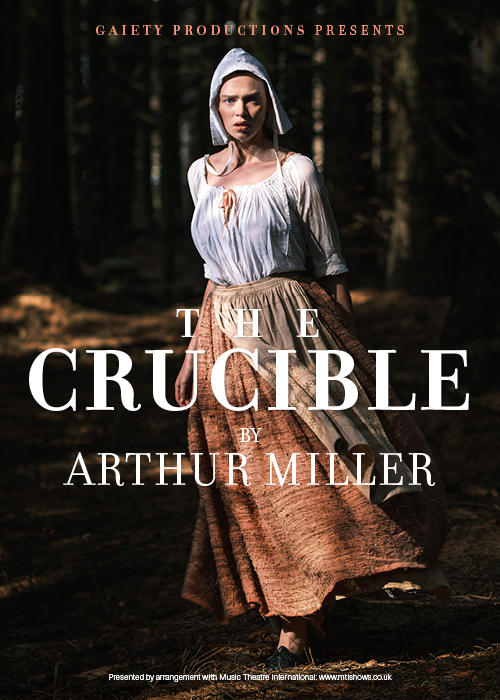
Niamh McCormack who plays Abigail Williams, and is the face of The Crucible’s publicity material, has just recently graced our television screens as courageous revolutionary Ellen Cochrane in the Netflix series House of Guinness. Her shift to playing an hysterical 17 year old is a testament to her range and versatility. You’ll likely have seen Charlene McKenna in Peaky Blinders and she is a first-rate ‘Elizabeth Proctor’ tonight. And so on across the board. Many cast members are instantly recognizable, have broad commercial appeal and a high marquee value.
To an actor, they give a commendable account of themselves in their roles. McCarthy, in particular, has tremendous stage presence. He is flawless as the arrogant and unyielding authoritarian who presides over the trials. As an American he has the advantage of not having to concentrate on the nuances of his accent or its consistency, which is proving challenging to some other players. Denis Conway is refreshing in his fearless portrayal of elderly farmer Giles Corey with an Irish brogue. Lara McDonnell stands out for her portrayal of the Proctor’s maid, Mary Warren. She perfectly executes the gamut of conflicting traits in a young girl enthralled to false accuser Abigail Williams, who later tries her best to tell the truth.
Costume designer Sinead Cuthbert’s frock coats, breeches, aprons and monmouth caps, and Maree Kearns utilitarian set, are faithful to late 17th century puritan society. There is a momentary, tantalising glimpse of sun-dappled forest behind the tall, dun clapboard which serves to accentuate the bleakness of the milieu. Lighting director, Ciaran Bagnall accomplishes a wondrous effect in the jail scene when light shines through the slats of the side-drops, simulating prison bars across the incarcerated women. Dark tales of superstition, persecution and witchcraft are catnip to a composer like Carl Kennedy whose score echoes the tension and fervency blanketing the community.
Flynn’s production is a traditional presentation of the play. If it were otherwise, I imagine music such as James Newton Howard’s hauntingly beautiful song ‘The Hanging Tree’ could have been hugely powerful and effective here. Hozier’s ‘Take Me To Church’ would have gone down a storm! A contemporary reworking of the play, which has a two hour, forty minute running time, would have given Flynn extra tools to help keep his audience engaged. Miller’s The Crucible is a significant play which continues to resonate in a time when the rule of law is being dismantled before our very eyes. But while its core themes remain enduringly relevant, so too must its staging.
Runs Until 21st March 2026.
