

Composers: Maurice Ravel, Alexander Scriabin, Igor Stravinsky and George Benjamin
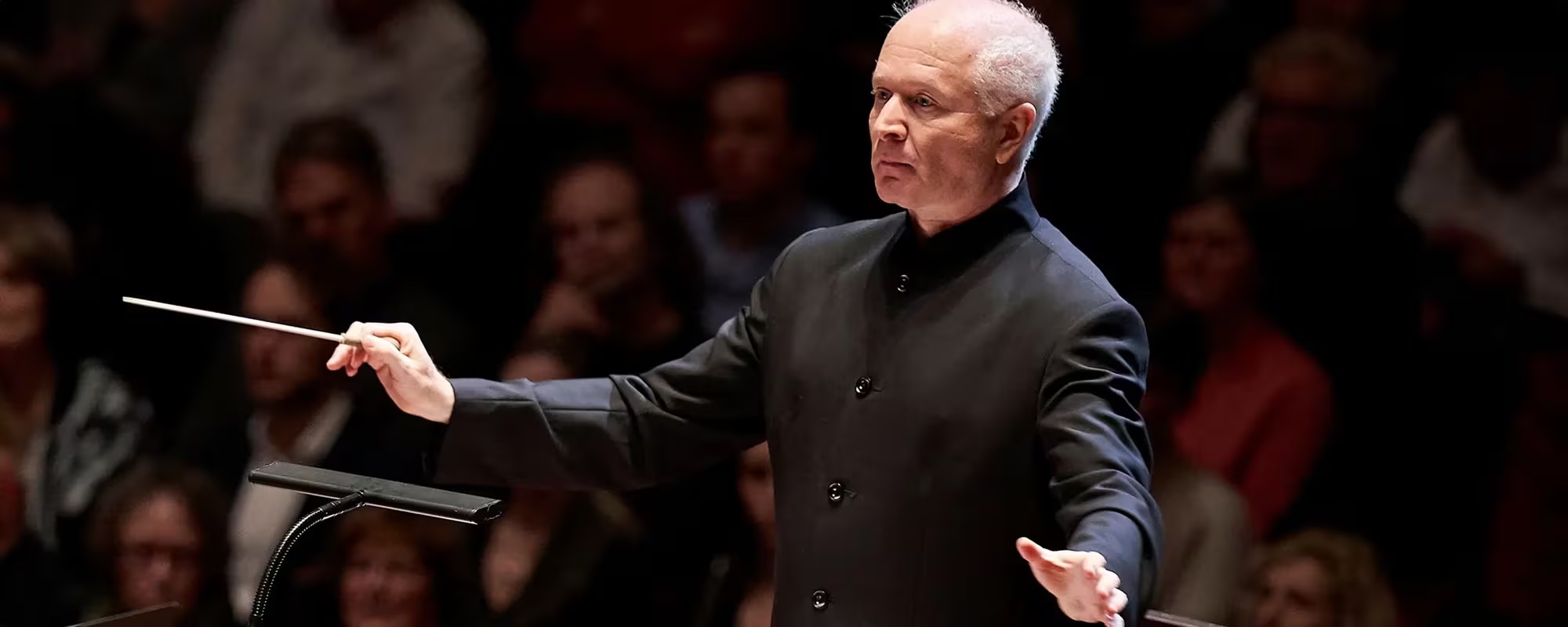
Conductor: George Benjamin
After a gentle and relatively melodic start, Alexander Scriabin’s Poem of Ecstasy erupts from a mass of instruments, including eight horns and an organ. Scriabin’s symphonic poem, written under the influence of esoteric philosophical ideas, was first heard in New York in 1908. It’s a rhythmically ambiguous, exhilaratingly experimental piece, generating a huge orchestral noise. Lashings of brass and woodwind and a cacophony of percussion all produce a whirlwind of sound that is quite mesmerising.
Scriabin wrote a long poem to go with the piece and explained that its theme is an awareness of Spirit “that it is consubstantial with creativity itself.” The Spirit, freed from substance, will reach a “Time of Ecstasy”. Conductor George Benjamin has conducted the piece many times before and calls it “orgiastic, over-the-top, ridiculous”, but also marvellous and wonderfully orchestrated. Benjamin’s style as a conductor is relatively restrained and understated, directing the orchestra with purposeful humour, fierce intelligence and precision.
Benjamin has been the London Philharmonic Orchestra’s Composer-in-Residence since September 2025. In this concert, he conducts his own composition, Palimpsests, which premiered in 2002. Benjamin’s early work Ringed by the Flat Horizon was played at the BBC Proms in 1980 when the composer was only twenty; his latest opera, Picture a day like this, premiered three years ago in France, later winning a 2025 Gramophone Award. Several piccolos, four clarinets, eight basses and two harps contribute to a striking orchestral sound in Palimpsests. Benjamin describes his own piece as crisper and “more transparent” than Scriabin’s lushness. The orchestration is deliberately eccentric. The cellos are gone, and there’s “a mass of wind with no oboes … and a very large complement of brass”. He was aiming to mix a “big band sound and that of a church organ.”
A palimpsest is a layered text, written-over but still visible, in particular an ancient or medieval manuscript on slate or parchment. Metaphorically, it can also apply to built environments with their successive historical strata. Benjamin says the piece is about “superimposing types of music that seem to be very far apart from each other, but in fact they’re all the same thing”. A medieval-style intonation from the clarinets is the first layer, which is built on and covered up by various musical strata, to fragment at last in a welter of drums. In the second movement, the brasses build a climax, which is again undercut by competing sounds. Palimpsests presents a great contrast between softness and sudden explosions of noise: a blast of brass, a skirmish of strings, pizzicato and percussive interjections including rattling vibraslaps. At other times, there is only the quiet susurration of a brush on a drum or the barely-audible fading note of a violin.
Woodwind and brass sound together in Stravinsky’s Symphonies of Wind Instruments, nine minutes of ever-shifting music that premiered in London in 1921. It’s a sombre and complicated work in memory of Debussy, Stravinsky’s dear friend. There is virtuosic playing from principal flautist Juliette Bausor, who also shines in the final piece with its fluttering birdsong notes and fairy-tale atmosphere.
The programme ends with the complete ballet version of Maurice Ravel’s Mother Goose. The seven movements of this half-hour work include a slow, evocative prelude and several narrative tableaux. The Spinning Wheel Dance, full of skipping woodwind and strings, is followed by a dreamlike, courtly Sleeping Beauty section. Other fairy tales include Beauty and the Beast, whose conversation sets Beauty’s lyrical melodies on the clarinet in conversation with the Beast’s deep contrabassoon.
In the story of Hop-o’-My-Thumb, a trail of crumbs is eaten by songbirds and various instruments chirrup and warble. There’s an oriental quality to the plucked harp, tamtam, and xylophone for the Empress of the Pagodas and, finally, in The Fairy Garden, Sleeping Beauty gently wakes up to the sound of soothing strings and celesta. It’s a beautifully peaceful end to a bewitching evening.
Reviewed on 11 February 2026
