

Writer: William Shakespeare
Director: Prasanna Puwanarajah
Following a successful run in Stratford-Upon-Avon last December, the Royal Shakespeare Company transfers its very sombre version of Twelfth Night to the Barbican for a London run where it joins a number of fairly bleak end of the year shows including the National Theatre’s Playboy of the Western World and All My Sons at the Wyndhams in one of the least festive West End selections in some years. Prasanna Puwanarajah’s RSC production looks for laughs in its slapstick presentation of clown Feste – here ultimately presented as the central character – but pulls in so many conflicting directions that there is no bang in its cracker.
And this is the third London production of Twelfth Night in four months, following a version at the Globe Theatre and a smaller fringe version at the Hen & Chickens Theatre, none of which quite settled on an interpretation of the play that makes sense of Shakespeare’s twin-based comedy of deception, misdirection, outright bullying and undying love. The better versions pick a set of characters to highlight and cut judiciously to add pace and purpose, but by giving almost equal weight to every subplot over an extended three hours, Puwanarajah never digs deep enough into any part of the play to justify the running time.
With Feste (Michael Grady-Hall) as the focus, extra time is devoted to tricks and audience interaction in the hope of creating an atmosphere of Christmas jollity that never extends into the auditorium, and it’s clear that most of the fun is being had on stage. A lot of the humour is very broad with physical comedy and big cartoon performances defining the group led by Sir Toby Belch (Joplin Sibtain), who roar drunkenly round the stage and plot their revenge against Malvolio for being too straightlaced. Yet, the group doesn’t feel cohesively like old drinking buddies, friends or even co-conspirators with Daniel Miller’s Fabian and Danielle Henry’s Maria offering a slightly different pitch to each other, while Demetri Goritas’ Sir Andrew Aguecheek is in a different show entirely with big physical gestures and unexplained intonation.
Over in the love stories, Puwanarajah’s approach is equally contradictory with Daniel Monks rather stranded as Orsino dying of love for Olivia while refusing to acknowledge a clear attraction to Gwyneth Keyworth’s Cesario from the start, and while the production starts to think about same sex attraction with dancing male butlers at Orsino’s home, it leaves the concept hanging. Among the performances, Samuel West as Malvolio and Freema Agyeman as Olivia have the best of it, finding great nuance and fun in their more thoughtful characterisations, reflecting perfectly the balance of comedy, love and tragedy that sits through the play without distorting its meaning, and could act as pole stars for others to pitch to.
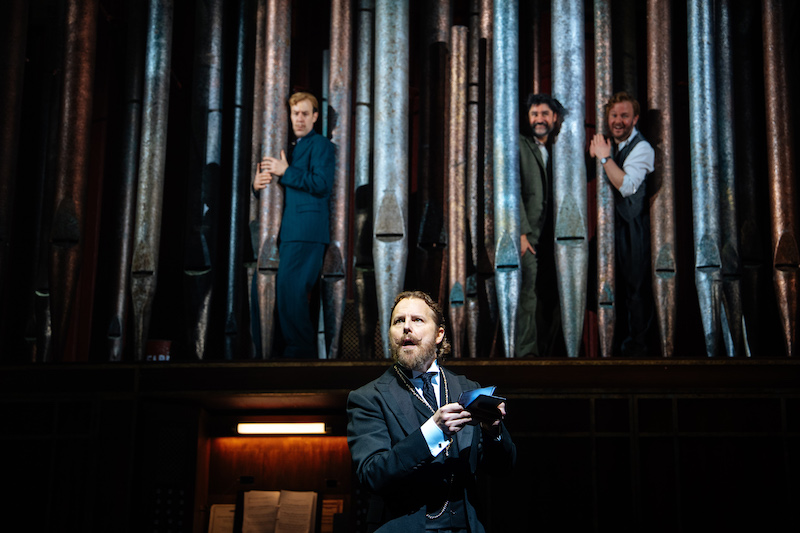
It’s all beautifully, if sometimes confusingly, staged by designer James Cotterill, who takes the colour palette from Malvolio’s yellow and black stockings used throughout the set and costume design, adding to the grief-fuelled pallor that hangs over this Twelfth Night. But the arrival of a giant organ in Olivia’s chapel, though impressive, becomes the backdrop of almost every scene till the end of the play despite Shakespeare’s many changes of location in between. It carves up the enormous Barbican stage, but the result is static and restricted as Puwanarajah struggles with pacing the unfolding story arcs around it.
It all comes together very nicely for a strong final group scene as all misunderstandings and mendacity are undone, but in a story about mistaken and assumed identity, this production seems uncertain of its own.
Runs until 17 January 2026
