

Writer: Edith Nesbit
Adaptor: Louise Haddington
Director: Simon Reilly
All aboard to the Tabard Theatre, where a beloved children’s story is playing for a limited time this holiday season. The Railway Children by Edith Nesbit is a well-known story from over 100 years ago. This production is adapted by Louise Haddington, who manages to keep the vital themes of hope, kindness and family central to this story.
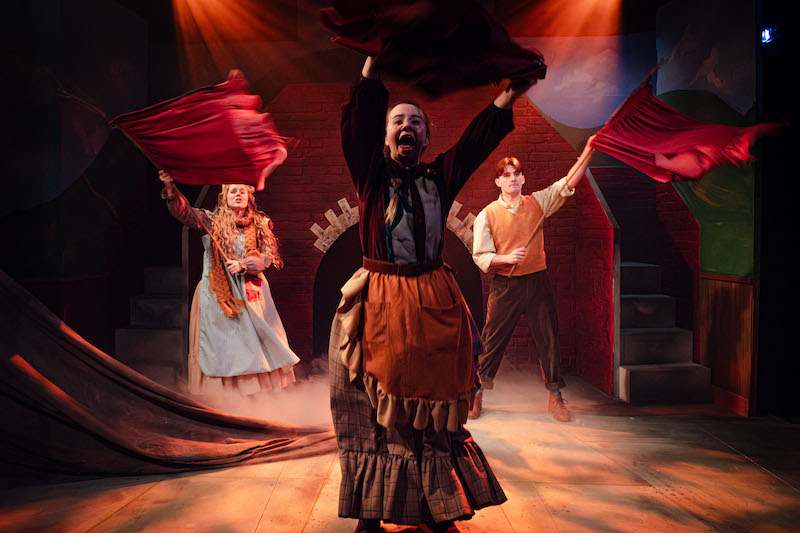
The play follows three children, Roberta (Emma Rowe), Peter (Max Pascoe), and Phyllis (Anya Burlton), whose father (Christopher Laishley) suddenly leaves home. The mother (Kirsten Shaw) and children leave London and move to the countryside. Now living near a train station, the children learn more about their new community, befriend the train station’s porter Perks (Jay Olpin), and save the day numerous times.
This play has it all: good actors, an impressive stage set up that allows audiences to easily imagine the hills and train station of a small English village, and a heartwarming story. The standout actors are Emma Rowe and Christopher Laishley. As Roberta, Rowe plays a wide range of emotions that clearly reflect an eldest daughter caught between having to help her mother, but also clinging to childhood when life is not fair. Laishley plays a variety of roles, from the Old Gentleman to Mr Szczepanksky to the children’s father. Though he may not have a lot of on-stage time as each character, his acting is superb. The final scene, where only these two actors are on stage, is emotional and well done.
From the beginning to end, trains are the connecting factor throughout this performance. This production does a magnificent job using its small stage to give trains a larger-than-life presence. The most memorable and astonishing scene is when the children need to stop an incoming train due to a landslide that affects the tracks. The production value and acting in these last five minutes of the first act are stunning and leave the audience on the edge of its seat.
This production has many different scenes that occur during the play. The multiple different storylines are resolved quickly before the audience has time to engage with the new material. As each scene bleeds into the next, there is a quick transition to move props around to set the next scene. Though these happen seamlessly, with the amount of scene changes that occur over the production, this ends up being somewhat tedious after the first few changes.
There is a necessary drawback in a production where so many events happen to show how these three children become the very heart of the community they now live in. Don’t save this production for a ‘train-y’ day and get your ticket to see this adaptation before the train has left the station.
Runs until 3 January 2026
