

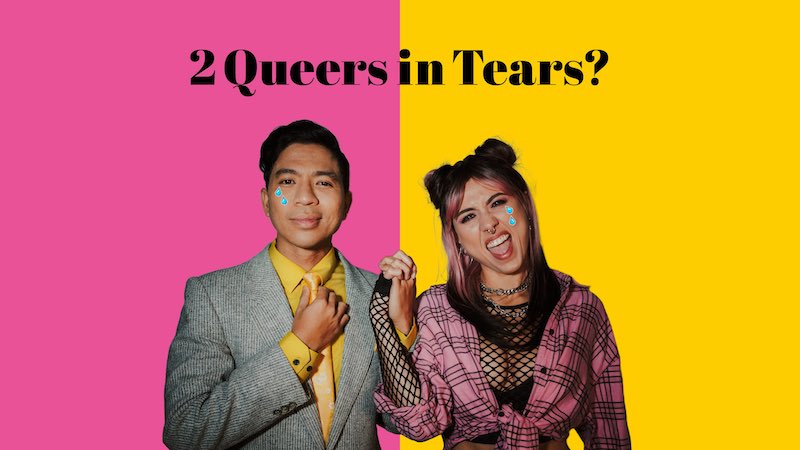
Writers: Jayvee and Lumi
Directors: Janette Eddisford, Jayvee and Lumi
Billy is a sassy early 30s pansexual from near Newcastle with a penchant for threesomes, a pink vinyl skirt, and a leopard skin jacket. She wants to be “the next Florence Pugh”, so she enrols in a two-year acting diploma at a London drama school overseen by “Principal Pruneface”. There, she encounters plan-speaking Elliot, a late 30s vision in yellow, who really ought to be playing Malvolio in Twelfth Night but instead creates respectable queer role-model content for his 500K Instagram followers. A classroom meet-cute sees the odd couple begin to bond. The set-up is rom-com, the destination is queer ‘found-family’ territory, with a few predictable bumps along the way.
2 Queers in Tears? (it could be tears as in sobs, or tears as in shreds – both fit) follows the couple’s burgeoning relationship across two years. Each is carrying a heavy burden of pain. Billy (Lumi, aka Bek MacGeekie) never knew her dad and has a disastrous relationship with her heavy-drinking Mum. “Being funny is the reward for trauma,” is how she explains her carapace of caustic wit. Elliot (Jayvee, aka Edward Garcia) is desperate for approval – from avaricious, homophobic parents who think he’s “too loud, too different, too colourful”, a scheming boyfriend, and his thousands of followers.
The narrative unfolds in vignettes, sometimes just a few seconds long, which take the couple from classroom exercises to drug-fuelled clubbing, to movie nights out, to stoned afternoons at the beach, to sob sessions with their respective therapists. The breakup crisis occurs when Billy posts a compromising video online, which threatens to bring Elliot’s influencer career to a crashing halt. He responds by ghosting Billy just as she gets bad news about her beloved Nana’s health. Will the duo realise what they have to lose? It will take a grand gesture from one or the other to put things back on track.
Jayvee and Lumi deliver likeable, recognisable, nuanced characters with enough depth to sustain interest (though at 70 minutes the play is too long). The writing is pithy, and there are laughs along the way. Still, one wishes they had chosen to invert or subvert the rom-com playbook, rather than follow it so rigidly. A lot of queer people dislike the politically toothless ‘found-family’ motif that sits at the heart of 2 Queers in Tears? It can feel patronising, as if queerness automatically and inevitably equals trauma and the need to rebuild. Not everyone wants their friendships, however close, framed as some soft-focus replacement family. If you can stomach the subtext, there is much to enjoy in this piece. But this is not the radical take on queer friendship the writers seem to think it is.
Runs until 10 December 2025
