

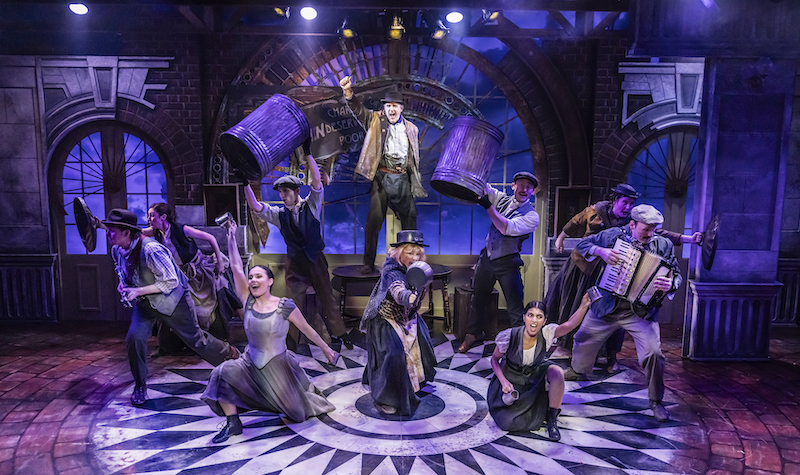
Book and Lyrics: Alan Jay Lerner
Music: Frederick Loewe
Director: Joseph Pitcher
Most musicals are lucky if one or two of their songs seep into the public consciousness beyond their dramatic setting. For Lerner and Loewe’s majestic My Fair Lady, first staged in 1956 and adapted into an Academy Award-winning film in 1964, the hit rate is remarkably higher. Nearly everybody knows I Could Have Danced All Night, Get Me to the Church on Time, Wouldn’t It Be Loverly?, and more.
The story, based on Shaw’s Pygmalion, is similarly well-known. Eliza Doolittle, a Covent Garden flower seller with a strong Cockney accent, is given elocution lessons by linguist Henry Higgins, who bets his friend that he can pass Eliza off as a lady at a grand ball.
Given the scale of a musical that, for the most part, exists within the upper echelons of Edwardian London high society, it generally does not fare well in a boutique staging. That it works at all when scaled down for The Mill at Sonning’s modest stage is an achievement in itself; that it does so while retaining, even enhancing, the charm with which Lerner and Loewe imbued the original is remarkable.
Diego Pitarch’s set design utilises a series of sliding columns to easily transition from the murky depths of grime-stained London to the swanky streets of Marylebone that Higgins calls home, with lush velvet curtains providing further quick changes to represent the interiors. Impressive as the scenery is, it is merely doing its job to support the cast, who each bring their strengths.
Simbi Akande’s Eliza is headstrong and proud from the off, a believably forthright flower seller who initially wants Higgins’s help so that she can be considered good enough for a job in a florist’s, rather than selling on the street for what amounts to little more than begging. While the character’s vocal transition proceeds in large jumps in Lerner’s book, Akande modulates Eliza’s change to create a more believable pace.
She also makes for a fiery foil to Nadim Naaman’s Higgins. Naaman (using the speech-singing made famous by Rex Harrison in the role on both stage and screen) is a haughty man consumed by his own ambition. Natalie Titchener’s costume design, giving Higgins a Homburg where everyone else wears top hats, hints at a man who is slightly out of step with the society into which he intends to inject Eliza.
This production does not shy away from the misogynistic attitude with which Higgins – and, to a lesser extent, his friend Colonel Pickering (Jo Servi) – treat Eliza. The original dialogue in which Higgins regards his relationship with his little experiment, purely transactional in form, is presented with enough ambiguity to dehumanise Eliza in his eyes. Whether that’s due to class or gender difference, or both, is ambiguous – but an ever-present contingent of women’s suffrage banners in the play’s outdoor scenes help to reinforce the social disparities of the era.
Musical director Nick Tudor’s four-piece band, occasionally supplemented by onstage actor-musicians, elicits a sumptuous sound far in excess of what one might expect from such a small team. The pinnacle of their excellence comes with a barnstorming production of I’m Getting Married in the Morning, led by Mark Moraghan as an impressively powerful Alfred Doolittle. Alfie Blackwell similarly impresses as the foppish lovelorn Freddy, who falls for Eliza at the drop of a hat. Some of the more minor ensemble work may not be quite up to the same standard, but everybody is having such a swell time that it hardly matters.
One does occasionally yearn for a little more backstory – quite how or why Higgins’s mother (Sophie-Louise Dann) becomes Eliza’s greatest ally, or the actual fallout from the ball in which Higgins’s experiment is truly tested, are elements that would work on stage. But these are the faults of Lerner’s original book, not the Mill’s impressive staging of the same.
My Fair Lady may have some dubious sexual politics at its heart. Still, by acknowledging them and placing us securely on Eliza’s side, the Mill’s production helps us contextualise everything that goes on. That it does so with such heart, and such impressive work from a company firing on all cylinders, that it feels like a delicious – one might even say “loverly” – festive treat.
Runs until 17 January 2026
