

Writer: David Eldridge, adapted from the novel by John Le Carré
Director: Jeremy Herrin
In the annals of British fictional spies, two names dominate despite being different in almost every respect. On one extreme, we have James Bond, the suave, womanising action hero. On the other sits George Smiley, a still, squat, toad-like man about whom his colleagues know very little, other than his wife is forever leaving him for other men.
John Le Carré’s creation had already been in two novels before 1963’s The Spy Who Came in From the Cold. As with its follow-up, The Looking Glass War, Smiley is always slightly off to the side, used more as a touchstone to reassure readers that they were in the same world as Le Carré’s other works, all infused with the sense of pragmatic, messy, occasionally brutal realism that came with the novelist’s history as a spy himself.
David Eldridge’s adaptation, transferring to the West End from its debut run at Chichester Festival Theatre and ahead of a UK tour, makes Smiley’s small but pivotal role in the novel much more explicit here. John Ramm’s Smiley pops up throughout in the haunted memories of Alec Leamas (Rory Keenan), one of the older spymaster’s former trainees.
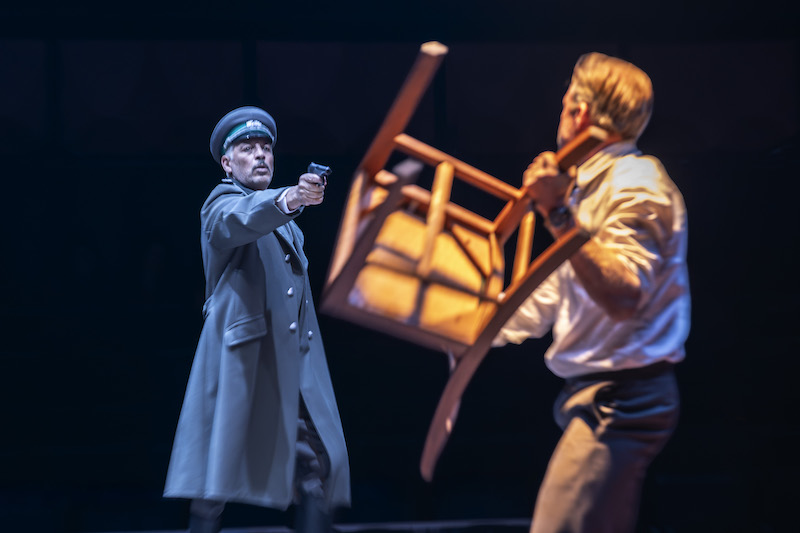
Formerly the head of British spy operations in 1960s Berlin, Leamas has returned to the UK (and his bosses in “the Circus”, Le Carré’s version of MI6) a slightly broken man, devastated by the systematic murder of all the agents he had been running in the Communist-held East Berlin. His GDR counterpart, Gunnar Cauthery’s Mundt, has become his nemesis. So when he is asked to capitalise on his public fall from grace in order to spring a trap that will frame the East German spymaster and make him look as if he is actually a British double agent, he leaps at the chance.
In the novel, much of what follows after that decision is deliberately unclear. How much of Leamas’s new, squalid life is part of the plan and how much just the result of a man’s purpose being washed away like all the blood on his hands is a mystery held tightly within Le Carré’s prose. On stage, though, it feels scrappier and less pointed.
Keenan inhabits the dishevelled former spy well, a man who has had the life knocked out of him but who retains enough spark to stand up to his schoolmarmish new boss, Norma Atallah’s Miss Crail. The library where he works after retiring from the Circus also houses Agnes O’Casey’s Liz, an articulate, poised young woman who is quite open about her appreciation for Communist ideals.
While Leamas and Liz’s relationship is sweet (however much the age gap between them seems to be a feature of novels written by older men), it is the relationship between Leamas and Mundt that dominates. Throughout Act I, Mundt is little more than a name on the wind, contributing to the sense that the play is, at best, an inessential adaptation.
That improves substantially in a tighter, more coherent Act II, as Leamas is captured, brought to Berlin and interrogated by Mundt’s deputy, the forensic Fiedler (Philip Arditti). It is here that the seeds of the Circus’s plan, the false breadcrumbs supposedly leading to Mundt’s treachery, take root and then sprout into something far more layered.
This is the point at which The Spy Who Came in From the Cold elevates itself into a piece of theatre, rather than a mere retelling of a novel. Layers upon layers emerge in the trial where both Mundt and Leamas are cross-examined. Holes in Leamas’s story could be unintentional slips, or they could be double or even triple bluffs. Director Jeremy Herrin, who seemed to be floundering in Act I, nails the tension as the knotted yarn begins to unravel.
By the end, the decision to foreground Smiley much more than the original novel did has paid off. While best known as the mole-hunting investigator in the later novel Tinker Tailor Soldier Spy, this work reveals why the character is so revered by readers and in the fictional world he inhabits. In Cold War Europe, spies on all sides had to be ruthless, finding ways to make the truth as malleable as possible to achieve their goals.
What Le Carré recognised, and what Eldridge’s adaptation eventually succeeds in delivering, is a world where the goal was never to win, nor even to make the other side lose. If East and West were playing chess, both were aiming for a stalemate. It is to Le Carré’s credit that this fundamentally nihilistic thesis makes for cracking reading – and, in the end, a suitably thrilling stage play.
Runs until 21 February 2026
