

Director: Max Reuben
New York-based cabaret performer Salty Brine has an ongoing project, known as the Living Records Collection, that forms shows around a classic pop/rock album and weaves them in unexpected ways through a very different lens. Previous shows have combined the music of The Smiths with a retelling of Frankenstein, or taken Annie Lennox’s 1992 album Diva and twisted it into a story of his own background as a child of divorce, with a bit of Judy Garland thrown in.
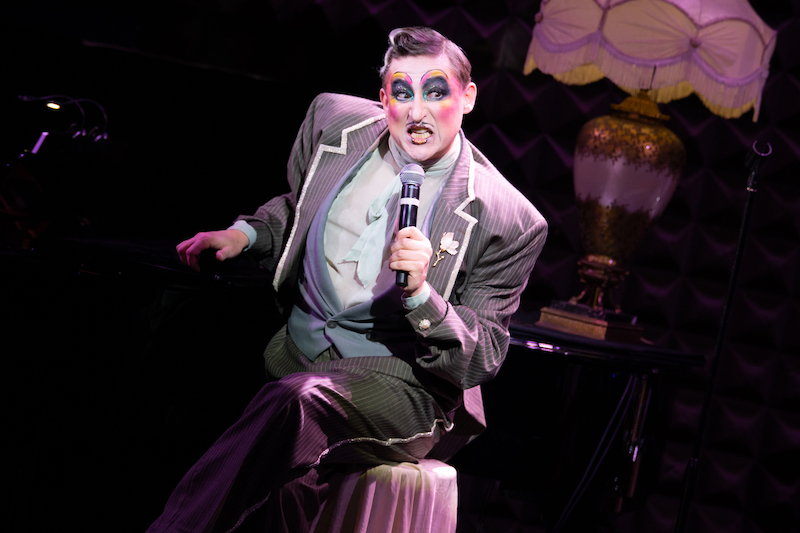
He’s so Unusual continues the series, this time telling a story of the queer club scene in early 1930s New York. Brine assumes the character of former performer WB Leslie, while his musical director Ben Langhorst plays Leslie’s accompanist, “the Duchesse”. The conceit is that their career was abruptly cut short when a local rent boy was murdered in the club where they were performing a New Year’s Eve show. After fading into obscurity, they died anonymously in the 1960s – but now their ghosts are back, only able to move on when they have solved the murder.
Such a premise would be a fun framing device for a performance involving songs of the era. But while Brine and Langhorst dip into the period well, it’s only ever to support the main musical spine of the show, from a very different time period – Cyndi Lauper’s 1983 debut album, She’s So Unusual.
And so the album’s opening number, Money Changes Everything, a paean to how love and friendship change when filthy lucre enters the picture, is performed in a 1930s style that allows for medleys with We’re In The Money, as well as tying into the murder mystery story.
But we also get versions of Lauper’s two breakout singles from that album, Girls Just Wanna Have Fun and Time After Time. Langhorst’s onstage band recreates the feel of a light swing band, the Soho Theatre’s downstairs performance space reeking with speakeasy charm as the performers bring us under Salty Brine’s spell.
Brine and Langhorst complement the 1930s musical styling with a snappy wit that fits in with the comedy double acts of the era, too. The jokes and punchlines often feel far from original, but that does not mean that they aren’t fresh, with an affectionate bite behind every line of repartee.
The musical Cabaret has often shown us that 1930s Berlin culture was decadent, risqué and eager to subvert the gender roles that have obsessed Western society before and since. Inspired by George Chauncey’s history book Gay New York, Brine shows us that such establishments existed in Manhattan, too. As America was pulling itself out of the Great Depression, a more liberal culture followed — only to be quelled by reactionary forces, as has happened many times since.
The murder-mystery story that Brine recounts over the evening – with sequences repeated, the monologue subtly changing each time to reveal more closely, and audience members used as proxies for the suspects – also taps into the darker side of gay life at the time. Physical and sexual violence are never far away when gay people’s lives are forced underground, and that is reflected in the tale being told.
But while those darker moments are taken seriously, Brine is careful not to dwell. Instead, we race backwards and forwards through Lauper’s album, with tracks such as Witness playing directly into the cabaret play’s main plot. The shortest track on Lauper’s album, the titular He’s So Unusual, receives the lightest reworking. Itself a 1930s pastiche, one can see how its inclusion on the album may have inspired the fusion of styles in Brine’s latest addition to his Living Records Collection.
Since bursting onto the music scene in 1983, Cyndi Lauper has always seemed a one-of-a-kind talent who never really fits into any one genre or era. Her music suits this performance and story so well that it becomes the connective tissue joining a setting 50 years into the album’s past, and our present, over 40 years since its first release. It really is a living record, and Salty Brine’s reinterpretation is a marvel to behold.
Runs until 22 November 2025
