

Music: Giacomo Puccini
Writer: Giuseppe Giacosa and Luigi Illicia
Director: Phyllida Lloyd
Conductor: Garry Walker
A show full to the brim of heart and soul, Opera North’s La Bohéme presents the seasons of life and love in an accessible and universally understandable way.
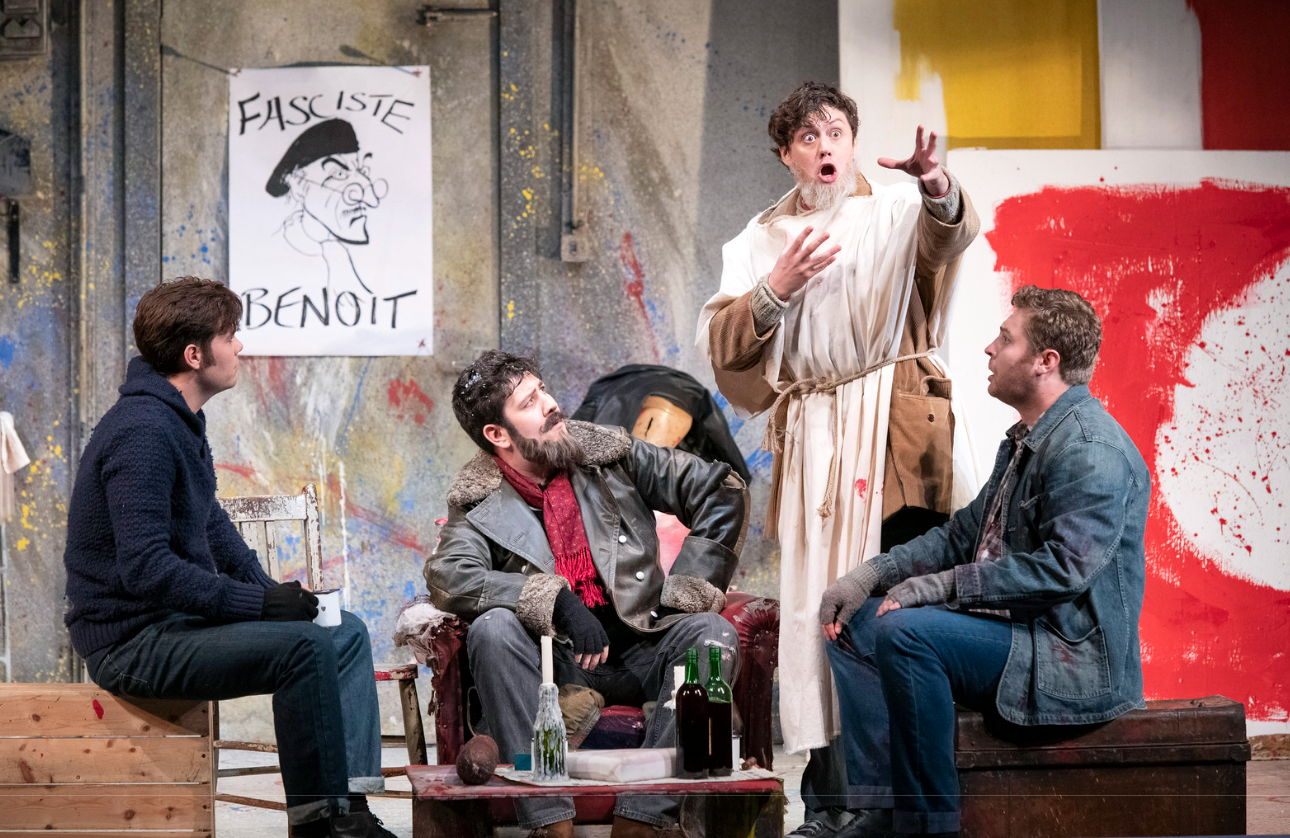
La Bohéme tells the story of the struggling writer Rodolfo and his bare-boned bohemian life with his artist friends in the harsh winter of Paris in the 1840s. In a blackout, he meets Mimì, a frail seamstress who is looking to light her candle. By candlelight, they fall madly in love and vow to face life’s challenges together. But can their love withstand their lowly circumstances?
The opera is a cycle of Rodolfo and Mimì’s tumultuous relationship, documenting the highs of their increasing closeness and the lows of Rodolfo’s fear of Mimì’s progressing illness.
Their love is mirrored by the on-off relationship between Marcello and Musetta. Marcello is in love with the renowned beauty Musetta, but cannot control his jealousy for the attention she gets from other men, causing him to dance between loving her and leaving her.
It seems that all cannot be happy in this story. One couple takes their turn at being happy and in love, while the other couple is left miserable and heartbroken.
Opera North’s ingenious idea of putting a running English translation on screens alongside the stage made the intentions of the characters easy to understand. Though it is natural not to understand the language when seeing an opera, I couldn’t help but feel the details of the plot would have been lost if it weren’t for the translation.
The set design was awe-inspiring and immersive. A white glowing square frame penned the performers in at the centre of the stage. The square framing of the set made the production look like a living Polaroid, the boundaries of which were never crossed. All except for one scene in which Mimì is not supposed to hear Rodolfo speaking of her. Standing outside the frame, she reenters to confront him, a forceful moment which drives the second act and cleverly conveys emotion and story with set design. It would have been nice to see more of this clever device throughout the performance.
However, it’s an achievement of the performers and set designers which makes you feel cold from the bitter winter and the bleak living conditions of Rodolfo and Marcello’s tiny studio apartment. Snow flutters down on the stage, and when caught in the spotlights, you can really see it blown sideways by the ‘wind’. Adding realism and a hauntingly beautiful effect to the production, the snow reminds you that the gruelling winter is ever-present throughout the story, posing a grave threat to Mimì and her frailty.
Though mostly focused on six core characters, this is an incredible ensemble piece which took 60 performers and a 70-piece orchestra. This has an overwhelming effect in the scenes taking place on the streets of Paris, where clusters of adults and children alike crowd the stage. The combination of young and old voices adds to the world-building, creating a rich and multilayered scenery. Only enhanced by the set design, which, with moving platforms and set pieces, shares the privilege of seeing multiple points of view in a single scene.
Director Phyllidia Lloyd kept an impressively fast pace in moving set pieces and rearrangement of a large ensemble, all while keeping the focus on the performing character. Though there was always plenty to look at and lots happening in the background, this was a very clean and sharp production which kept the audience’s focus exactly where it needed to be in each scene.
A stunning part of the performance is at the show’s close, tragedy has struck, and the impact of the orchestra’s blaring of brass and strike of the drum impales the audience. There’s a moment on stage where you no longer need to look at the translation and the pain in the voice of the singers melts into a universal language. It is moments like these which make opera a guttural experience.
First performed in 1896, Puccini’s tale of the lives of struggling artists, La Bohéme, has a legacy which continues to impact modern theatre. A hundred years later, in 1996, it inspired Jonathan Larson to write the hit musical RENT, one of the longest-running Broadway shows. For fans of the musical, the parallels are delightfully scattered throughout the Opera. They can be noticed in songs such as Light My Candle or shared lines between Maureen and Musetta in Take Me Or Leave Me and Musetta’s Waltz.
La Bohéme is an aggressively exciting opera to watch. This detail-oriented production provides heaps of realism and Opera North’s modern enhancements, making opera accessible to the masses, certainly pays off.
Runs until: 15 November 2025
The Reviews Hub Star Rating
-
8
