

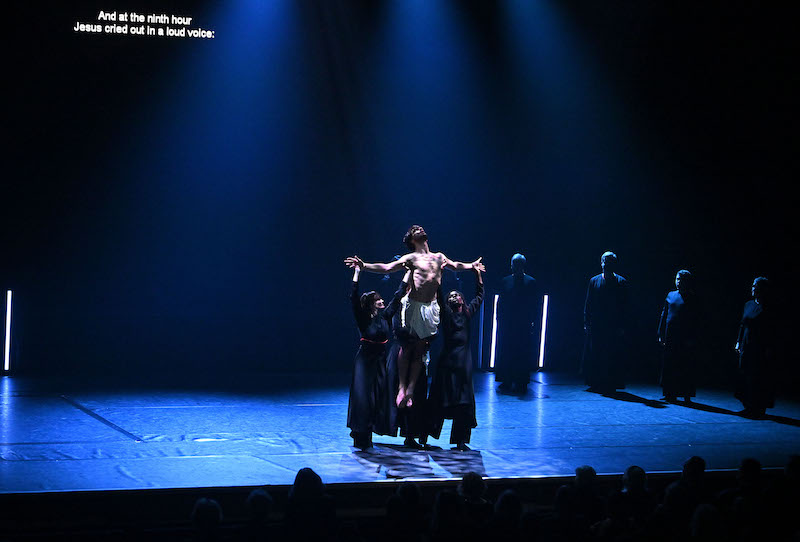
Conductor: Paul Agnew
Choreographer: Amala Dianor
A capella voices, contemporary dance, and Christ’s crucifixion are fused together in this performance, reinventing Carlo Gesualdo’s 17th-century classical music.
This is a result of an artistic collaboration between Amala Dianor’s dance company and six vocalists from the Baroque music company, Les Arts Florissants, both based in France. Dianor produces dance that amalgamates hip-hop, contemporary and African styles, whilst Les Arts Florissants presents Baroque music of the past on the present stage. Despite their different artistic ammunition, both companies experiment with the classic and the contemporary, using art to connect modern audiences with the past.
The collaboration is brought to London’s Barbican Hall as part of Dance Umbrella: a month-long festival showcasing international and UK dance in venues across the city, and a curated online programme of films.
Originally composed for Holy Week in 1611, Responsories for Holy Week depicts Christ’s last moments in intricate polyphony. The expressive score reflects the intensity of this but also alludes to the composer’s own drama – it is believed that Gesualdo murdered his wife and her lover.
The sounds created by Les Arts Florissanta are exquisite. The ethereal harmonies, effortlessly crafted by the six voices that are unaccompanied by instruments, cascade across the auditorium, transfixing the audience with their emotional retelling of Christ’s final days.
The dancers are just as impressive as they take on the horror of the crucifixion. Their classical training soundly underpins the contemporary style as they break beautiful lines, seamless floorwork and expert transfers of weight with isolations, twitching, and stamps. Particular commendation goes to Elena Thomas’ perfectly fished foot and Clément Nikiema’s headstand that represents Judas’ hanging. Moreover, the dancers’ synchronisation is commendable considering the minimal beat provided by the a capella soundtrack.
Making this classical interpretation so unique, the singers branch out of their choral comforts as they move alongside the four dancers. The dancers equally assimilate with the singers. The intentional use of unison breathing during movement, as well as choreographed claps and stamps, contributes to the a capella canvas, uniting the two art forms. This produces a truly integrated performance that brilliantly embodies Dance Umbrella’s desire to harbour connectivity through art.
The dynamic performance between music and dance, crescendo and softness, is absolutely fitting to explore the light and dark of Christ’s final days. However, at times, the movement interpretation is confusing, especially during some of the most tense moments. What’s more, the audience has to juggle between watching the performers and reading the translation projected above them, which is crucial to understanding the story, and so some of the creative effect is lost, albeit minorly so.
Like all artistic reinventions, this experiment will not universally land. However, the undoubtedly captivating collaboration of classical and contemporary movement and sound is a creative feat worthy of attention.
Runs until 16 October 2026
