

Writer: George Bernard Shaw
Director: Benedict Esdale
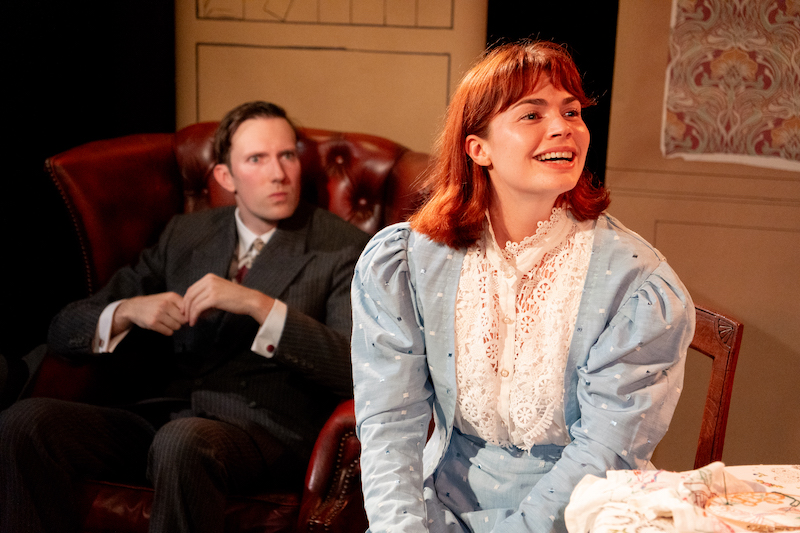
Six actors, six plays in six weeks, Flywheel Theatre Company’s enjoyable repertory season at the Old Red Lion Theatre continues with a smart adaptation of George Bernard Shaw’s Pygmalion that runs for just under an hour but retains the play’s core themes and important characterisations. Directed by Ella Rowdon under the Artistic Directorship of Benedict Esdale, the company have shorn Shaw of some of the most famous scenes and instead presents a reduced but nonetheless skewering time jump drama about the effectiveness of good manners and the price of humanity.
Discovering her words have been of interest to phonetician Henry Higgins in Covent Garden, flower seller Eliza Doolittle presents herself at his door, requesting elocution lessons. As a six-month experiment begins, Higgins bets his friend Colonel Pickering that he can transform Eliza’s vocal modulation along with her manners and dress, so she can pass in good society as a lady. As the trio draws closer, the results surprise everyone.
On the surface, this may seem like a brutal truncation of Bernard Shaw’s play: gone are the extended cast, including Eliza’s savvy father and her would-be lover Freddie, and there is no elaborate ball. The play never contained scenes in which Higgins is seen teaching Eliza; those were inserted for the film and used in the Old Vic production in 2023, and the creatives resist the urge to insert them.
But Flywheel have actually retained the scenes that really matter, certainly to this production, which focuses less on whether it is possible to change someone’s class and instead considers the philosophy of behaviour and its impacts. Higgins here proves himself far less worthy than Eliza through his snobbish and entitled behaviours, while his cancelling of her humanity from the beginning – referring to her as a “block of wood,” as “that thing” and a “baggage” – is scarcely altered by the end of the play, where she is now “that creature.”
The downside is that it puts Higgins rather than Eliza at the centre of the play, requiring her to be mostly hysterical and not really exploring her agency across the story. One of Eliza’s most fascinating traits is her great self-sufficiency at the start of the play, a young woman earning her own money with a strict morality about men and alcohol, as well as aunt-killing, while knowing she has no one to rely on but herself. The production, and Sadie Pepperrell’s performance, could do more to emphasise how gentrifying her actually strips Eliza of the freedom she once had, creating a cage for a robotic and haunted woman rather than the doorway to the better life she had imagined.
Charlie Woodward has the best of it as a very entertaining Higgins, whose certainty about his skill as a teacher matches his belief that he is a representation of decency, which proves nicely deluded, and Woodward plays him as a man who slides from cheerfulness to sulking very easily and lands all of the observational comedy. The abridgement means other characters are a little paler, but the gender-swapped Pearce, Higgins’ butler, adds a touch of finesse, bowing to the room after changing the scenery and apologising to someone in the front row when Higgins turns over a bin too enthusiastically on their feet.
Rowdon’s production skips along very nicely in its shorter form, and the laser focus on the ethics of remaking another person is a welcome alternative to the comedy of class.
Runs until 4 October 2025
