

Writer: Alexandra Montalbano
Directors: Alexandra Montalbano and Brock Looser
Cas, short for Cassandra, has a mark on her neck. When her best friend spots it, she wants to know whether it’s a hickey or a bruise. One of the bigger questions, though, is who gave it to her, her husband or her lover – the latter of whom just happens to be her adult stepson.
Actor and dancer Alexandra Montalbano has chosen to create a contemporary monologue for her debut stage writing, inspired by the 17th-century tragedy Punishment Without Revenge by Lope de Vega. As with that earlier work, Cassandra is in an unhappy marriage with an older man. In this case, her partner is a businessman who, even before their wedding, is sleeping with other women in the couple’s apartment.
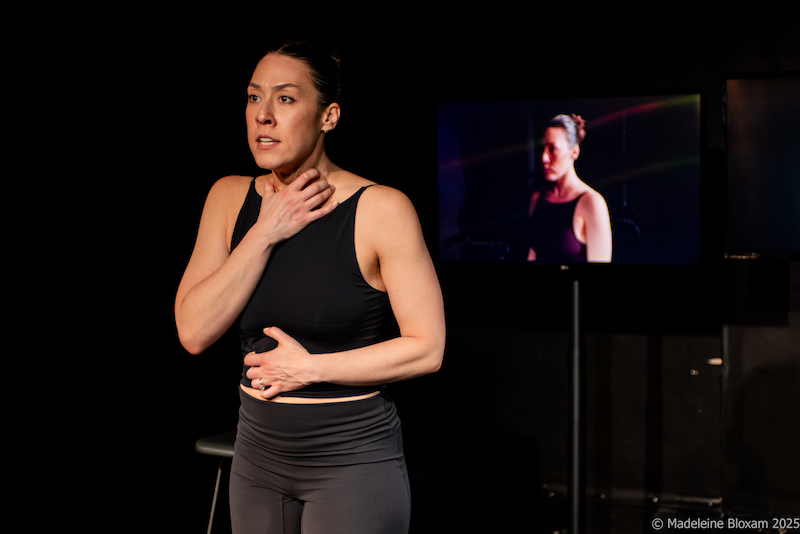
Montalbano creates a cast of characters, including Cas’s parents, her best friend Luce, and a variety of dates, who are visually and aurally distinct from one another. While some of those portrayals dip into the well of broad caricature, they all help propel the narrative effectively and rarely succumb to overuse.
Montalbano, who is also a movement director, effectively utilises her prior experience, bringing physicality that adds further layers to each character. It also allows her to introduce the relationship between Cas and her lover through a tango in which the actor performs both roles. Video cameras on either side of the stage occasionally play live feeds of the actor’s performance onto screens behind her, culminating in an excruciating dinner party in which Cas is joined by Luce, her husband, and his son. The screens then switch to pre-recorded views. This allows Montalbano to register the reactions of other diners as characters bicker in front of them. A technical fault with one of the televisions on press night distracted from the full effect, but Montalbano’s live work by far exceeds the bonus of the technical work behind her.
There is a pleasing amount of ambiguity in this debut script, leading one always to wonder whether Cas’s affair is a need for passion missing from a marriage where her husband tracks her ovulation cycles more closely than she does, or if it is a revenge for his infidelity.
But there is more, too. While the suggestion of sexual strangulation (the ambiguity extending to whether it is always consensual) provokes the play’s title, Cas is being choked more metaphorically. Stuck in two relationships in which she is the lesser partner, both father and son have a chokehold on her life. Even the couple’s therapist, who suggests that her husband’s infidelities must somehow stem from Cas’s inability to fulfil his needs, stifles her.
De Vega’s original play ends in multiple murders and bleak desolation. Montalbano chooses not to go down that path, and choke me is all the stronger for it. It also helps solidify the play as a boldly effective piece of new writing that holds the audience by the throat until the last moment.
Runs until 28 September 2025
