

Writer: William Shakespeare
Director: Bill Alexander
This slimmed-down version of Twelfth Night starts with shipwrecked Viola, stranded and alone in a strange country, thinking her brother has drowned. The dispossessed opening better suits director Bill Alexander’s determinedly melancholic take on Shakespeare’s complicated comedy. A spirited Martha Ibbotson plays both Viola and her twin brother Sebastian, making it far more plausible that the other characters keep mistaking the siblings for each other. It’s a device that works brilliantly right up until the moment they need to appear on stage at the same time.
Cutting the play’s five overstuffed acts down to an interval-less 70 minutes calls for some sacrifices, but also brings speedy benefits. Apart from Viola/Sebastian, the cast of eight doesn’t double up, and the small stage rarely gets crowded. In the absence of the original sea captain, Viola confides in the audience. She explains her plan to disguise herself as a man and work for Duke Orsino, making us complicit. Jonny Wiles is an unusually warm and likeable Orsino, bonding with his new servant and sending him off with messages of love for Olivia. Eliza Horn’s ice-queen Olivia is quickly thawed by the young messenger’s charms, and the play’s central love triangle swings into action.
Alexander, who has already directed the play on half a dozen previous occasions in the course of a celebrated career, miraculously manages to keep the full plot intact and even gives the comedy room to breathe. Whereas, in a full-length version of the play, the comic characters can often feel like lagging interruptions to the action, here they create refreshing oases of joy in the whirlwind of romance and revelation.
Rez Kabir is superlative as Olivia’s disreputable uncle Sir Toby Belch, whether he’s cajoling Sir Andrew Aguecheek (a hilariously feeble Jamie Newall), plotting and canoodling with Maria (Mary Chater), or drunkenly gagging on pickled herrings. John McAndrew’s dour Malvolio is compelling in his journey from gloomy household servant to manic suitor and beyond. With his ponderous delivery, his (slightly erratic) Northern Irish accent and officious black folder, he is the perfect foil to the others’ partying. The scene where Sir Toby and Sir Andrew break into song and dance routines to Malvolio’s disgust is a highlight of the play.
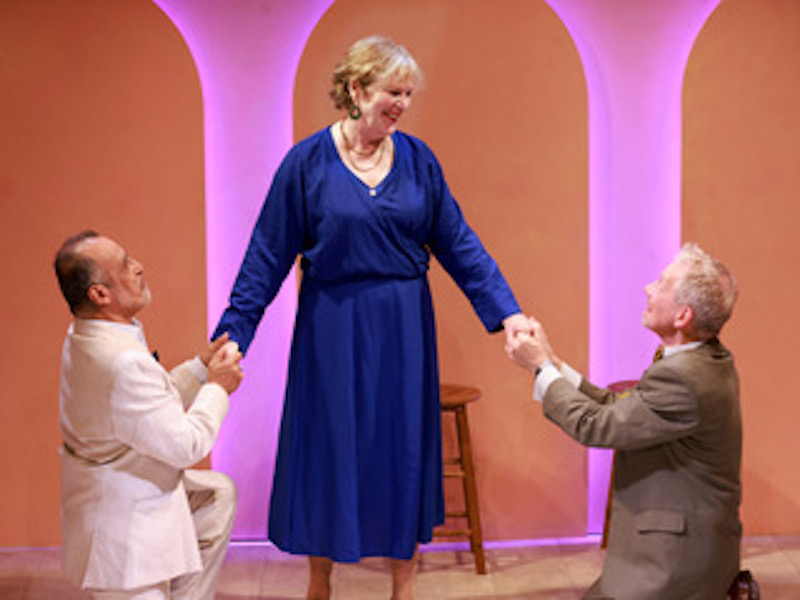
Otherwise, the songs are missing and the jesters have gone, although some of their lines end up in other people’s mouths. Sarah Sayeed’s sound and music include a few soulful tunes in the margins of the show. The set, designed by Lucy Fowler, consists of three arches and three stools, but it’s enough to hint at Illyria’s Mediterranean colonnades, especially when enhanced by Rajiv Pattani’s warm lighting. Fowler’s costumes are similarly simple, but effective: Olivia starts off in an elegant black dress, Orsino wears a pink satin shirt and Sir Toby cream linen.
In contrast with the courtly characters, piratical Antonio, who rescues and then falls in love with Sebastian, is dishevelled and muddy. Robert Bouvier’s Spanish accent suits the character well, but it slows the pacing of his scenes. The decision to dwell on the two stories of unrequited love (Antonio’s for Sebastian and Malvolio’s for Olivia) comes at the expense of the happier heteronormative pairings. Alexander’s illuminating idea that the humour of Twelfth Night is shot through with tragedy eschews feel-good farce in favour of something more thoughtful and challenging.
Runs until 18 October 2025
