

Director: Fiona Cunningham-Reid
Sharply merging the personal with the political, Fiona Cunningham-Reid’s documentary, Ackroyd & Harvey: The Art of Activism, doesn’t just look at what it’s like to be ahead of the curve, but what it really costs to do the right thing.
Heather Ackroyd and Dan Harvey met in the 1980’s and a relationship began, both between themselves and their respective approaches to art-making. Harvey’s “alchemist” way with materials and Ackroyd’s gift for performance melded to create a unique double act in the contemporary art world. Working with natural materials (their signature pieces are portraits grown from grass seed), Ackroyd & Harvey made art that focused on climate change. In an art scene that was leaning towards the industrial and urban, they stood out.
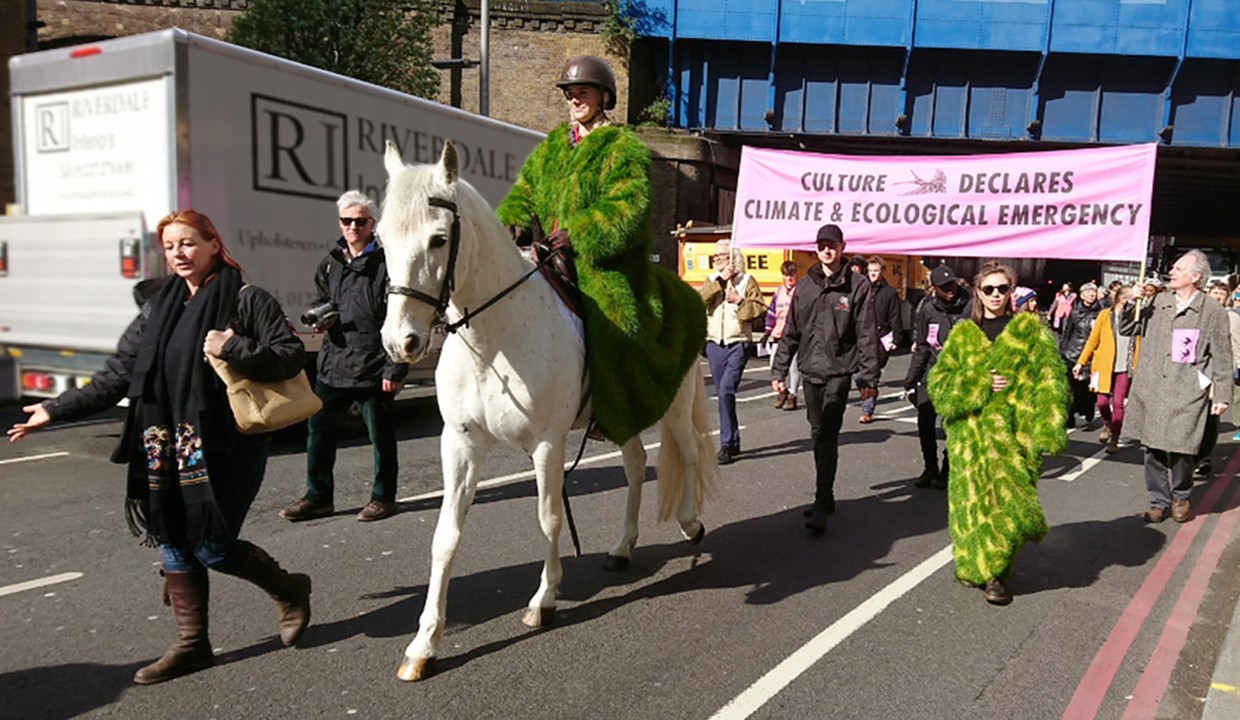
Cunningham-Reid follows the artists over a number of years, including their activist involvement with Extinction Rebellion, a frantic calendar of installations and commissions, to a forced hiatus during the Covid-19 pandemic, where everything – art, life and love – is re-examined. Cunningham-Reid takes us on a whistle-stop tour of their greatest hits: the History Trees commissioned for the 2012 Olympics; the Dilston Grove installation where a derelict church in Bermondsey is transformed into a lush, verdant interior of living grass. This resulted in the inevitable “but is it art?” furore, leading to an incongruous appearance on Richard & Judy.
What the documentary gets across is Ackroyd & Harvey’s undiminished commitment to waking us up the climate catastrophe. The artists have a gift for attracting attention: their creative disruption of London Fashion Week was not just about ceasing the use of fur in designs, but asking the industry to look at the impact of its supply chains and trading practices on the environment. This was years before the true cost of fast fashion became more publicly visible. Cunningham-Reid also reinforces their financial integrity. Ackroyd & Harvey have turned down several invites to work with corporate clients, including BMW. Their opposition to corporate green-washing, again, shows them to be thinking not only of themselves, but what they will leave behind. Their daughter wittily remarks that her parents could have been incredibly rich, if they didn’t have principles.
It is during the pandemic that the wheels start to come off for Ackroyd & Harvey. Described by the couple as a “threshold moment”, cracks in their personal relationship end up with them separating, but continuing to work together. There is a noticeable sense of the artists stepping back from the film: when they are interviewed on camera, they are sit on the very edges of the frame, not wanting to get too close. They talk about exploring different projects. Cunningham-Reid doesn’t probe too far into this, and it feels like a weakness in a film that has, up to this point, felt very intimate and familiar. While the artistic legacy they have cultivated feels sturdy enough, The Art of Activism leaves us on a very uncertain note. As Ackroyd & Harvey’s work comes of age, the sense of personal disconnect is hard to ignore.
Ackroyd & Harvey: The Art of Activism will be in UK Cinemas in from 19 September.
