

Writer/Director: Alan Ayckbourn
It’s not always easy to work out the target of Alan Ayckbourn’s 91st play. Is it about the nature of goodness or a satire on the social media, technology-powered love of lunatic rumours and unmotivated witch-hunts? Well, both really. At times it feels as if two different plays have been pushed together, but, with Ayckbourn, it’s inevitable that we get an unexpected twist at the end.
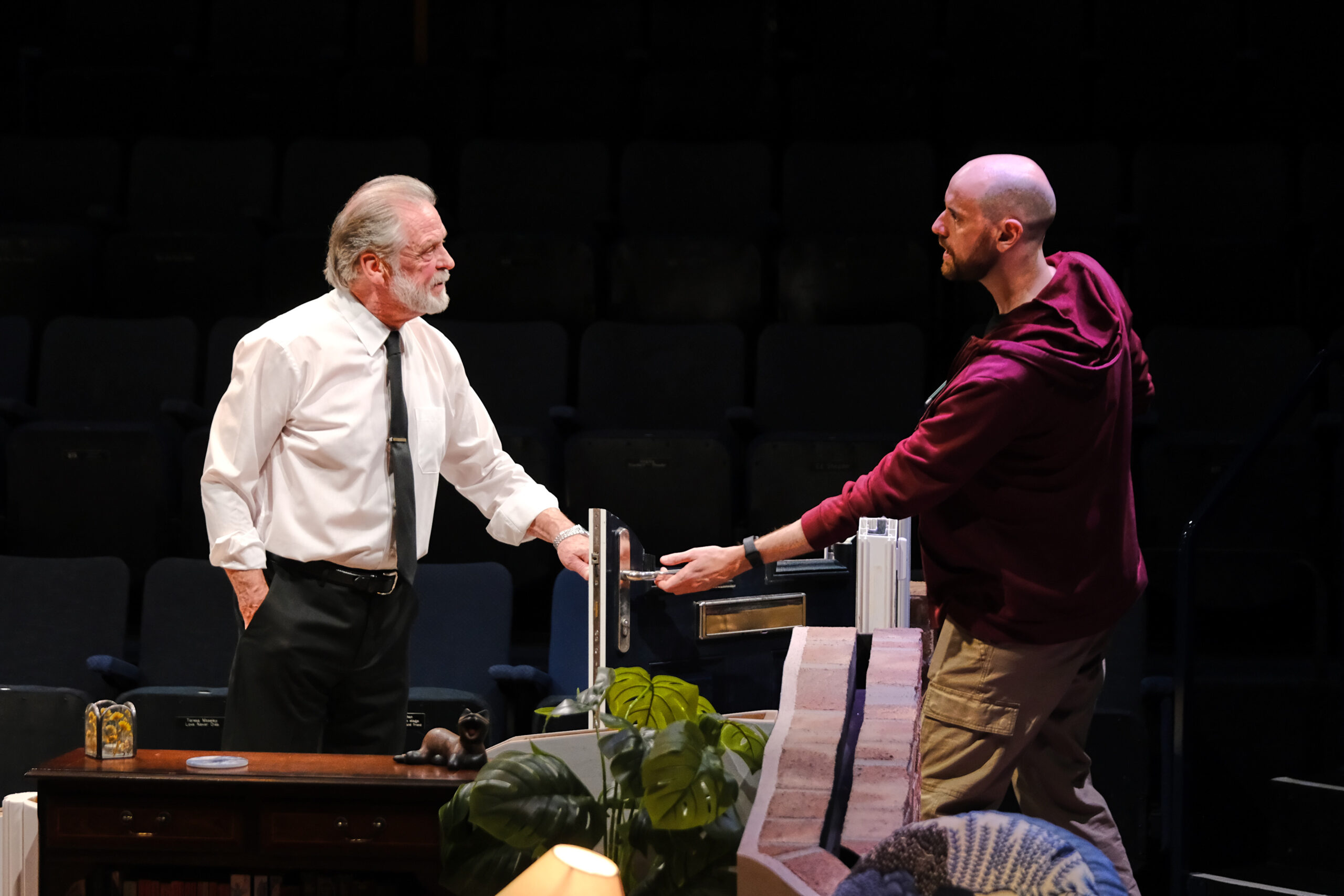
Gerald Mallett’s wife Amy, much younger than he is, has died and after the funeral, as his interfering, but kindly, neighbour, Norah, washes up, a young man, Daniel, who nobody knows, wipes. Gerald sits alone in the living room and for much of Act 1, these are the only characters we see. Norah is tremendously impressed with the vicar’s choice of phrase about Amy: “Earth Angel”. Eventually it becomes obvious that Daniel, a charming smiling presence, has no intention of leaving and Gerald offers him the spare room. Norah is patently worried and takes an eternity to leave.
It’s at this point that the farce clicks in. Hugo, another neighbour, alerted by Norah, appears with a cock and bull tale of lack of heating, and settles in on the sofa to protect Gerald. Then Gerald’s sister, Maxine, a magistrate, and her ex-policeman husband, Adrian, arrive and the surveillance begins. Hugo can perceive the world only via his iPad, misses everything that’s going on around him and instead gets messages alleging all sorts of mad notions of who Daniel might be and what his motive is. Adrian conjures up ever more absurd police action and Maxine spouts class-ridden nonsense.
Hayden Wood understates Hugo’s obsessive character neatly, Stuart Fox’s Adrian grapples with dangerous ideas through gritted teeth and Liza Goddard relishes the importance of Maxine in every speech. Norah is a different matter, a real-world character among the crazies, though she activated the whole thing. Incapable of seeing goodness without some personal pay-off and facing the world through a babble of trivial talk, Elizabeth Boag nevertheless makes clear that she genuinely wishes the best for Gerald.
The relationship between ex-English teacher Gerald and mysterious visitor Daniel is central to the human story. Iskandar Eaton is perfect as Daniel, kindly, anticipating Gerald’s every wish, yet somehow enigmatic, with occasional acts that suggest he may not be what he seems. Russell Richardson’s Gerald beautifully conveys the nostalgia, the sense of loss, the willingness to rely on other people, combined with humour and spirit. The final emotional scene between the two answers all our questions.
Kevin Jenkins’ set meticulously fits Gerald’s living room and kitchen into the Round space, though in Act 2 the switch to Norah’s living room alongside Gerald’s kitchen produces one or two awkward entries and exits.
Runs until 11th October 2025
