

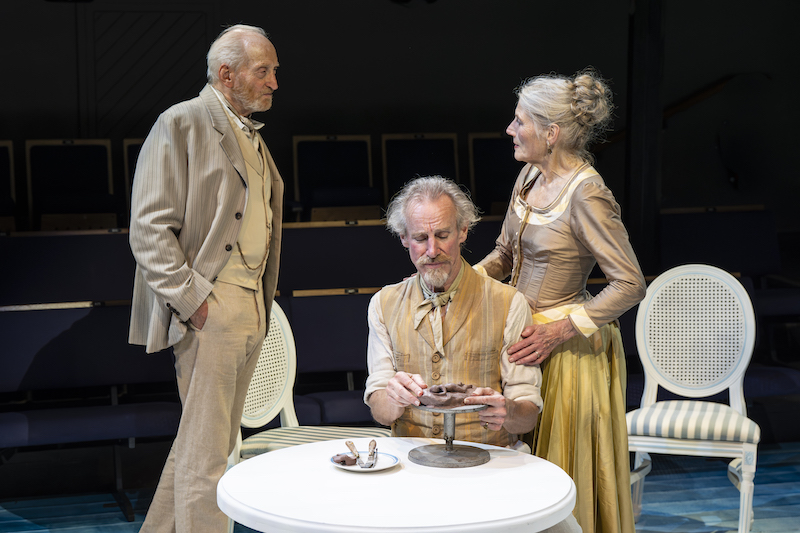
Writer: August Strindberg, adapted by Howard Brenton
Director: Tom Littler
Three charismatic and deservedly famous actors: Geraldine James, Charles Dance (reunited for the first time since their Jewel in the Crown days) and Nicholas Farrell (Chariots of Fire) star in this revival of Creditors.
Veteran of several failed, resentful marriages, whiskery nineteenth-century Swedish playwright August Strindberg poured his vitriol into this dark tragicomedy about a trio of characters in various conjugal states tormenting each other with unintentional force.
In brief, the play explores the relationships between enigmatic Svengali-like figure Gustav (Charles Dance), failing artist Adolph (Nicholas Farrell) and his latterly more successful, authorly wife Tekla (Geraldine James), all staying in a seaside hotel. The plot, involving debate around modern morality (influenced by Nietzsche’s writings on post-religious modes of existence) and hidden identity, echoes a tricky social situation Strindberg found himself in during his stormy marriage to actor, muse and controversial divorcée Siri von Essen.
Fascinated by the complexity of Strindberg’s work, writer Howard Brenton and director Tim Littler embark on their eighth collaboration with this rendition of Creditors, a title that refers to the emotional debt that partners in lop-sided relationships often feel owed.
The actors’ presence in London’s premier quasi-rural thespian retirement hub has guaranteed a sell-out run: tickets have been hoovered up by those nostalgic for their 1980s heydays. So, has the challenge of exceeding inevitably high expectations been achieved? Emphatically yes, and any reservations around selecting pensionable players for such an energetic piece are absolutely blown away. The casting is impeccable.
Dance is suave, dastardly, cutting and irascible as Gustav, hectoring and prevailing on Adolph to take a firmer line with his wife. The ice blue gimlet gaze is deployed to kind, cajoling and terrifying effect. In Tekla’s absence he subtly, ruthlessly, manages to set himself up as Adolph’s career saviour – “All you needed was the signpost back to your true path” (sculpture rather than painting) – denigrate Tekla, and persuade Adolph that she’s not only on the prowl but also out to derail his artistic career having stolen all his freely-given ideas: “It’s cannibalism… this woman has eaten your courage and soul.”
It’s no surprise that Adolph (Farrell) is flushed and flustered under Gustav’s barrage of observation and ill-meaning advice. Farrell cuts a suitably pathetic figure, fraught, dithering and cowed, reliant (after an unspecified incident) on a literal wooden crutch to hop about. Succumbing to Gustav’s guidance, he veers credibly between bouts of wobbly confidence to fits of absolute self-doubt, his voice reduced to a croak. Watching his creeping realisation that Gustav’s seeming concern isn’t wholly kind – “You pull me out of a hole in the ice then torture me” – but acquiescing to it regardless, is quite affecting. It becomes clear that his only hope is escape from the machinations of this newfound ‘friend’.
Geraldine James, lively and imposing in swishy satin skirts, strides around merrily, twining around Adolph to kiss him, rubbing his fevered temples and brashly defying him as the mood takes her. It’s saddening to see her natural, free and easy attraction to Adolf wane as he parrots Gustav’s vile accusations of flirtation and idea thievery, and stomach-churning to think of his glee next door as he listens in. James moves seamlessly from fond, light-hearted banter, to distracted nervousness – “There are ants in your head, shall I shoo them away? – and outright suspicion – “Who told you not to paint…who has been here?” – and her righteous anger at Adolph’s sudden, inexplicable character shift builds relentlessly.
The script is still electric, suffused with vengeful insight (only those in the throes of divorce could write with such verve and spite) and riddled with amusing one-liners worthy of Wilde or Shaw: “People think we can’t be married because we kiss all the time!”, “I long for your forgiveness… as long as you don’t talk!”
Brenton’s iteration supplies the material for a true acting masterclass: perfectly calibrated, with absolute synchronicity between the players. It’s as deeply unsettling as it should be, especially since the Orange Tree gives such close proximity to the stage: in the lower level, it feels like being slowly steeped in humorous bile. Much of the laughter from the audience is extremely nervous, as if real-life raw nerves have been exposed.
The depth of nastiness is quite surprising: all niceties are peeled away, and it’s quite exhausting. But once the venom is blurted out, it’s all over a bit too soon: one of those plays that could do with being long enough to sustain an interval in which to recover and talk through all the ideas being pelted out.
But this is the historical nature of the piece: written in haste by Strindberg to replace Miss Julie, which was originally cancelled by censors. And maybe it’s all the human frame can take in one session.
Louie Whitemore’s excellent set is a cosy palm court encroached on all sides by lapping sea and smudgy sky (influenced by Strindberg’s paintings), and Max Pappenheim’s evocative soundtrack is of heady fairground music, shrieking gulls and howling winds. Both very effectively set the outdoorsy yet claustrophobic scene and serve the action well.
Overall, this version of Creditors is an extraordinary experience on many levels that could only be improved by an interval and a much longer run.
Runs until 11 October 2025
