

Writer: Giannine Tan
Director: Elisabeth Tu
The shocking story of the Comfort Women is one many of us may know little about. Somewhere between 20,000 and 200,000 women and girls were snatched from occupied territory by the Japanese Imperial Army during and after WW2 and forced to become sex slaves. The majority were taken from Korea and China, but there were also victims from Australia, the Netherlands and the Philippines, amongst other countries.
Giannine Tan’s story focuses on the story of an elderly Filipina woman and her friend, both ‘Lolas’ – the name given to grandmothers who are now giving their accounts of the brutal treatment they received at the hands of the Japanese. They’re in some ways the lucky ones, in that they survived. Many died as a result of beatings and multiple rapes.
Her story is told tactfully and gently – perhaps too gently to convey much of the real horror. The frame is that Maria, one of the two Lolas, meets for the first time the grandson of Lola Hilum. She smilingly asks some basic questions, establishing the fact that the young man knows nothing of his grandmother’s story. The rest of the drama is a recreation of scenes from the past.
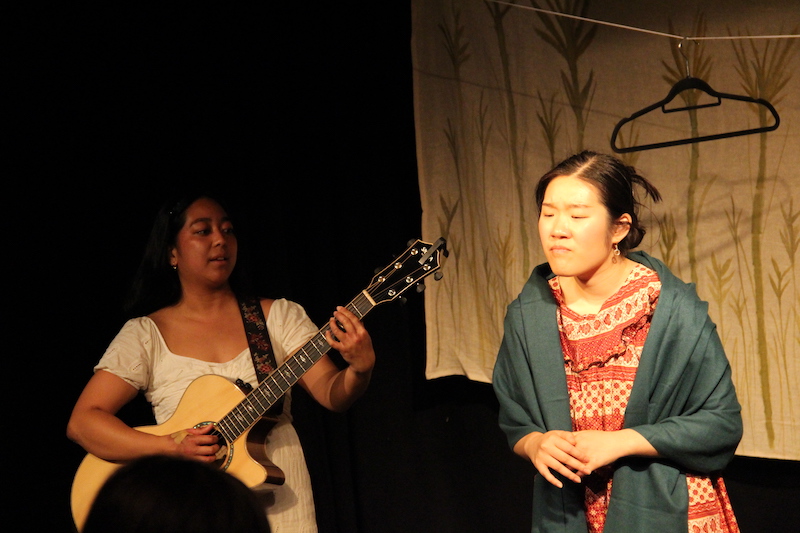
Tan transforms from the elderly Maria to the innocent girl she once was. There is nice ensemble work from Tan, Mary Suarez and Janna May, including imaginative use of small chicken puppets to establish the simplicity and happiness of Maria’s childhood. But rather too much time is spent on this, and the device of having Maria connect each of the chickens to one of her family members doesn’t add a great deal.
More significant to the piece is the music – Suarez and May both play guitar, and all three women sing. They perform well, and we hear a wealth of lovely folk music. But to fully understand the contribution the songs are supposed to make to the play, the audience really needs to be given a copy of the words or hear an explanation.
Tan’s writing delicately side-steps much of the brutality of the women’s treatment, perhaps so the play can be shown to young people without a trigger warning. A crucial rape scene takes place out of sequence, only seen close to the end. It’s done in mime, men’s shirts on hangers doing duty as the aggressors. But this coyness lessens the impact of what continues to be a controversial and disturbing issue.
Also, by focusing on the story of two women who were just girls when they were abducted, we are not told much of the overall context and nothing at all about how the surviving victims felt themselves to be outcasts, so remained silent for decades.
We do learn, however, about the formation in 1992 of Lila Pilipena (League of Filipina Women) demanding compensation from Japan and a formal acknowledgement of all that happened, but not the fact that the legal action that’s been taken against Japan has so far failed because they have not been adequately supported by the Philippine government.
Runs until 22 August 2025
Camden Fringe runs until 24 August 2025
