

Writer: Heva Kelly
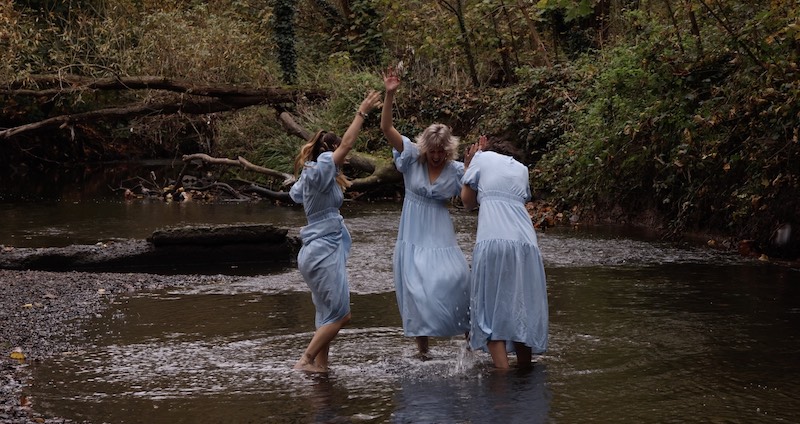
Marketed as a darkly comic origin story of Macbeth’s witches, The Weirdest Sisters bears little resemblance to the world of Shakespeare’s tragedy. The production never addresses why its events unfold in a recognisably contemporary London when Macbeth is rooted in 11th-century Scotland. Without a bridge between these two vastly different settings, the supposed link to the Scottish play feels more like an afterthought than a guiding concept.
The pacing of Heva Kelly’s script proves uneven. The opening 20 minutes pass with little incident, heavy on atmosphere but light on narrative development. When the plot does begin to move, it lurches forward at breakneck speed, cramming in murder, miscarriage, revenge, and magic in rapid succession. The effect is disorientating, with significant events landing without the build-up or reflection they deserve.
The nature of the sisters’ relationship is briefly established in the opening lines, only to be left largely unexplored for the remainder of the play. With little reinforcement or clarification, the familial connections become increasingly difficult to follow. This confusion is compounded by casting choices that place almost every character, whether an MP’s wife well-established in the community, a reclusive witch from the Scottish moors, or the three half-sisters themselves, at roughly the same age. The lack of visible generational differences undermines both the credibility of the relationships and the production’s world-building.
Performances from the three central sisters play out like a theatrical Goldilocks test. Lottie Oldham gives far too much, delivering with such unrelenting intensity that scenes are often overpowered. Heva Kelly offers too little, with a performance lacking the emotional weight needed to land key moments. Erin Astra sits somewhere in between, attempting to bridge the gap between the two extremes, but the stark difference in styles makes cohesion elusive.
In contrast, Beca Barton emerges as the production’s standout presence. Their performance is consistently funny, tonally precise, and layered, lending nuance to a role that might otherwise have read as one-dimensional. Barton’s contribution provides much-needed balance amid the fluctuating energy of the rest of the cast.
Thematically, the piece circles an oddly narrow core message: that London is unliveable without wealth. While the city’s inequalities are undeniable, reducing its complexities to this single takeaway risks diminishing the experiences of countless working-class Londoners who have carved out lives and identities in its diverse landscape, none of whom feature in this play.
The absence of a single director is felt throughout. The show’s stylistic choices feel like a grab-bag of theatrical devices, from heightened physicality to straight-faced realism, none of which fully integrate into a coherent whole. As a result, moments that should be climactic or emotionally charged sometimes pass without impact.
Despite running around 30 minutes longer than the material warrants, the production retains a level of engagement thanks to its consistently applied, if inauthentic, Shakespearean-style language. The writing’s commitment to this heightened register gives the dialogue a certain charm, even if its connection to the source material remains tenuous.
The Weirdest Sisters offers ambition and one standout performance, but its muddled focus, inconsistent pacing, and stylistic disunity leave the spell only half-cast.
Runs until 14 August 2025
Camden Fringe runs until 24 August 2025
