

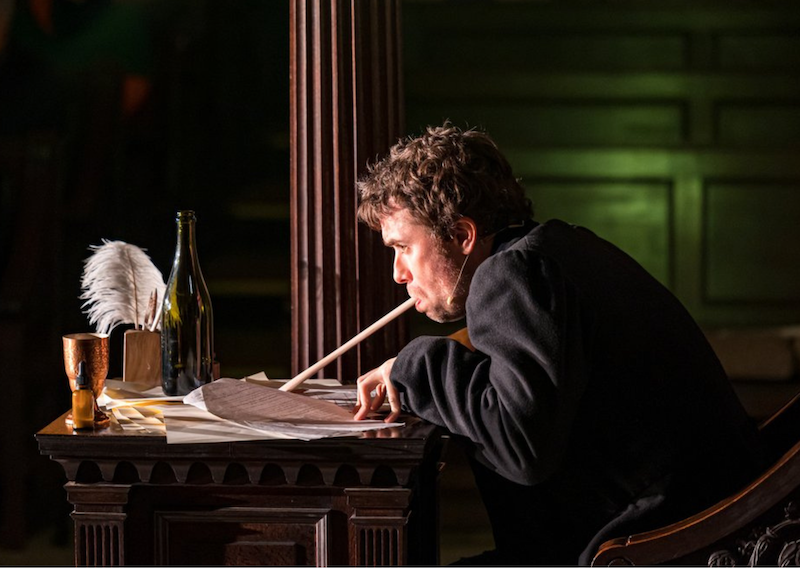
Creator: Tama Matheson
Music Director: Jayson Gillham
Beethoven: I Shall Hear in Heaven, created by Tama Matheson, is a strange hybrid. It’s billed as a play, but it’s more a programme of Beethoven extracts interspersed with a retelling of Beethoven’s troubled life. The music, of course, is glorious, but as a dramatic work it falls short.
Matheson plays Beethoven with conviction. But his words – one assumes Matheson draws heavily on Beethoven’s own – are almost entirely in an artificially high-flown rhetoric. Robert Maskell and Suzy Kohane play all the other parts, doing their best to bring to life a series of short scenes. But they, too, are made to speak in the same stilted register with a lot of unnaturalistic ‘How greatly you do me wrong’ sort of speech, so their various characters become almost interchangeable.
The other problem facing the actors is that their characters often have little to do in scenes where the action stops and the music plays. They carry on in character, but it’s regrettable that they often talk over the music. There’s a lot of writing at writing desks and swigging of wine.
Having said that, the music itself is a delight. Jayson Gillham has thoughtfully arranged a rich programme for string quartet and piano, and is himself an excellent pianist. Alongside him, the string players of Quartet Concrète perform with vigour and intensity. A choir drawn from members of the English Chamber Choir are rather underused, however, having to sit on stage throughout the first act with nothing to do except briefly impersonate the people of Vienna when Beethoven first arrives, their sombre choir-kit not really suggestive of the colourful scene he describes.
They finally come into their own close to the end with a short burst of Beethoven’s Ode to Joy from Symphony No. 9. You might hope, at this stage, you’re going to hear the whole thing, but you’re never sure in this show whether you’re just going to hear a snatch of the music or an entire movement. There’s a slight whiff of jukebox musical about the listing of the pieces in the programme (‘What a city Vienna is!’ … ‘How did it happen, Carl?’), so ‘Mama! Mama!’ might briefly promise a segue into ABBA. It signals, in fact, the touching adagio from Quartet No. 7, chosen to present the death of Beethoven’s mother.
The second act necessarily focuses on Beethoven’s descent into deafness and the agony this causes him. It can’t be an easy thing for an actor to convey this. Matheson has to spend a lot of time repeatedly crouching in pain while cupping one ear. One egregious scene attempts light-hearted comedy, showing Beethoven, now using an ear trumpet, trying to converse with another identically equipped sufferer. But really, stuff about age and deafness just isn’t funny, whatever the misunderstandings about coffee and toffee.
Matheson conveys the sense of Beethoven’s increasingly erratic moods with a lot of angry stamping round the stage. The overall tone becomes more and more melodramatic – there is little subtlety here. The show comes to rest on the idea that Beethoven somehow found peace, able to hear with his inner ear. But it’s a hard concept to make convincing.
The set seems designed to convey something of Beethoven’s inner turmoil – there are great piles of crumpled manuscript paper everywhere and decorators’ ladders which don’t seem to have a use. It would have been good to have a sense somewhere of the German lands in this period.
Reviewed on 8 August 2025
