

Writer: William Shakespeare
Director: Emma Sampson
Much Ado About Nothing is rightly regarded as one of Shakespeare’s more accessible comedies, with the interplay between Beatrice and Benedick, whose tumultuous bickering often hides a fierce love, becoming a dynamic that is frequently cited as the foundation of many screwball comedies.
What the play also has going for it is its extensive cast of characters, including the other romantic couple, Hero and Claudio, Beatrice’s uncle Leonato, the visiting army led by the villainous Don John and his brother Don Pedro, and Constable Dogberry – the list goes on. So for a travelling company of just four actors, there is additional comedy to be mined in the rapid multi-roling and character changes necessary to keep the plot moving.
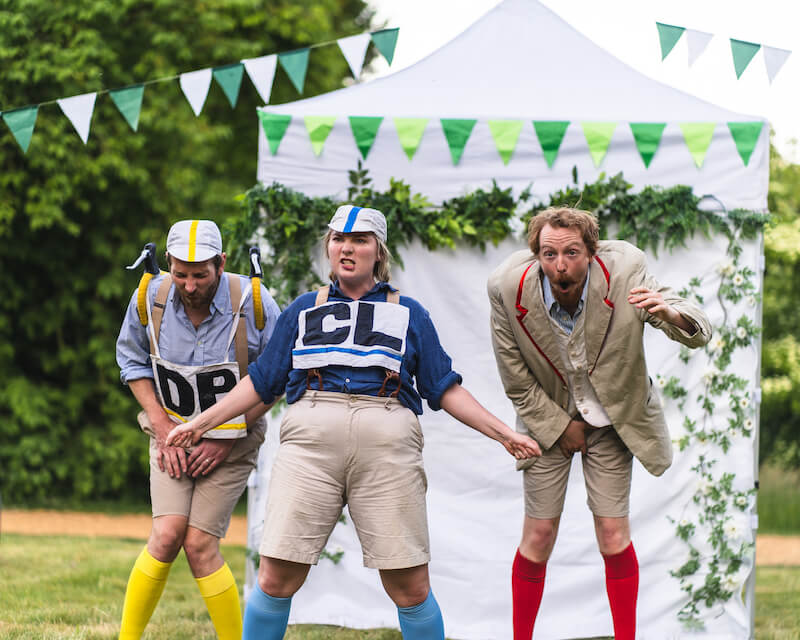
For The Handlebards, a company that proudly boasts of being able to transport all their props and costumes on bikes as they cycle to outdoor venues around the country, their basic costumes – knee length shorts and braces – are supplemented by a variety of hats and other accoutrements to keep a tally of who’s who. Many of the characters, especially those of Don John’s army, wear detached handlebars across their shoulders, from which hang abbreviated cloths denoting their names. So Benedick is “Be”, Borachio is “Bo”, and William Ross-Facwett’s moustache-twirling Don John is “DJ”. For other characters, more regular costume flourishes help distinguish them: Sarah Bulmer’s Beatrice is wrapped in a plaid skirt, while Leonato (Ross-Fawcett again) wears an Edwardian cricketer’s jacket.
Oh, and Hero is a mop in a dress.
For a play not renowned for hanging around, the Handlebards’ adaptation is even more sprightly than usual, with each of its two acts coming in at a spritely 50 minutes each. The pace is unrelenting without ever becoming unclear, sticking to the original storyline while still affording moments of improvised silliness with the audience, from pinching parts of their picnic to dragooning them into non-speaking onstage roles.
Emma Hadley-Leonard makes for a charming Benedick, especially when hiding from his compatriots as they, aware of his presence, talk about how much Beatrice loves him. And as the second act takes its familiar darker turn when, as Claudio (Bulmer again) has been conned into denouncing his would-be bride, Hero (still a mop) at the altar, Beatrice (Bulmer) asks Benedict to prove his love by killing Claudio. But even with these darker moments, the Handlebards find much silliness: not least because Benedick’s weapon of choice for the deed is a deadly banana.
Dogberry and Verges make their exits and entrances on a motorbike and sidecar (enacted through yet more handlebars, a cycling wheel and lots of “brmmm, brmmm” vocalisations), and Andrew Armfield, taking on a multitude of smaller roles, also provides the lion’s share of composer Guy Hughes’s musical interludes.
If their outdoor performance were taking place on a drizzly, grey day, one would find this version of Much Ado About Nothing brightened up the damp evening. In the broad July sunshine, it’s something else: a celebration of the very best, quirkiest and most delightful events of a pastoral summer evening.
Reviewed on 8 July 2025 and continues to tour
