

Writers: John Cleese and Connie Booth
Director: Caroline Jay Ranger
“Zhoom! What was that? That was your life, mate! Oh, that was quick. Do I get another? Sorry, mate. That’s your lot.” Basil Fawlty mutters these lines to himself between two acerbic interactions with his wife, Sybil. Mixed in with the farcical misunderstandings, the slapstick pratfalls, and quickfire one-liners that have made Fawlty Towers such an enduringly popular comedy is a lurching sense of sadness and futility. “Oh, happy. Yes, I remember that,” says Basil.
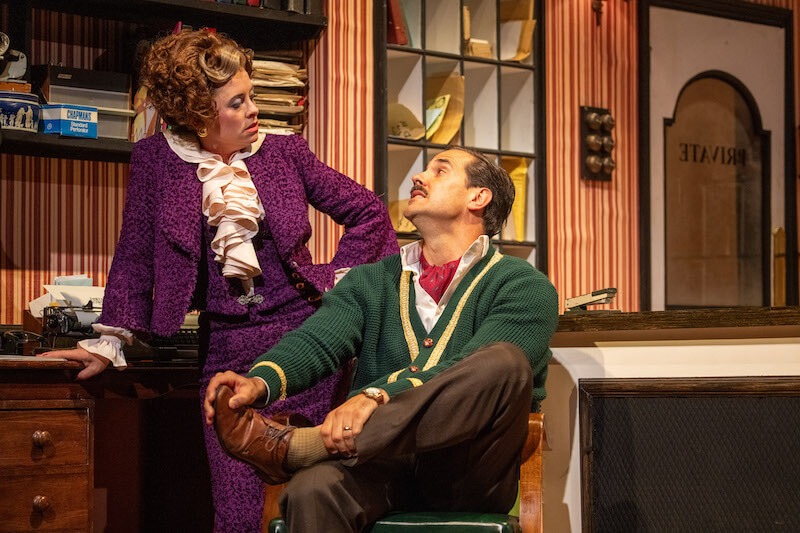
Danny Bayne as hotel owner-manager Basil Fawlty and Mia Austen as Sybil replicate the spirit and nuance of the original 1970s TV serial, building the same chaotic collage of insouciance and disdain, sobbing despair and manic gusto. Bayne’s mimicry of John Cleese-style physical comedy is assured and impressive, oscillating energetically between violence and obsequiousness. Director Caroline Jay Ranger leans into the audience’s nostalgic reverence for the original show, but there are moments of freshness too. She has let the cast borrow what works best for them and allows them to add their own flourishes.
Cleese was first inspired to create the character of Basil Fawlty when he and the rest of the Monty Python team stayed in a real hotel in Torquay with an eccentric, inhospitable owner. The resulting sitcom on BBC2, set in a shambolic seaside guesthouse, only ran for 12 half-hour episodes, but its cringe-core humour has influenced British comedy ever since.
For this revived production of Fawlty Towers – The Play, Cleese adapted three episodes and added a rather sudden finale to round off the stage version. The whole thing rolls in under two hours, including an interval. The original TV show draws heavily on the conventions of farce, so the theatre feels like a natural home for Fawlty Towers. Cleese talks in an interview for the programme about the “socially joyous experience” of watching a show as part of a big theatre audience, where the laughter is infectious.
Designer Liz Ashcroft has created a clever dolls’ house of a set with the hotel dining room and reception desk, faithfully copied from the original TV sets, and a bedroom up a staircase on the mezzanine floor above. Every teacup and light switch, biscuit tin and stapler is chosen with an eye for period detail. It all creates the perfect sense of cluttered claustrophobic pressure with the two phones ringing, the kitchen door flapping on one side of the stage and a stream of unwelcome guests arriving on the other.
Ashcroft’s costumes are similarly precise: Sybil’s big frosted hairdo and frill-fronted blouses, Basil’s cravats and cardigans, the dapper Major’s bright tie as he heads off to a memorial service (“I didn’t like the chap”). A veteran star of stage and screen, Paul Nicholas plays the Major with subtlety and panache, lurching between dithering charm and frothing racism. His most egregious joke is wisely absent, but the audience is encouraged to laugh at his peculiar British xenophobia. Basil’s lines about joining the common market feel presciently pertinent in the post-Brexit era “I didn’t vote for it myself, quite honestly, but now that we’re in, I’m determined to make it work”, he says to his beleaguered German guests.
The funny lines are still funny. There’s the scene with the Major and the moose’s head and Basil asking the annoying Mrs Richards (a comically-formidable Helen Lederer) what she expected to see out of a Torquay hotel bedroom window: “Sydney Opera House, perhaps? The Hanging Gardens of Babylon?” Hemi Yeroham has captured the original Manuel’s self-effacing haplessness while Joanne Clifton channels Polly’s elegant pertness.
When John Cleese and his then-wife Connie Booth (who played the original Polly) first submitted the script for Fawlty Towers, the BBC’s head of comedy James Gilbert initially rejected its “clichéd situations and stereotypical characters” as well as its single-location setting. He wasn’t totally wrong about the clichés and stereotypes. There are jokes that were wearing thin even in the 1970s: wives as dragons, malfunctioning hearing aids, foreign accents. But, while the whole premise is deliberately dated (Mrs Richards complains about her room costing £7.20), there is an evergreen aspect to the funniest lines that makes them worth repeating. The streak of sadness that underscores the comedy is one of the things that makes it last. The search for happiness, the folly of humanity, the fleeting nature of life: these are perennial themes.
Is it the right moment to be reviving a ridiculous farce? Maybe we need escapist comedy more than ever in dark times. Nica Burns, chief executive of Nimax Theatres, introducing the programme, offers up Fawlty Towers simply as “an evening of laughter” and “an antidote to the seriousness of the world outside”.
Runs until 13 September 2025, then continues to tour
*BOOK TICKETS NOW FROM JUST £19 FROM THE REVIEWS HUB TICKETS*
