

Writer: E.M. Delafield
Director: Luke Dixon
Above the popular gastro pub bearing the same name is the prominent and beloved White Bear Theatre, which has developed a reputation for developing new talent and, as for this production, its ‘Lost Classics Project’.
Its current offering is by E.M. Delafield, best known for the comic classic The Diary of a Provincial Lady (which has not been out of print since it was first published in 1930), is To See Ourselves, a domestic comedy which premiered at The Ambassadors Theatre, London, in 1931. Even though Delafield was famous for her sharp wit and surprisingly radical themes, plays being seen around Britain and heard on the wireless no less, her work was eclipsed by the likes of her contemporary Noël Coward, and her works faded from memory.
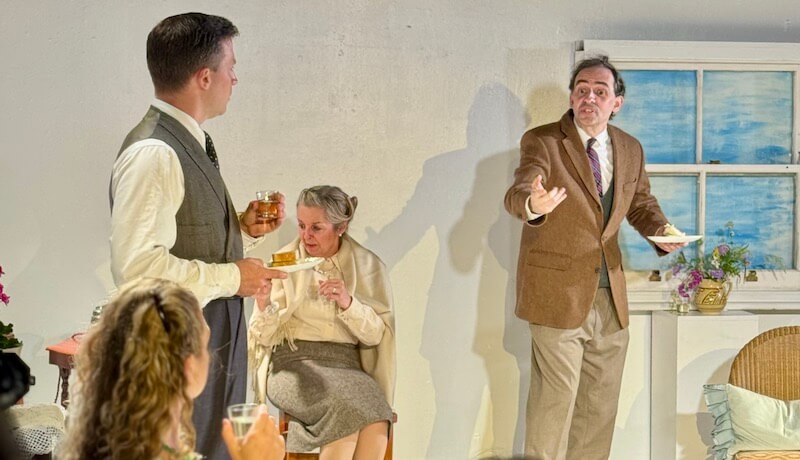
From the moment one settles into the White Bear’s rather intimate embrace, the scene is set with exquisite precision. A cube of a room is painted white with a simple set of antique furniture and a window in the wall, the sound of birds chirping. It is instantly clear this is the parlour of a rural country house. What is truly charming about this cosy theatre is that, as the space is limited to three rows of seats per side, the audience is bathed in performance light, allowing one to see the collective enjoyment, and the laughter resonates.
The play opens with Freddie and his wife, Caroline, sitting in the parlour and quickly sets the scene of strained domestic bliss as Caroline attempts conversation with her husband, who merely grunts replies from behind his newspaper. Her increasing exasperation is palpable, her bemoaning their lack of a radio is quite telling.
The arrival of Caroline’s sister and her new beau set for a fascinating exploration of characters from different eras against the backdrop of a rapidly changing Britain. There is a lovely line from Caroline in which she states that her husband is late Victorian, whilst she is early Edwardian. The younger couple, clearly more Bright Young Things down from London, exude liberating freedom in their sexual attitudes, their work and matters of domesticity. They spark a yearning for romance in Caroline and prompt both women to reflect on themes of domesticity and discontent, the social constraints placed upon upper-middle-class women and their limited agency in managing servants.
Becky Lumb breathes life into the character of Caroline with a truly commanding and endearing performance, embodying the character’s frustration with remarkable conviction. Jonathan Henwood, however, plays her husband with rather dismissive grumpiness. If he were to demonstrate a more wry dullness, a subtle weariness perhaps, it may better serve the play’s flow and inherent wit. The chemistry between the characters, at times, regrettably disrupts the overall rhythm, too. The pivotal moment of the play, where Caroline comes close to kissing Owen, her sister’s boyfriend, played otherwise convincingly by Jonathan Davenport, somehow lacks the sexual tension this moment desperately demands.
The relationship between Owen and Jill, played charismatically by Rebecca Pickering, really brings to life the feeling of freedom, of new possibilities and ways of living life felt by the younger couple. This stands in stark contrast to the rather dispiriting drudgery of Caroline’s existence, who, sadly, doesn’t even get to interact with her own sons, shipped off to public school to be moulded into miniature versions of their father. Caroline’s only other interactions come with her servants and, with her ageing parlourmaid, played deadpan straight for perfectly judged laughs by Pat Holden.
Originally, as was normal for the times, this was a three-act play clocking in at 90 minutes. The 20-minute interval means the final act feels very short. This raises the question of whether the flow of the play may be improved by simply removing the intermission altogether, as seems to be the modern trend for plays of this length. This would afford the audience more time to reflect and contemplate the evolving roles and expectations of women over the past century.
Runs until 12 July 2025
