

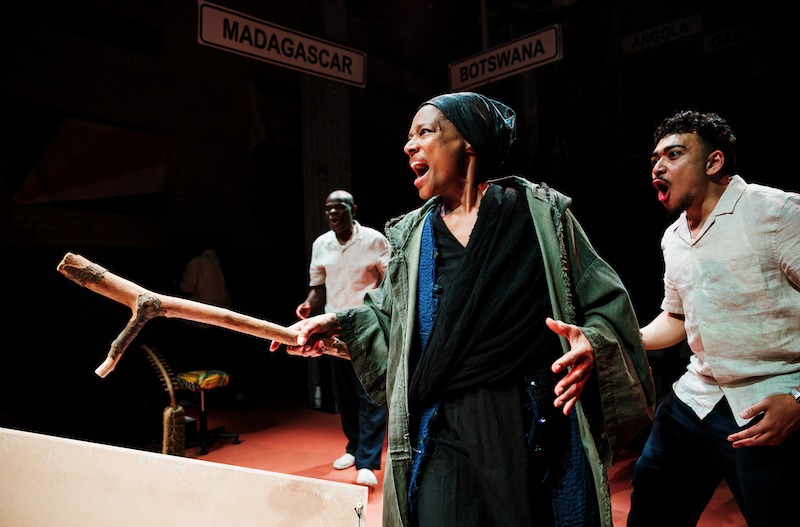
Writer and Director: Femi Elufowoju Jr
It is not what was taken that matters, it is what remains: the closing lines of Femi Elufowoju Jr’s first published play 54.60 Africa, which is an odyssey of identity based on a real journey undertaken by the author to visit all 54 countries on the continent before his own 60th birthday and the equivalent anniversary of Ghana’s foundation. The resulting drama, premiering at the Arcola Theatre, mixes music, dance and conversations in an anthology of encounters that give a flavour of identity, heritage and possibility, if only a sketchy impression of individual locations.
Inspired by Yaa Africa – a symbol of resistance-cum-Mother-Earth figure – (Suzette Llewellyn) to understand what future exists for Africa as both an important international force and a place of meaning and culture, she gives 11 representatives, all badged as ‘Africa’, seven days to visit all 54 nations and collect evidence of potential. Divvying up the visits amongst themselves based on their backgrounds and interests, these wide-ranging embodiments of Africa meet fascinating people in every location.
Elufowoju Jr’s play is a mix of narrated reflections and acted scenes, capturing the vast array of impressions and interactions he had in this biographical journey, which skips through a choice selection of those 54 places in around two hours, including an interval. The emphasis on Elufowoju Jr’s own experience is also sharpened by the playwright subbing in for an unwell actor at the Press performance, reading his own words about the people he met along the way.
And those experiences are highly varied, some welcoming and sensory, others a little more dangerous, with each act containing at least one moment of jeopardy. These are the places where the narrative finds distinction, as Africa 8 (Funlola Olufunwa) describes a potential carjacking in Cameroon as balaclava-covered faces emerge from the trees, while later in the bus heading towards Libya, Africa 2 (the writer) encounters some aggressive fellow passengers who resent his presence. Here, the writing has edge and tension that contrasts well with the more positive activities elsewhere.
But these impressions of Cameroon, Tunisia and the numerous other places dramatised, by necessity, are fleeting and singular. The concept of 54.60 Africa offering a collective picture of a vibrant and highly diverse land mass means each area is reduced to a single characteristic. Likewise, the value of these individual conversations is variable as the 11 Africas meet soldiers and electrical shop owners, passport control officers and a stranger in line for food, all of whom offer brief conversation but offer less traction as separate scenes than as a collective impression.
There is enough information included here – and presumably not included here – to fill a memoir, but for drama, the through lines need to be stronger. Elufowoju Jr occasionally reflects on his Britishness, the lack of distinction between Caribbean and African heritage made in the UK and his home in London, but understanding how his African identity is developed during his travels is a strong basis for evolving the piece. It is full of music, largely performed by The Ganda Boys, Denis Mugagga and Daniel Sewagudde, as well as dance that liven the pace but 54.60 Africa could reflect more on the process of bringing all 54 of those countries back to the Arcola and what that might mean for the identities that the author sees for himself as a result.
Runs until 12 July 2025
