

Writers: Billy Barrett and Ellice Stevens
Director: Billy Barrett
Music: Frew
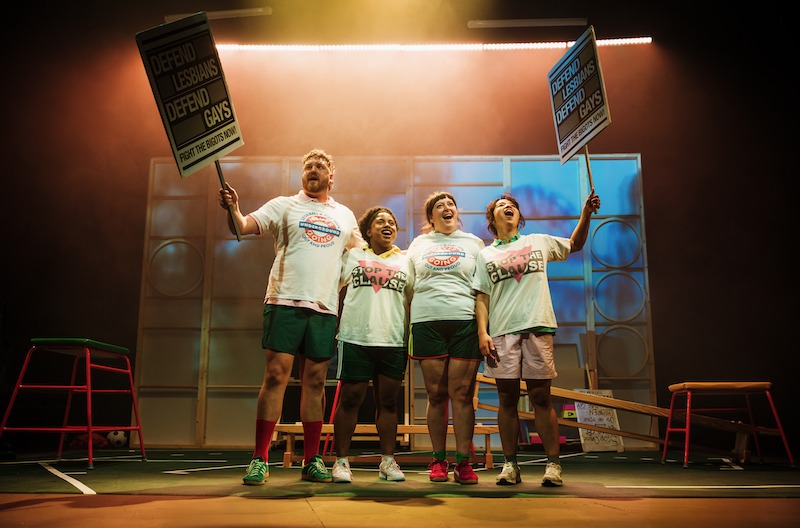
One of Thatcher’s many legacies was the homophobic Section 28, sometimes referred to as Clause 28. The 1988 ruling forbade local boroughs from promoting homosexuality and stopped schools from discussing homosexuality as a ‘pretended family relationship’. Coming in the middle of the AIDS crisis, Thatcher’s government truly kicked the LGBTQIA+ community when it was down. But the ruling also brought the community together, and this aspect is at the heart of the verbatim musical After The Act, returning to London after several successful tours.
It begins with one of the most thrilling nonviolent direct actions in British history: the ‘lesbian invasion’ of the BBC Six O’Clock News. Handcuffing themselves to the news desk as Sue Lawley is about to deliver the news on live TV, two protestors managed to shout ‘Stop Section 28’ a few times before co-anchor Nicholas Witchell put his hand over one woman’s mouth to muffle her yells. Famously, a calm Lawley continued to read the headlines. By 10pm, the BBC news was the news.
Using the testimonies of the protestors, and then, teachers and pupils, affected by the new law, Billy Barrett and Ellice Stevens’ show is, at times, a little ramshackle with the four actors always busy doing something on stage. It’s mostly played for laughs, too, which can be initially frustrating. It’s possible that a more traditional retelling of the politics behind Thatcher’s policy could elicit a more emotional response from the audience.
However, the slightly cheesy approach eventually makes sense. The protests were engineered by ordinary queer people and Section 28 affected ordinary queer students who were seeking support either through books or from their teachers. If this production were too polished or too glitzy, it would somehow work against its representation of a grassroots movement.
Never have four actors worked so hard. Nkara Stephenson has to skip with a rope when he tells one of the testimonies, while writer Stevens gives us a campy Thatcher. Ericka Posadas and Zachary Willis are extraordinarily talented in embodying various characters related to the story, such as Posadas’s Haringey librarian who endorsed the controversial book Jenny Lives with Eric and Martin, and Willis’s Ian, a pupil who contemplated suicide while at school.
Frew’s music, performed live on stage, is a selection of poppy songs, with the highlights Roll The Dice and Thatcher’s song Cheated. Some of the songs are quite clever, too, with each performer singing different words over the music, but when this happens, it often means that most of the lyrics get lost. Still, the many “Stop Section 28”s that punctuate the final rousing number are plain to hear.
After The Act may not be the best way to explore the controversy of Section 28, but it’s certainly one way to tell the story. And even though it’s nearly 40 years since the law and over 20 since its repeal, its resonance with the way trans people are treated by Parliament in the current day is, sadly, too easy to see.
This won’t be the only gay historical musical we will see in the near future, as the National Theatre plans to turn hit movie Pride, about Lesbians and Gays Support the Miners, into a musical. It’s heartening that these important events are being presented on West End stages, but let’s hope that not all of queer British history is reduced to a musical.
Runs until 14 June 2024
