

Director: David Bickerstaff
Choreographed by: David Bickerstaff and Phil Grabsky
In covering the biggest names of the art world, the risk is in rehashing old ground. With Michelangelo, safely holding his spot in art’s top tier, the challenge is to get us to look at the sculptor, painter, architect and poet from a new perspective. In the Exhibition On Screen documentary, Michelangelo – Love and Death, we are given a panoramic view that goes beyond his greatest hits.
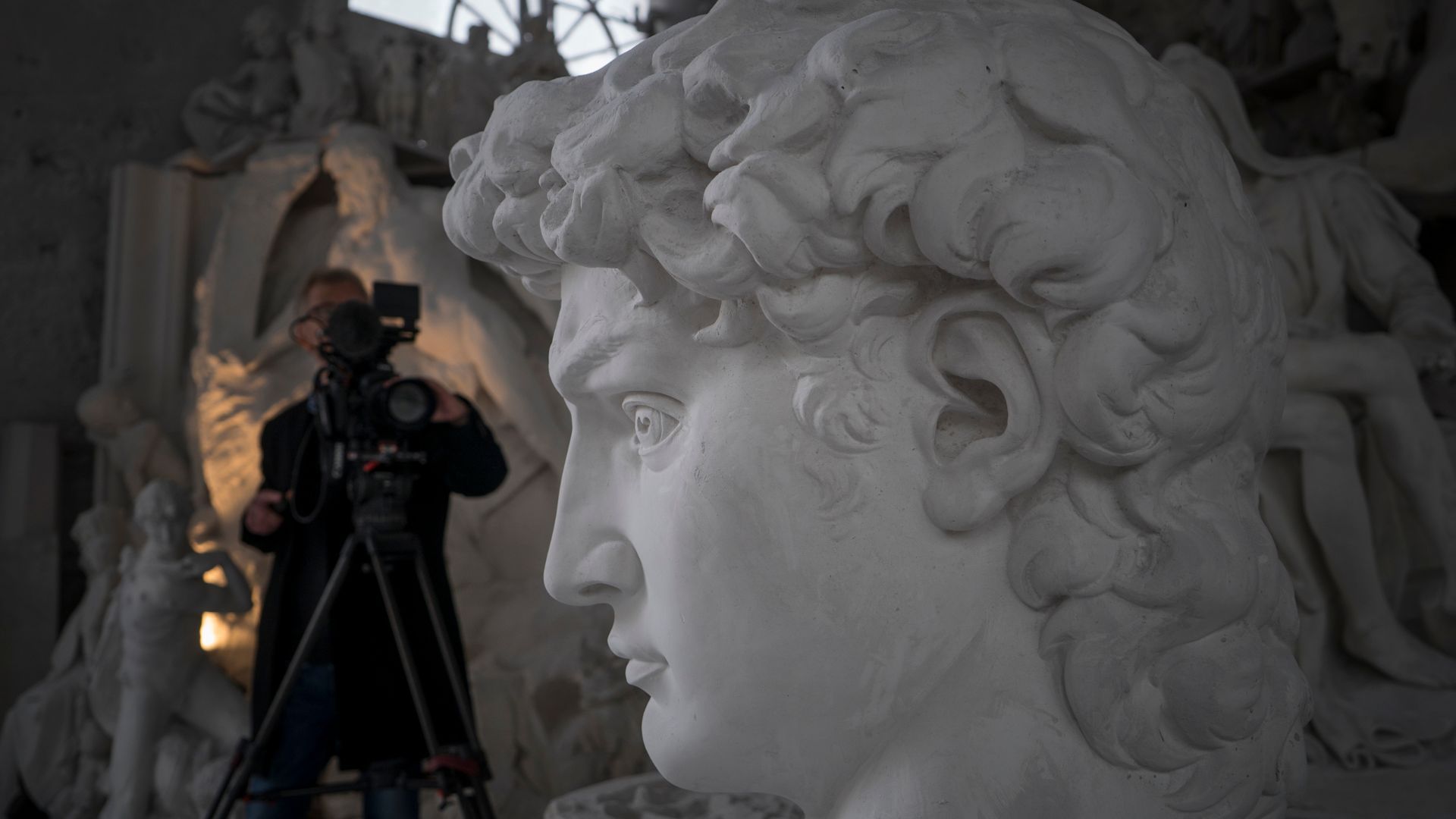
To be fair, the hits are pretty massive. The sculptures speak of monumentality. But the EOS camera work, lingering on Michelangelo’s David doesn’t just convey size. Focusing in on a gently curled hand, a foot steadying its stance, it is in the details that Michelangelo creates the story. The coolness of the sublime male physique suddenly gives way to a youth, readying himself for an unfair fight. We see this again in Bacchus – Michelangelo’s interpretation of the mythical god goes way further than liking a drop of wine. The unsettling, vacant stare of the statue is Bacchus now completely untethered from reality. It reiterates the point that Michelangelo’s genius was more than his astonishing technical skill. His portrayal of emotion is what separated him from his peers.
Michelangelo makes the familiar point about his sexuality: in his Pieta, even in death, there is a solemn beauty in the Christ figure, cradled in his mother’s lap. But the documentary looks deeper into Michelangelo’s interest in anatomy. Interviewing Peter Abrahams (Professor Emeritus of Clinical Anatomy, Warwick Medical School), Abrahams asserts that both Michelangelo and Leonardo da Vinci were years ahead of the medical profession, in their examination of dissected bodies. This wasn’t prurience, but a desire for knowledge. We look at a commissioned drawing, The Fall of Phaeton, and the doomed son of Apollo, falling to Earth, taps into themes of hubris. It was a warning for Michelangelo himself. Even in his 70’s, he was still working on multiple projects. In The Last Judgement, Michelangelo paints himself as the flayed skin of St. Bartholomew. He’s exhausted and nearly spent.
But there is still more. Critic Jonathan Jones places Michelangelo’s poetry not as an aside, but within the context of the early Renaissance. Author Martin Gayford notes how, during the 1530 siege of Florence, Michelangelo was tasked with fortifying the city. The documentary alludes to Giorgio Vasari’s friendship with Michelangelo. The art historian, while having the advantage of great contacts, embellished when facts failed to provide a good story. Vasari, voiced by Laurence Kennedy, is suitably gossipy in tone. It’s a neat touch that really brings the era to life.
It is these surprising moments that bolster the documentary. Michelangelo – Love and Death gets us thinking about the artist in a more rounded, considered way. What we get is a clearer understanding of the man: his interpretive skill is equal to his techniques; there is a sensitivity to dark, difficult subjects that feels modern. In looking at his reputation, piece by piece, the monumentality still stands, because we now appreciate what it took to build it.
Michelangelo – Love and Death comes to cinemas nationwide on 20 May 2025.
