

Writer: Sam John
Director: Annabel Lisk
Joseph’s definition of being a man depends on being able to tell a heroic and daring tale of hunting prowess and while the reality of killing another creature may be less palatable, he clings to the year-long celebration in his honour that he knows will be the outcome of his success. Sam John’s new play Joseph and the Stag, playing at the Hen & Chickens Theatre, takes the style of Victorian melodrama to explore two forms of masculinity colliding as Joseph tries to live up to the reputation of his father.
This 60-minute play is structured around three distinct phases, and as the story unfolds, its purpose becomes increasingly opaque when the styles and themes start to clash. The first segment is the strongest, the encumbered Joseph (played by John) arriving through the storm, lugging what we are told is a hefty dead stag as proof of his manliness. Here, in a first-person narrative common to Boys’ Own adventures and mid-nineteenth-century detective fiction, there is a pace to the unfolding story as Joseph first comes to accept that he has finally achieved this significant aim and then, speaking to the dead animal, recounts the exciting story of its capture.
And all of this is entwined with the overlaid expectations of proven male behaviour, frequently drawing on his father’s reputation as a hunter and comparing his own experience of the adventure with his parents, along with how he should carve and display the creature – activities Joseph struggles to complete. This part of the play has most to say about inherited ideals and intergenerational shaping of gender norms that challenge Joseph’s concept of who he is, should be and actually wants to be, so it is a shame that this discussion doesn’t continue through the rest of the piece.
In the second part of the play, Joseph recounts falling in love with a local girl called Emily and being welcomed into her family. It allows him to talk of his performing arts dream, making a different kind of man to his father, but the illusion is too thin and her presence makes little difference to the overall story, while the final section is all supernatural visitations by a wandering spirit of the stag that haunt him but again offers very little conclusion.
It seems like a missed opportunity not to play with the audience’s expectations of what’s in the cumbersome wrapping that Joseph has circled around, and some ambiguity would present more opportunities for extending the narrative, better integrating the supernatural scenes into the play. The package could indeed be a stag precipitating Joseph’s breakdown, but it could also be a figment of his imagination, triggered by his mental collapse or even another creature entirely, a helpful opportunity to resolve his relationship with his father.
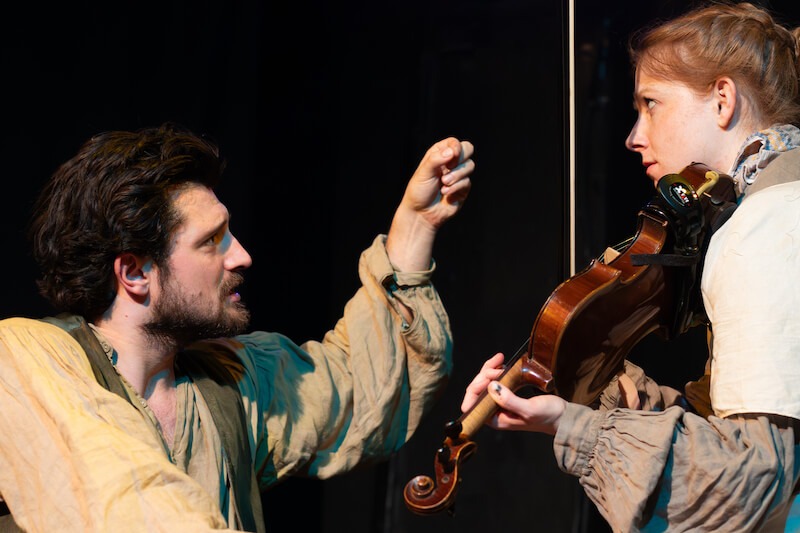
There is a real range of promising ideas here, including Lucinda Freeburn’s violin performance used to great effect to animate the hunting stories and the response of the woodland creatures, but this sits alongside unnecessary slapstick as Joseph urinates, defecates and vomits into separate buckets, inevitably mixing them up for a pointless gross-out moment. If this is the story of how a son is driven to distraction by his father’s expectations, even in his absence, the character needs to have a stronger presence in the drama, helping to limit the ways Joseph is allowed to be a man.
Runs until 10 May 2025
