

In the 1978 film Satyam Shivam Sundaram (“Truth, Divinity, Beauty”), actress Zeenat Aman plays Roopa, a devotee at a local Hindu temple, with a scar on her cheek and neck from a childhood accident. When handsome engineer Rajeev (Shashi Kapoor) arrives in town, she keeps her scarring hidden from him because he abhors anything ugly.
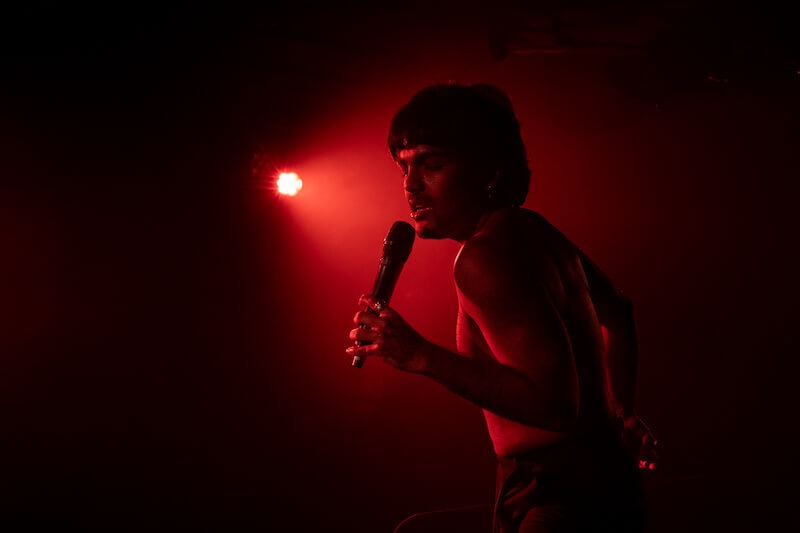
Queer cabaret artist Shafeeq Shajahan delves into the film’s themes and how they have played out in the lives of his mother (who loves the film) and himself. In collaboration with Cypriot composer and keyboardist Vasilis Konstantinides, he constructs a musical journey through the three stories, examining the scars in his own life.
The result is a tightly scripted cabaret that mixes Hindi, Greek and English-language songs with a story about Shajahan’s sexual awakening. Weaving his way through the three themes of the 1978 film’s titles, He uses looped clips from the film – large-screen GIFs that make the movie’s exaggeratedly melodramatic performances seem almost comical – as a backdrop to talk about the film’s darknesses. Rajeev marries Roopa without ever seeing his bride’s full face, and when he does, he rejects her. As she seeks revenge, a storm ravages the village, destroying the dam that was engineer Rajeev’s pride and joy.
The second half of the film’s plot is more convoluted than Shajahan suggests, but his simplified version does play into his own thoughts and struggles, which is the true focus of the piece. He has his own Rajeevs, who have rejected him because of his battle scars. That sensation of being rejected because of a part of oneself that one can never remove is a feeling borne by so many people, especially those in the LGBTQ+ community; even more so with those who straddle many intersectional minorities. With every rejection, the scars burn.
This is reflected well, and with great humour, by Shajahan, whose ebullience is nicely contrasted by Konstantinides’s deadpan qualities. Sections where the pair slip into a metatextual mode, attempting to deconstruct Shajahan’s reasons for constructing this cabaret or placing him at the centre of a story in which both the fictional Roopa and his mother had their own scars, are less successful, suggesting a lack of confidence in the strength of the general conceit.
Take away the postmodernism, and Shajahan’s simple message would be all the stronger. The vocal numbers, the cheekiness of the central performance, and the recitation of a letter from his mother that reiterates a simple, fundamental truth – we love who we love because of their scars, not in spite of them, and it is up to us to accept that love from them and ourselves – is enough.
Continues until 5 April 2025
