

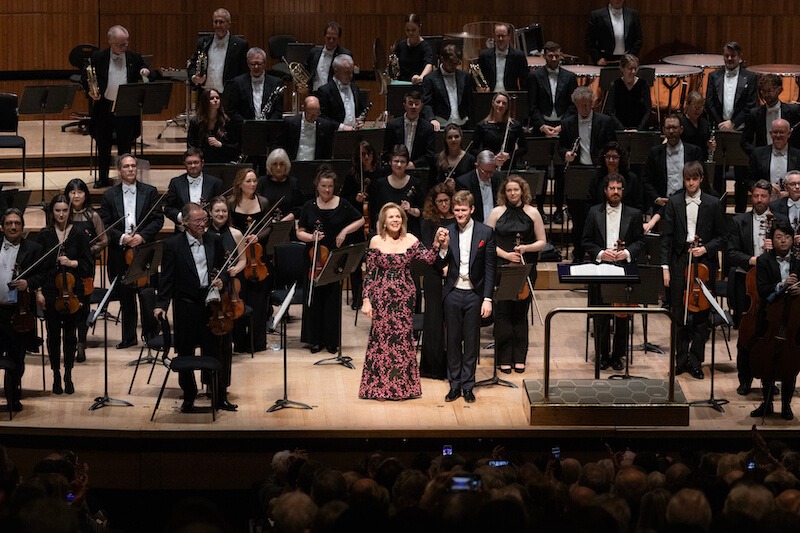
Conductor: Thomas Guggeis
Soprano: Renée Fleming
Thomas Guggeis makes his conducting debut with the London Philharmonic Orchestra in this rich programme of romantic and late romantic German music. At its heart is Renée Fleming’s glorious account of Strauss, Four Last Songs, bookended by evergreen Wagner favourites: the Prelude and Liebestod from Tristan und Isolde, the Overture and Venusberg music from Tannhäuser, the Prelude to Act 1 of Lohengrin and the Overture to Die Meistersinger von Nürnberg.
The LPO clearly adores the Wagner, leaning into every changing mood of the opening. With its dazzling palette of sweeping crescendos of the strings, the sweet lyricism of the woodwind and sections of urgency, delivered forcefully by brass and timpani, the music creates a sense of intense, exquisite desire. Wagner himself wrote to Liszt in 1855 ‘ I intend raising a monument to that most beautiful of dreams, in which love shall, for once, be utterly fulfilled’.
Richard Strauss’s Four Last Songs (1946-48) create a very different mood. Written, as the posthumously applied title suggests, at the end of his life, they are calm, contended meditations on a life fulfilled. There is no fear of death; rather a peaceful acceptance of the end. Renée Fleming understands like no other singer every nuance of the four poems, Hermann Hesse’s Frühling, September and Beim Schlafengehen, and Joseph von Eichendorff’s Im Abendrot. With her wonderfully creamy voice, she captures afresh the gently melancholic undertow to these songs of gentle celebration of life’s richness. She gives particular poignancy to the image of the two skylarks soaring at the end of Im Abendrot, as, in Michael Hamburger’s translation, ‘dusk comes the vales exploring, the darkling air grows still.’
It was a pity in this performance, however, that Guggeis doesn’t always get the balance between orchestra and soloist quite right, his enthusiasm for the the orchestra occasionally allowing it to overpower Fleming’s naturally rich and full voice. This is particularly so in Frühling and September where it was sometimes hard to hear the ends of her phrases. Fortunately, there is a subtle adjustment for the second two songs and the full glory of Fleming’s voice shines through.
Guggeis is in his element in the second, all Wagner half of the concert, encouraging the orchestra to deliver the lushness of the Overture and Venusberg music from Tannhäuser, the thrills of his Prelude to Act 1 of Lohengrin and his delightfully exuberant Overture from Die Meistersinger. One of the joys of attending a live concert is getting the flavour of the whole orchestral range, and being able to note the contributions of the strong horn section, under principal John Ryan, the trumpets, under Paul Beniton and trombones and tuba.
A rich programme and a real treat to hear Renée Fleming.
Reviewed on 5 March 2025
