

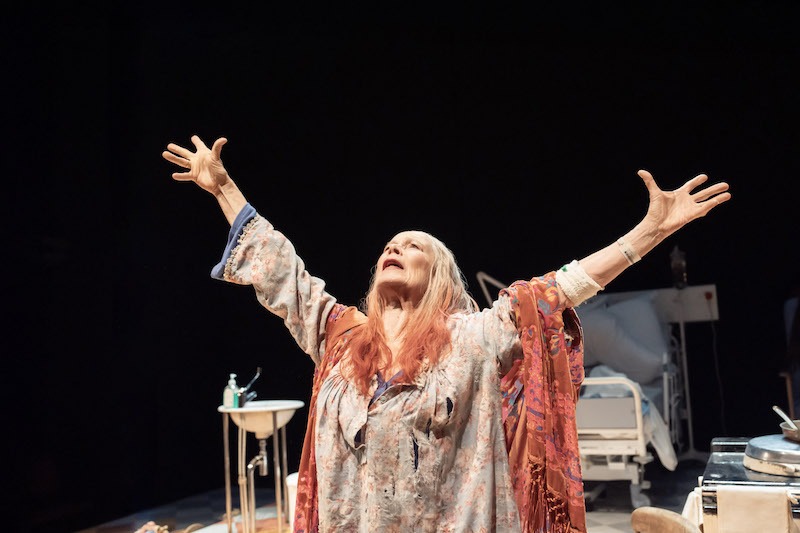
Writer and Director: Anna Mackmin
As a mother-daughter combination, the acting prowess of Celia Imrie and Tamsin Greig ought to be unbeatable. In Anna Mackmin’s Backstroke, though, even they struggle.
Mackmin’s story is of a codependent relationship that is put to the ultimate test when Imrie’s Beth, who already has dementia, is hospitalised after a stroke. Her daughter Bo (Greig) struggles to communicate her mother’s wishes to the consultant and nurses, partly due to Beth not having written any advanced care directive. Bo’s inarticulacy about what her mother has previously expressed results in concerns being dismissed and misinterpreted by the hospital staff.
These scenes, in which Imrie is largely immobile, alternate with flashbacks where she is a much livelier Bohemian artist whose unconventional manner causes constant friction with Greig’s Bo. These scenes allow Imrie to grapple with Beth’s eccentricities, creating a character who is as charismatic as she is infuriating. In contrast, Bo remains elusive in these scenes: mostly grumpy and resentful at ages six to 50.
Occasional flashes of video imagery on the Donmar’s back wall show fleeting glimpses of lives past and present. These include references to Bo’s adoption of a traumatised young girl whose PTSD is causing Bo to struggle already, even before her mother’s hospitalisation. However, this aspect of Bo’s story is so underserved that it distracts from, rather than illuminates, Mackmin’s character study.
Only by the end of Act II do we start to see any expression of love between the two characters. Flashbacks with an older Bo see the seeds of an affectionate, adult relationship between mother and daughter, while in a swimming lesson scene, Greig now playing a six-year-old version of her character, demonstrates that beneath Beth’s eccentric narcissism she is capable of loving and supporting her daughter.
However, elsewhere, Mackmin’s tale is weighed down by its choppy structure, overly cluttered set, and characterisations that rely upon the two central performances to provide depth that feels missing from their dialogue alone.
That does not mean Backstroke is unmoving; it sometimes elicits powerful emotion. But more generally, it feels inauthentic. Greig closes the show with a list of things Bo’s mother taught her: for a few bright, short minutes, the play comes alight with the sort of love and character it otherwise lacks.
Continues until 12 April 2025
