

Writer: Chris Bush
Director: Ann Yee
Chris Bush’s Otherland opens with the marriage of Jo and Harry but, after a brief race through what looks like the most enjoyably raucous of wedding receptions, quickly skips ahead to their breakup.
We quickly discover that Harry, who came out as trans to Jo not long after they started dating, is now beginning the journey to fully transition to everybody else. The tensions arising from that have fuelled Jo’s decision to separate. While she initially said she was fine with Harry’s identity, and despite being mostly attracted to women anyway, Harry’s journey is not one that Jo can share.
But Jade Anouka’s Jo is not one of the “trans widows” so beloved of this country’s mainstream newspapers. Their split is as amicable as a painful divorce can be, and she is changing herself: on a quest to unplug from the modern world, she takes herself onto Peru’s Inca trail. She also has the contraceptive implant she has had since she was 15 removed, wanting to know what the adult Jo is like when drugs aren’t pumped into her system.
Throughout the first act, little acts in Jo’s life are contrasted succinctly with the steps Harry (Fizz Sinclair) takes on her transition journey. We see micro-aggressions at work, from well-meaning suggestions from an HR manager who seems to prioritise Harry’s work colleagues over her own professional life to adverse reactions when she attends a work conference. Most heartbreakingly, phone conversations with her mother Elaine (Jackie Clune) about attending a family wedding seem to carry a message of acceptance – until it is clear that the invitation to “come as you are” is extended not to Harry in the present tense, but to the man she has long since left behind.
With a heavy hand on the pen, this could become a heavy issues-led play, too worthy for its own good. For Bush, though, while this is her most personal work yet, it neatly sidesteps any impression of being the Big Trans Play™ she writes of in her programme notes. With Jo also undergoing significant upheavals in her life, the parallel stories ground each other.
Coming out as trans is a significant change for Harry and has its upheavals – for example, to get a passport with her correct gender marker, she requires a doctor’s letter. Even after navigating the horrendously long waiting lists, the requirements for getting the letter include conforming to a stereotype of femininity that many women reject (why should it matter if you turn up to a doctor’s appointment in jeans or a floral dress, with painted nails or without). But Jo, too, is transforming: from a married woman to a single and independent lesbian – and then, with the introduction of Amanda Wilkin’s boisterous Gabby, a happily coupled-up woman who is suddenly thrust into a role of motherhood she has always said she didn’t want.
This exploration of how women constantly transform themselves, either to please themselves or through external pressures, helps those of us who aren’t trans to see Harry’s journey for what it is: just one different way to walk through life. Indeed, it’s only when Act II opens with Jo and Harry cast in allegorical versions of themselves that the play seems heavy-handed in its messaging.
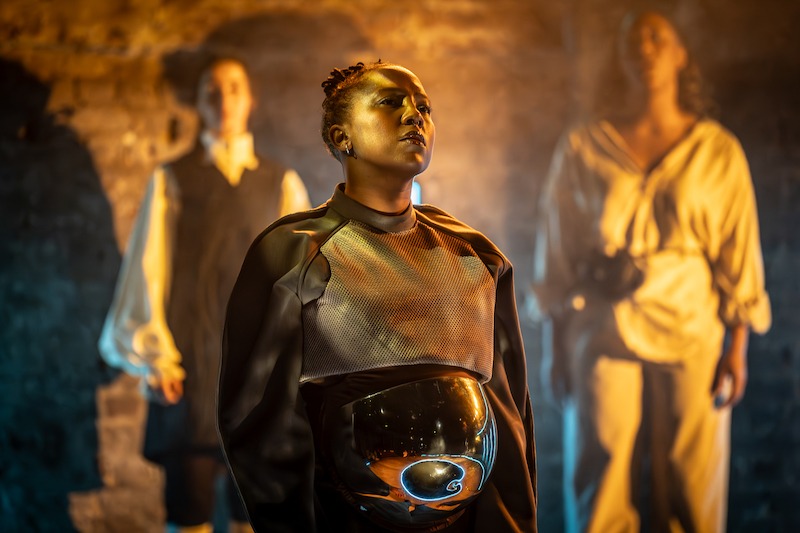
In these fantasy versions, Harry is a beautiful mercreature adapting to life on land; captured by a Victorian scientist, she is poked, prodded and paraded around, treated as a curio rather than an individual. For Jo, her story veers into the far future, where she is an android whose sole role is carrying Gabby’s baby and is not permitted much of a personality beyond that.
These sequences contrast with the realities presented in the first act and help illuminate how we treat women, both cis and trans, with the pressure to conform and behave in particular ways. But throughout them, one yearns for Bush’s simple honesty in Act I, to explore the journeys of her characters with the same forthrightness, humour, and heartache.
The team of four supporting actors, who pop in to narrate, Greek chorus-style, in both elevated poesy and song (accompanied by composer and musical director Jennifer Whyte’s three-person band), help to give the script the same sort of heightened form that made Bush’s book for Standing at the Sky’s Edge so enjoyable.
So yes, even with misgivings about the fantasy diversions, Otherland remains a significant work. It lays out the experience of trans women without denying the pressures felt by many about what being a woman really is (discussions about whether Harry could, or should, join a women’s march underlying the point without bludgeoning us with it). Bush successfully avoids the pigeonhole of the Big Trans Play™, but at the same time, that is what she has created. Otherland is not a “worthy” piece – what it is instead is worthwhile, moving, and very much needed.
Continues until 15 March 2025
