

Writer: Anya Ostrovskaia
There are three points in the twentieth century at which writer Stefan Zweig believes he should have intervened to save the world, and Anya Ostrovskaia organises her stage adaptation of Zweig’s memoir The World of Yesterday around these lost moments – the period just before the Great War, the 1918 Armistice and the start of World War Two. But Ostrovskaia’s self-styled cabaret is overly focused on recounting the known history of Europe in these years and, despite having three actors in the leading role, spends too little time on Zweig’s biography and what he thinks he could have done to prevent it all.
Stefan Zweig is recounting the events of his life for an audience, from early essays published in an Austrian newspaper to becoming a renowned inter-war writer and being made ‘stateless’ by Hitler’s election in the 1930s. As Europe becomes more fractured, the disintegrating certainties and community that Zweig once enjoyed leave him in despair, and fearing persecution, he flees Austria for good.
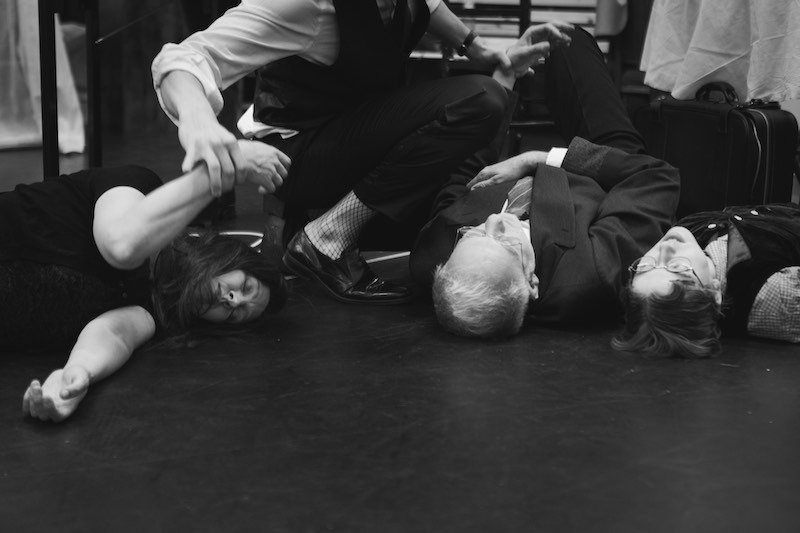
Running for only two performances, The World of Yesterday feels a little under-rehearsed in the Camden People’s Theatre space, with sometimes large gaps as props and visual aids are shuffled into place, or hesitant actors become entangled with the overly produced vision. There are too many performers for the number of roles and small stage, making it harder to keep track of the different strands of activity, while attention to detail is sometimes a little shaky – including having a First World War Austrian soldier sing a distinctly British musical hall and then wartime song.
As well as having three versions of Zweig at different points in his life, all narrating in the first person, Ostrovskaia also includes a surfeit of techniques including acted scenes and dramatisations, songs, voiceover, visual aids, use of microphones at different points of the performance, an overhead projector with many transparencies, props including a child’s railway track and excerpts from Zweig’s writing in spoken and printed form.
This ultimately distracts from understanding Zweig’s importance to this period of history and how it shaped his writing. Very small images of book covers are shown on screen, but this piece doesn’t move beyond telling the audience the history of the early twentieth century rather than examining that from Zweig’s perspective, drawing out the associated meaning of this context for the direction of his fiction and historical biography. Ostrovskaia is too distracted by the methods of storytelling to focus more specifically on Zweig’s personal story and his contribution.
To become a cabaret in the true sense, The World of Yesterday needs to divide itself into clearer ‘turns’ with each chapter of Zweig’s life, giving a distinct performance style and using an Emcee-like character, potentially Zweig himself, to hold the biography in check. Most of the audience will be familiar with the 1914-1945 period, so Ostrovskaia should focus this show on the elements of Zweig’s life they won’t know about and why his writing made him first a celebrated author and then a target. The very earliest cabaret shows were highly political, and this can be too, only sometimes less is more.
Runs until 20 November 2024
