

Writer: Katori Hall
Director: Nathan Powell
Whenever the Reverend Doctor Martin Luther King Junior visited Memphis, as he did in April 1968 to support and march with striking sanitation workers, he lodged at the Lorraine Motel. It would become the place of his murder on April 4. After that, Room 306, where he had been staying, was left unlit and preserved as a memorial to the civil rights leader.
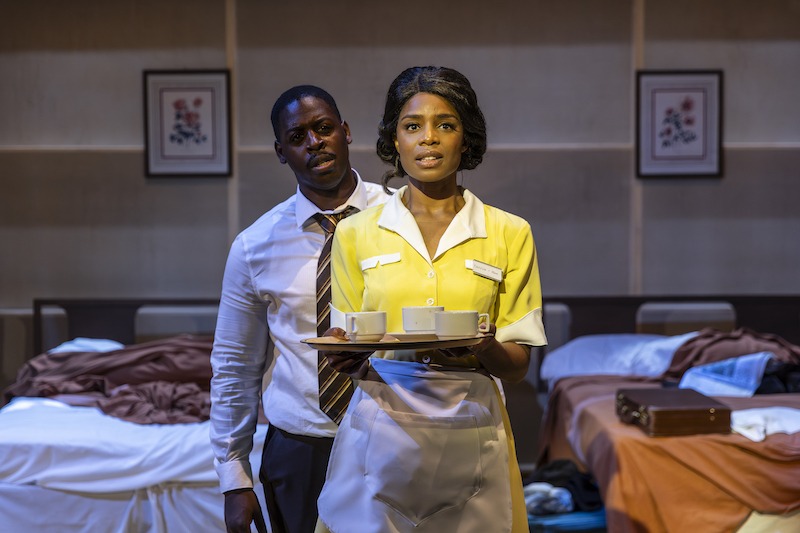
Lulu Tam’s set design for The Mountaintop contains the same sense of preservation, recreating Room 306 for a play set the night before Dr King’s assassination. Katori Hall’s play shows us a man who, having just delivered his “I’ve been to the mountaintop” speech earlier that day, is now working on his next piece of oratory. He is tired, his smelly feet burst from hole-ridden socks – and when a sassy maid arrives to bring him some room service, this married man is extremely flirtatious.
In other words, this is a flawed man despite his exalted status. Ray Strasser-King’s King is proud, passionate and demonstrative; he is also permanently on edge and wary, turning over bedsheets to look for hidden microphones and closing the curtains as soon as he enters. An ongoing storm, however clichéd that may be for driving tension, sets him on edge: every thunderclap sounds like a gunshot.
The man’s more serious nature is tempered by Justina Kehinde’s Camae, the maid who stays longer than she should to smoke, drink and flirt with the closest the motel has to a celebrity guest. There is a lightness to the character that doesn’t always come across in Kehinde’s delivery. Perhaps it’s an artefact of this touring production never settling in one place long enough to know a venue’s acoustic properties, but at times, it feels as if Kehinde is reticent to scale back her performance, lest it be lost at the back of the room.
And that’s a shame because when she and Strasser-King click, it provides an electric current through Hall’s script that demonstrates why the play’s 2009-10 London run deserved its Olivier award. There is, inevitably, an earnestness around some of their conversation, from the ongoing Vietnam War to the death of Malcolm X – who was assassinated three years earlier at the age of 39, the same age as King in the play. But a playfulness is evident, too: as King talks up his plans for a future mass assembly in Washington, DC, Camae playfully scorns the tactics of yet another march.
If the entire play were like that, it would be an overly earnest examination of King’s legacy with rivulets of black humour to offset the certainty of what would be to come. But midway through Hall’s piece, the stakes – and the set – change substantially as The Mountaintop enters magical realist territory. King is made aware that this is his last night on earth; Camae is not a maid but an angel sent by God to prepare him for the moment.
Tam’s set expands and distorts at this point; like King, his fate and his legacy, there is always more to be seen. Snow, rose petals, and even popcorn fall from the skies as Kehinde settles into her true role. If, in the first half of the play, she seemed to be performing rather than living her character, the change in tone does at least allow us to believe intent in that.
This second half asks of King, and of us, what happens when a man who has shouldered the civil rights struggle for so long has to come to terms with being forced to relinquish it. Strasser-King takes us through several stages of King’s grief, from denial and anger to bargaining – literally so, as he cajoles Camae into organising a phone call directly with God.
The humour remains, with Kehinde relishing the chance to play a character whose foreknowledge extends far beyond King’s death to a time when (among other things) phones might be wire-free and portable. That helps the play become a more significant examination of Martin Luther King’s legacy than any straight biographical piece could ever be.
The Lorraine Motel is now the National Civil Rights Museum. Visits conclude with a video of the civil rights challenges, triumphs, and further challenges since Dr King’s death. That is, perhaps, the inspiration for Camae showing King and us a similar montage. In the play’s very first run, this ended with Obama as a figure of hope; today, the images continue onwards, showing footage from the US, UK and around the world, including Nigel Farage mangling a speech from the film Independence Day on the day of the Brexit vote, and video from this year’s riots and attacks on asylum seekers’ residences.
The work goes on. Hall’s work tells us this through a stirring final monologue delivered by Kehinde, which contains all the oratorical poetry for which Martin Luther King was known. He was no saint, just a man; his baton has been dropped, but any one of us can – and should – pick it up.
Continues until 2 November 2024
