

Composer: Giacomo Puccini
Conductor: Alexander Joel
Unable to bring the full productions of Puccini’s mini masterpieces to Oxford, WNO opted to present concert  versions of these three one-act pieces: a bold choice but one that allows the music to fully speak for itself when stripped of the usual theatrical trappings. And whilst there is no doubting the musical excellence of the event, the reduced stage presentation means that some of the dramatic impact risks being lost.
The first opera of the evening, Il tabarro, is a brooding tale of betrayal and loss set on a barge in Paris. A piece that is too often overshadowed by the other two in the triptych, it emerges here with an almost filmic quality from the opening evocation of the flowing river through to the music of a street organ and inexorably onwards to the high drama of the climax.
The singing is of the highest order. Natalya Romaniw shines as Giorgetta using both the darker tones of her chest register and the gleaming upper parts to her voice to great effect. She is well matched by the glowering baritone of Dario Solari and the piercing tenor of Andres Presno.
What feels missing is the cloak of the title. The addition of a single piece of costume would add just a touch of additional theatricality which would aid audience engagement. However, it works as a persuasive introduction to an unjustly maligned opera.
Following this is Suor Angelica – Puccini’s hymn to the female voice – an affecting tale of a nun desperate for news of the infant son she left behind when she was forced by her family to enter holy orders. The stark black stage works well to capture the repressive atmosphere of the convent. However, the decision not to use any costuming means that it feels more like a rehearsal than an actual performance. Given the quality of the acting and singing that does the performers an injustice.
Natalya Romaniw is outstanding in the title role. This is no more true than in the closing minutes of the score where her torment and ultimately rapturous music is delivered with a heartfelt simplicity that it is hard not to be moved to tears.
Many of the roles in all three operas are taken by members of the WNO chorus. And it shows the depth of talent that the company has at its disposal. The chorus is such an integral part of the organisation that it is hard to imagine the future that may see them reduced in size if not completely lost.
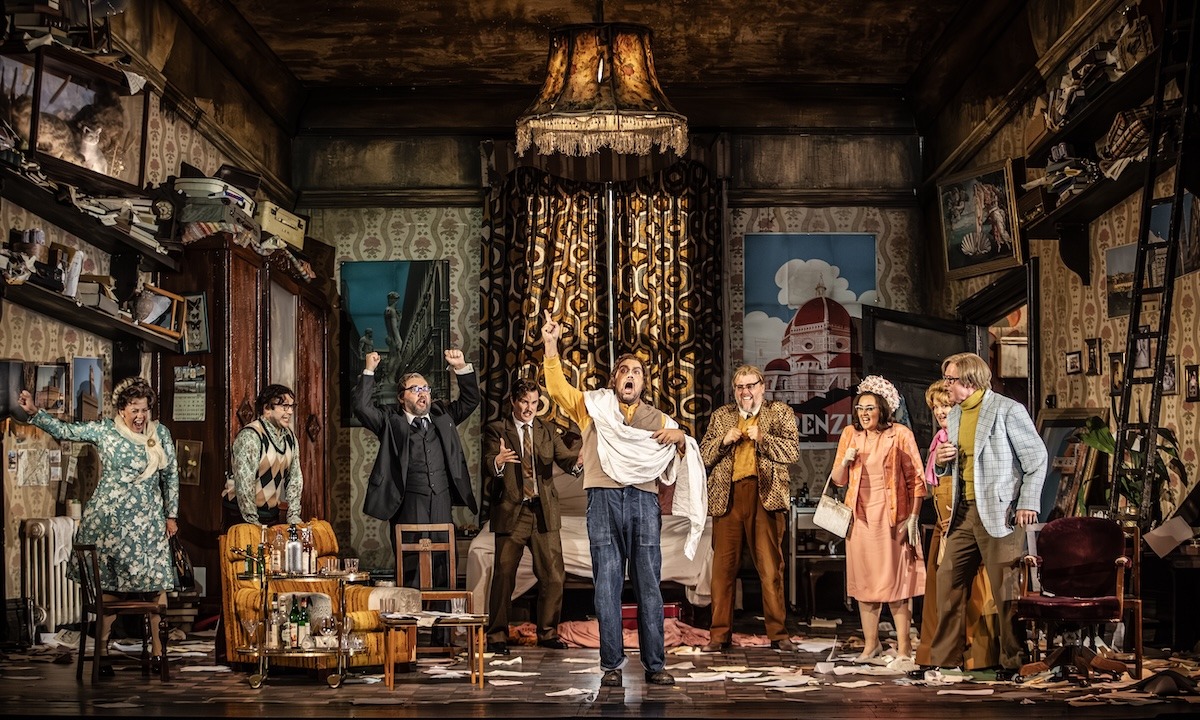
Completing the event is a brilliant rendition of the hilarious farce that is Gianni Schicchi. This riotous comedy is given in a semi-staged format with full props, costumes and furniture. It evokes the world of the 1970s sitcom perfectly and immediately captures the audience with the vitality of the performances.
It is a tale of greed and family disagreements with a neat twist at the end. It makes one wonder why Puccini did not write more comic works as the music is some of his very finest. Of course, it is where one of his most famous arias can be found. O mio babbino caro here emerges as the piece of emotional manipulation that Puccini intended and that is captured beautifully by the bright soprano of Haegee Lee.
The rest of the cast is equally entertaining. Linda Richardson (Nella) is perky and playful whilst Trystan Llyr Griffiths puts his elegant tenor to great use as the ineffectual romantic Rinuccio.
Special mention must go to three long-standing WNO regulars who provide luxury casting in supporting roles through the operas. Mark Le Brocq who set the opera world on fire with his performance in WNO’s recent Death in Venice has huge fun with his roles. Similarly, Yvonne Howard and Anne Mason use their many years of experience on opera stages around the world to bring their contrasting characters to life. Their presence in the cast shows the continued quality of WNO as a home for talented singers to give of their best.
Holding the entire event together is the alert and nuanced conducting of Alexander Joel. He relishes every shifting moment of these very different scores and helps both instrumentalists and singers express the detail of the music from a fresh perspective. The music really is the star of the show here – which is what you want from a concert.
However, the decision to only deploy props and costumes in one out of the three operas feels like a mis-step. WNO has these elements to hand from the full productions seen elsewhere in the season. Given the venue is a theatre, it is understandable if audiences do not fully comprehend the decision not to deploy a little more theatricality as part of the presentation.
WNO continues to deliver performances of the highest musical quality. Whilst not perfect, this concert presentation is a great way to hear Puccini’s music sung by three incredible casts. Let us hope that the future allows for more such opportunities.
Reviewed on 25 October 2024
