

Writers: Ila Firouzabadi, Pirouz Nemati and Matthew Rankin
Director: Matthew Rankin
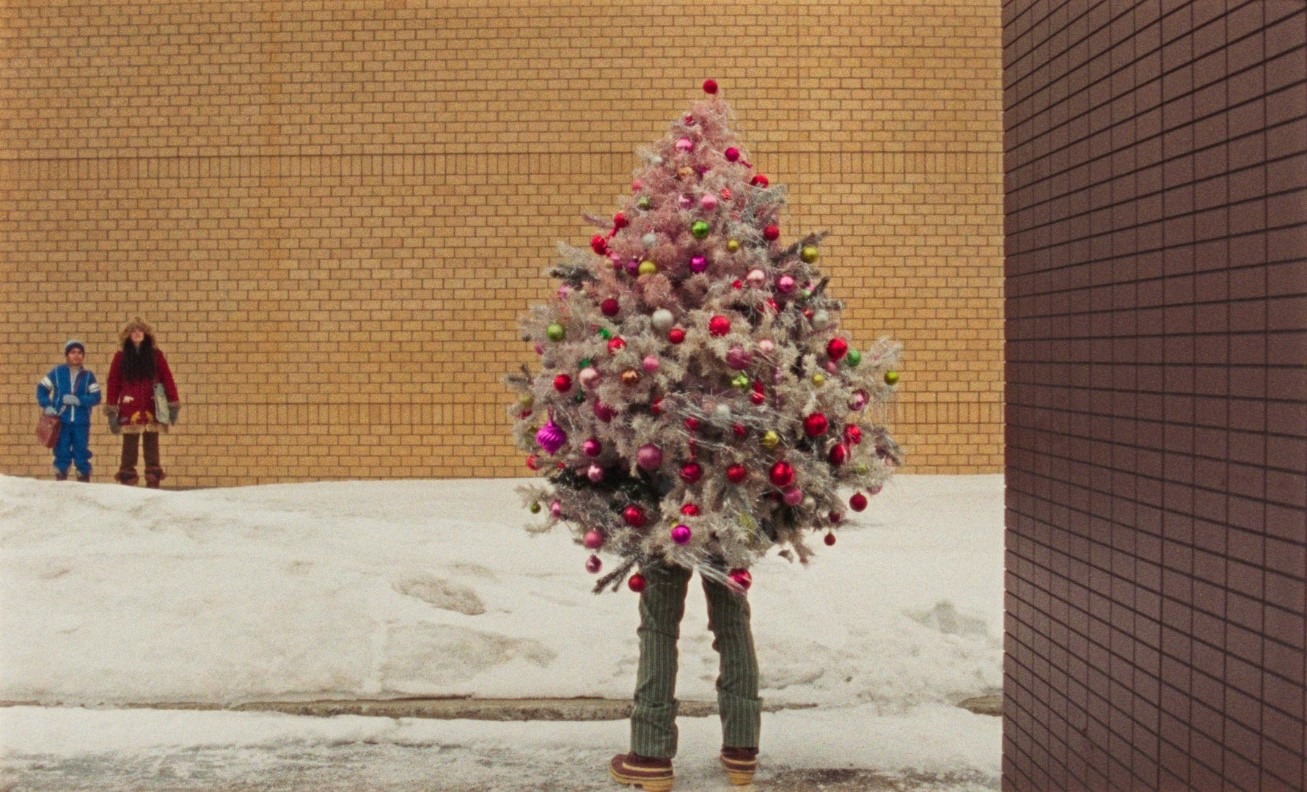
Offbeat may be an overused adjective nowadays, but it’s certainly the best word to describe this Canadian absurdist comedy that reimagines Winnipeg as a kind of suburb of Tehran. Peopled by the oddest residents, the Brutalist landscape is both beautiful and stark. It makes the perfect backdrop to this story of a group of schoolchildren looking for a turkey that has stolen one of their classmate’s glasses.
Until Omid recovers his glasses, school is suspended for everyone. The teacher, at the end of his very short tether, has expelled all his charges. He’s flabbergasted that his pupils think so little of him when he wears an earring. The children have high ambitions, with one boy dressed as Groucho Marx wanting to be a famous comedian when he grows up. Quite rightly, the teacher tells him to stand in the cupboard.
Inspired by Iranian films such as The White Balloon, director Matthew Rankin presents a story where children have to navigate the strange world of adults. So, Universal Language is a homage to Abbas Kiarostami and also to Winnipeg. While the city the children inhabit appears to be one huge industrial site, most crucially the Beige District where the street signs are in Persian and where Iranian stores hide behind shutters, a tour guide leads a group of disgruntled visitors around Winnipeg’s most revered sites. Comically, there’s very little to see. The tourists are asked to marvel at some brickwork decorating a block of flats, the pattern more visible now the annoying tree has been knocked down. “Did anyone famous live here?’ enquires one eager sightseer. “No” is the curt reply.
Meanwhile, another story begins to form about a man leaving Montreal to return to Winnipeg, his home town. He’s not been back for years, and he’s keen to see his mother, who he left in the city. Matthew, played by Rankin himself, cuts a lonely figure trudging through the snow only to discover that his mother now lives somewhere else. He comes across the children who are on a mission to thaw a banknote embedded in thick ice. If they can melt the ice, they will buy Omid a new pair of glasses.
Rankin creates a hidden world that is like no other, where community thrives in a Brutalist dystopia, and as the film progresses, the absurdity becomes woven with a sense of redemptive humanity. These people, despite their eccentricities (the teacher’s exasperation, the tour guide’s zeal for ordinariness), are good people. We could learn a lot from these city dwellers. The film’s surprising ending suggests that we never leave home at all; our ghosts remain even if we depart for a new life, a new city.
However, Universal Language never falls into sentimentality, aided by the acting that always keeps us at a distance. Co-writer Pirouz Nemati is a delight as the tour guide, and if his film career ever falters, he will do well taking tourists around a frozen city, giant ear-muffs on his head, his abrupt manner the biggest-selling point. As he conducts a 30-second silence on the edge of a motorway intersection, you’ll wish you were there, too, in a strange Winnipeg that is ultimately full of heart.
Universal Language is screening at the BFI London Film Festival 2024.
