

Writer: Peter Straughan
Director: Edward Berger
It is surprising that so few of Robert Harris’ political and historical thrillers have been adapted for cinema; we saw Munich with George McKay and Jeremy Irons a few years back, but Edward Berger’s adaption of Conclave at this year’s London Film Festival will surely set more of these page to screen transfers in motion. One of Harris’ most geographically contained novels, the election of a new Pope may not seem an obvious setting for high-stakes drama but Peter Straughan’s highly faithful script proves a gripping two hours.
The Pope is dead and the Conclave must begin, a collection of all the Cardinals tasked with selecting a worthy successor from among their number. Many think themselves suited to the role but Dean Lawrence discovers intrigue, cover-up and irregularity within his peer group, and as the days pass, voting patterns become strained as scandal beckons for several of the front-runners.
Harris’ novel gives equivalent weight to the process of voting with all its grand traditions and ceremonies taking place in gloriously decorated chapels, and the back of house experience, a staid existence of men in a simple hostel who commune in a starkly lit cafeteria. Berger and Straughan mute some of the voting and give most space instead to the various discoveries as Lawrence investigates the Conclave and questions both his motivation for doing so and his faith. That shifting emphasis works well given the repetitive processes involved over multiple ballots and allows Straughan to focus on the human as opposed to the spiritual drama.
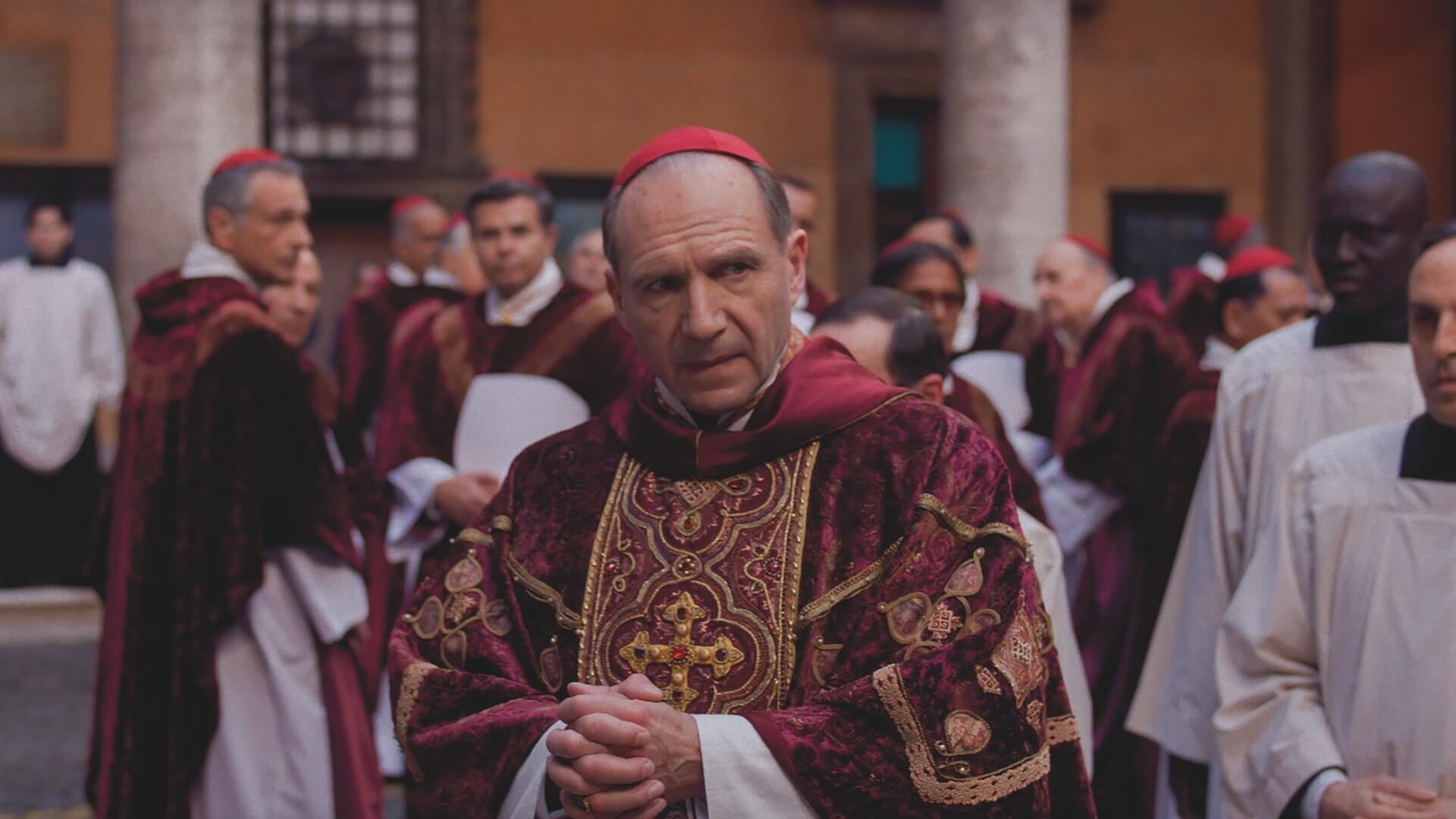
Stéphane Fontaine’s cinematography reflects those two perspectives, the opening sequences washed out and tonally subdued with a focus on the administrative functions of disposing of the former Pope’s body and preparing rooms for the new arrivals. Once the first day of the Conclave begins, Fontaine explodes the screen with colour as the sea of red and white against the backdrop of the Sistine Chapel underscore the significance, and to a degree the pomp, that indicates the action is really beginning – the scene of all the cardinals walking under white umbrellas in the rain is a painterly vision.
The creative team make some slight amendments to the text, substituting the Italian Lomeli for the English Lawrence which makes the film multi-lingual and gives scope for the Italian faction to be represented in the way Harris describes. It also increases the isolation that Lawrence feels as the days wear on and Ralph Fiennes captures that weariness and the confusion of mind that comes from being locked in a room and seeing the mortal weakness of those who wish to lead the church. Speaking Italian, Latin and English, Fiennes’ Lawrence is a man driven by honour but also discovering a courage to act for the greater good, although he never fully knows whether his own earthly ambition is driving his actions rather than God.
With so many characters to cram in, the audience inevitably spends too little time with fine performers Stanley Tucci’s Bellini, a moderate who distrusts his friend Lawrence when it really matters, John Lithgow’s Tremblay whose last interview with the former Pope proves vital, Lucian Msamati’s Adeyemi whose ambition makes him a target and Sergio Castellitto’s nationalistic purist Tedesco. But Isabella Rossellini makes the biggest impact as the watchful Sister Agnes who has a decisive role to play in the outcome.
In Conclave the debate between preserving the purity of the Catholic faith and evolving into the church of the future shapes the film. Essentially a locked room mystery, Berger and Straughan’s movie maintains its tension throughout, and by trusting Harris’ original text the contrasts between the natural and spiritual worlds ultimately prove indivisible.
Conclave is screening at the BFI London Film Festival 2024.
