

Writer: Kara Wilson
If you were curious about the private life of Beryl Cook, that painter of cheerful large ladies and gents doing saucy things, writer and performer Kara Wilson makes it clear from the offset that there are not going to be many revelations.
Cook apparently led a happily uneventful life, mostly in the south-west of England, except for a stint in Salisbury, Rhodesia. This was long before Salisbury became Harare following Zimbabwean Independence. Not that that’s mentioned here: evidently, geopolitics didn’t inform any part of Cook’s interior life.
Wilson tells us in the post-performance Q&A about making contact with Cook’s son John and that most of the anecdotes which make up the piece were supplied directly by him.
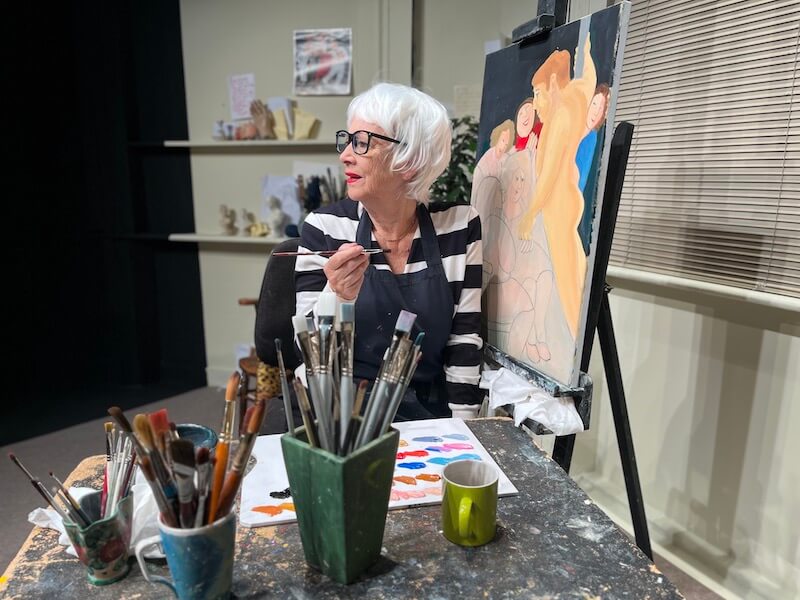
Wilson’s USP – this is her fifth play about a painter – is that she paints a picture in the manner of the artist in the course of her performance. No mean feat, one imagines, and her steady colouring-in of a pre-drawn outline (here, of Ladies’ Night) makes for a soothing backdrop to her monologue. The premise here is that the notoriously shy Cook, who never went anywhere and always refused to give interviews, has agreed to video herself talking on camera to a TV producer from her studio as she paints. This has the virtue of creating a naturalistic setting and Wilson is adept at using the rhythms of supposedly spontaneous thought as she works.
The disadvantage, of course, is that the lively and communicative Wilson can’t really have her cake and eat it – her Beryl Cook is as lively and communicative as she herself is. We can’t hope for anything resembling analysis here. Why, we might wonder, was shy middle-class Cook so drawn to the ebullient, let-it-all-hang-out characters she depicts? Wilson is probably quite right to put it all down to her sense of fun rather than some spiteful satire of the working class, but there’s only so much drama you can make out of this.
Cook, a self-taught artist who only began to paint at 35, admitted to interesting influences, notably Stanley Spencer and Edward Burra. But her paintings have none of Spencer’s eccentric visionary qualities nor Burra’s dark transgressiveness. Hers, as Wilson suggests, have more in common with Donald McGill’s saucy seaside cartoons. Make of that what you will.
Runs until 26 October 2024
