

Conductor: Edward Gardner
The London Philharmonic Orchestra’s new season gets off to a cracking start with this sparkling programme of Barber, Berlioz and Beethoven.
The first short piece, Samuel Barber’s Medea’s Dance of Vengeance (1955), may not be a familiar one, and it’s certainly a sound world away from his Adagio for Strings. Aaron Copland had described the earlier work of the young composer as ‘emotionally conventional’, but now, having served in the Army Air Corps for four years, Barber’s composition is informed by a far darker vision of the world. Written as part of a ballet requested by legendary choreographer Martha Graham, Medea’s Dance of Vengeance holds nothing back. The eerie sounds of its opening, created by nagging percussion and haunting woodwinds, never fully go away, even in the passages of lively, jazz-like rhythm. It feels like a thoroughly modern, urban piece – not a comfortable listen, but an energetic and invigorating one.
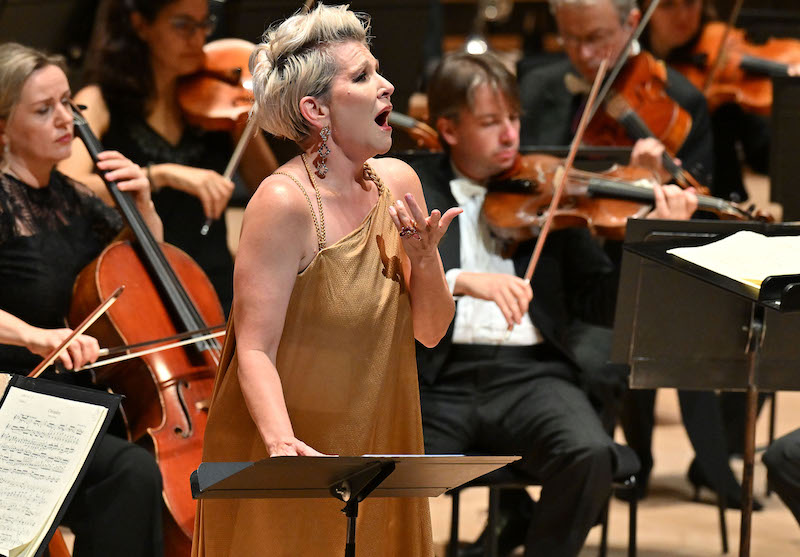
But the real show-stopper is Hector Berlioz’s cantata, La Mort de Cléopâtre. A glorious composition to a poem by Pierre-Ange Vieillard, it features a superlative performance by mezzo-soprano Joyce DiDonato, who is every inch a queen in her golden floating gown. Her voice is miraculous – her richness and range astonishing. And beyond this, she is a dazzling actor. She makes us feel every emotion, beginning with her deep shame of being delivered into the hands of Octavius Caesar (‘C’en est donc fait!’). This leads to a beautiful and touching memory of her past loves – ‘Ah! Qu’ills sont loin ces jours’ and her moment of triumph, soaring like Venus triumphant on the banks of the Cydnus.
In the Méditation which follows, Cleopatra addresses not Mark Antony, as she does in Shakespeare’s play, but the ‘Grands Pharaons, nobles Lagides’ of her Egyptian ancestors, fearing she will profane their sacred abode. Berlioz creates a wonderful range of moods. When death approaches, there is one last rush of rapid tempo before the music slows and quietens. By the end, all we hear are the quiet heartbeats of the double basses.
It’s extraordinary to reflect on the fact that this astounding piece of music was rejected by the committee of the Prix de Rome in 1826 and remained unpublished and unperformed in Berlioz’s lifetime.
The second half of the concert is devoted to Beethoven’s Symphony No. 3, the Eroica. Inspired by the figure of Napoleon, to whom he first dedicated the work, it’s a stirring celebration of heroism. The London Philharmonic Orchestra’s Principal Conductor, Edward Gardner, gives Beethoven all the attack, vigour, sweetness and excitement it deserves. The orchestra plays with zest, never losing the work’s sense of urgency. The first movement, Allegro con brio, has glorious moments of lyricism, notably from the flutes. The Marcia funebre, which forms the second movement, is magnificent, with its growling strings and piercing horns and woodwinds. The vibrant Scherzo, with its rallying hunting calls, leads finally to the thrillingly imaginative Finale.
A fabulous concert.
Reviewed on 25 September 2024
