

Writer: Abi Zakarian
Director: Sarah Brigham
There are moments of exhilarating, tear-jerking joy in Welfare, with two stand-out performances and lots of  memories evoked in this new play by award-winning writer Abi Zakarian.
The play tells the story of the groundbreaking Derbyshire Miners’ Holiday Camp in Skegness – the first place in the country to offer a completely free holiday to workers and their families in recognition of their labours. Zakarian has chosen two devices to illustrate the camp’s history: four generations of a single family; and the game of Bingo calling which cleverly leads us through the years (84, knock at the door, becomes 1984…). The use of a family over generations to tell the story of a building was used recently – to greater effect – in Standing at the Sky’s Edge.
The play’s time span covers 1939 to 1990 and takes in the Second World War, a flood, mine disasters, votes for women, immigration, racism, the miners’ strike and the shift to foreign holidays – which ultimately led to the demise of the camp: “Who’d want to come here when you can go to Torremolinos for the same money?”
Before curtain-up, the audience is entertained by a trio of musicians in the style of a holiday camp troupe and given bingo cards to play. We are encouraged to sing along, talk amongst ourselves, get up and dance and laugh at jokes. The cast really generates excitement, joy and a sense that we’re all in this together. That atmosphere unfortunately deflates a little in the first scene in which we meet our two ‘narrators’ Bingo Bob and Kat. She is the last in the line of the family at the heart of the story who is taking photographs of the dilapidated camp to jog the memory of her dying father. The scene is halting and slow – such a pity after the excitement of the pre-show performance.
The two stand-out performances in the show are from Ivan Stott as Bingo Bob and John Holt-Roberts as Jack.
Stott is on stage from start to finish, playing multiple musical instruments, singing, joking and completely epitomising the maître d’ of the camp. He has a convincing bonhomie, concern for others and a sense of history; he provides a constant guiding hand through the play. His performance is reminiscent of the late lamented Brian Glover – from his cheeky chappie manner, his verbal delivery and even his stocky build. His When You’re Smiling has the audience singing along uninvited.
Holt-Roberts is responsible for the most memorable scene of the show – a barnstorming rendition of Billy Bragg’s There is Power in a Union. Starting alone on stage with an electric guitar, the song builds in power as the Derwent Band join him and all the actors gather, one by one, many in miners’ hard hats and lamps. Once the stage is full, his voice rises in power and emotion to the last refrain and the glorious Derbyshire Miners NUM banner is unfurled. Absolutely showstopping. Billy Bragg should get to see it.
The primary weakness of the play is that covering so many characters and events inevitably means that each is dealt with relatively superficially and without nuance. The scene showing the onset of war, the enlisting of miners, and the subsequent death of Thomas, one of the family, is rendered schmaltzy by the speed of telling for example.
The play is performed by ten professional actors and a community company of around twenty, which enables the crowd scenes to be realistic but does mean that there are obvious differences in the quality of the performances.
The choice of music is excellent – immediately enabling us to place the action in time. It ranges from In The Mood right through to Frankie Goes to Hollywood’s Two Tribes. In addition to There is Power in a Union, the all-cast performance of the 1970’s The Hustle is utter joy – the cast dancing in unison and Bingo Bob drawing the audience in to arm-dance in our seats. Tremendous fun, and some funky dancing from Oraine Johnson in particular. Derwent Brass Band plays a number of set pieces throughout the show. They are delightful – no play about the mining community could possibly be complete without a great brass band. Their early performance of Flash Bang Wallop sets the tone for the evening.
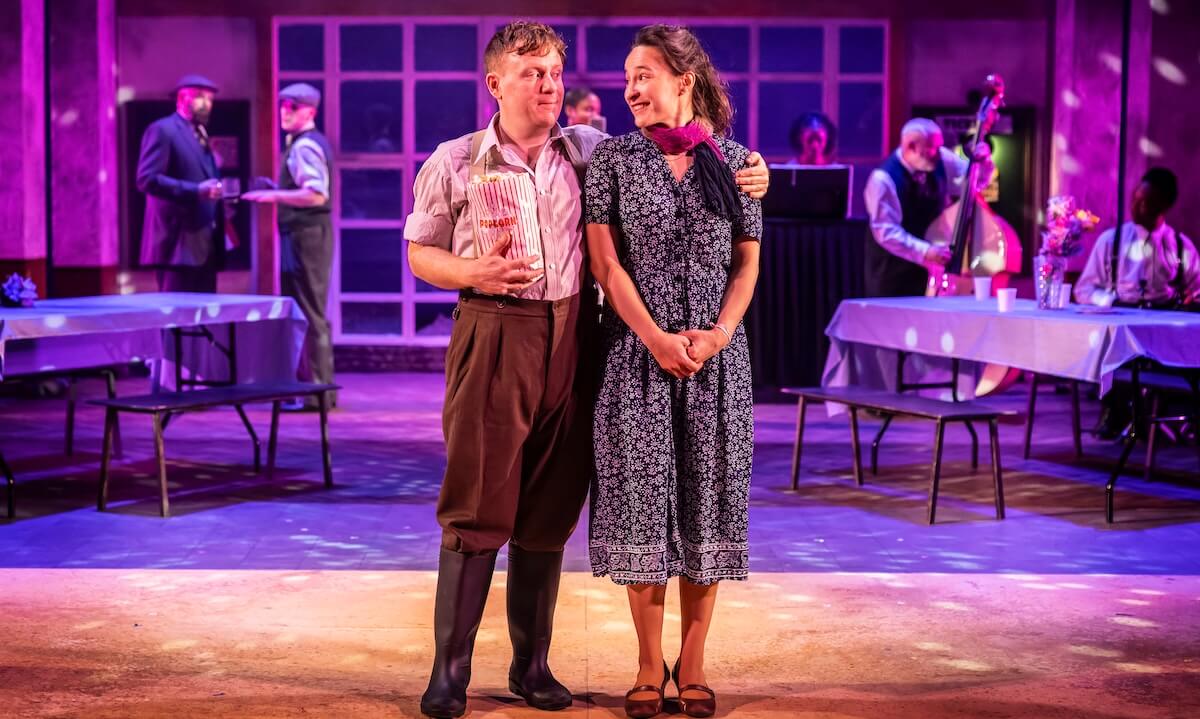
The set is an empty framework of what looks like a warehouse, with flats, tables and benches used to illustrate interiors. It is unobtrusive but is overshadowed when, in the background of There is Power in a Union, we see the outline of the pit headstocks. The costumes nicely highlight the passing of the years, from the smart, formal thirties’ outfits to the embarrassingly naff casual wear of the nineties.
Audience members have the chance to opt for an ‘experience’ seat – a seat at the front of the auditorium, with a little cabaret table, lamp and regular seats. They are invited to join in with the dancing on occasion, so only sit there if you have a performative streak.
The play does not shy away from tackling the political choices at the heart of the period. A poignant scene deals with the welcoming of Hungarian refugees to the camp in the 1950s “When we still did that sort of thing”. Joseph (Andrew Westfield) leads the miners in a heartfelt welcome which brings tears to the eye. That is followed quickly by the overt racism experienced by a black family in the 1970s. The juxtaposition is shocking, and even more upsetting given recent events.
Of course, the big political upheaval for the industry – and the camp – was the miners’ strike in 1984, which is acted out as a boxing match between Mrs Thatcher’s man and Arthur Scargill’s, to the tune of Two Tribes. The scene is followed by Billy Bragg’s song.
The final scene, where Bob reminds us that “This was never just a holiday camp” returns to the slower delivery of the start of the show – somewhat over-wordy and a little too sentimental. The very end however returns to its upbeat start, with a quick reminder of the bingo numbers by Bob, and a massive shout of “House” by the audience who all – amazingly – win the game.
The programme is designed to look like the holiday camp programmes from the 1980s, which is a nice touch. It contains reminiscences from local people of their times in Skegness and reminds us that “You would wave your mates off when you broke up and see them next day in the queue for the bus to the Miners’ Camp!”
Runs until 12 October 2024
