

Writer: Rae Skerrett
Directors Rae Skerrett and Billy Woodhouse
Billed, quaintly, as a ‘Queeriod’ drama, Kensington’s Bottom is a new play by writer, director and actor, Rae Skerrett, looking at LGBTQ+ life in Georgian England.
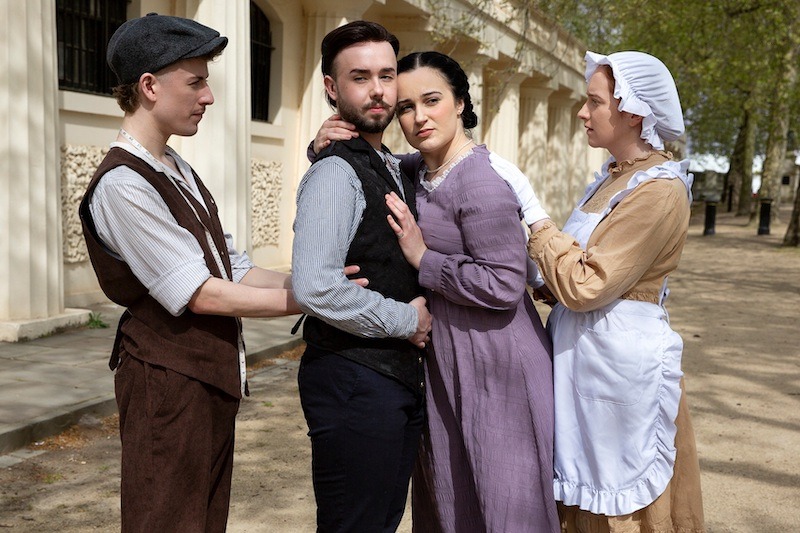
Set in a village on the outskirts of London, it focuses on Betsy Squires (Rae Skerrett), daughter of the well-to-do tailoring family, and Morris Bennett (Billy Woodhouse), family friend of the Squires’. Both are of an age where their parents’ attention turns to getting them married off and, as the two families are of similar stature and get on well, decide that they should marry each other.
Unfortunately, Betsy and Morris have other ideas, which surprisingly are rather similar. Both are in love with people of the same gender. Betsy is besotted with her family’s parlour maid, Claurice (Louisa Jane), while Morris is taken with the tailor at his work, John Frank (Callum Gaffney). On becoming aware of each other’s situation, they decide to go along with the marriage as a subterfuge to shift attention away from their real desires.
Unfortunately, everything is not plain sailing. Betsy, worried about adding more lies to her life and concerned that the plan is not as watertight as Morris believes, decides to break off the engagement and in doing so, sets the course for a very different life for the both of them.
Skerrett’s writing pays more than a passing nod to Austen, and that’s no bad thing. The script is littered with delightful phrases and presented with a meter of language you’d expect from Austen. Moreover, Betsy would be a perfect heroine in one of Austen’s novels, acting the equal to her male counterparts and dismissing ‘ladylike’ behaviour for what she finds pleasurable behaviour.
The story too, looks at life through a subtly critical lens of Georgian society and shows how some were trying to move beyond those confines. The story looks at gender, class, family, position, and of course, sexuality. However, in trying to cover such a wide range of elements none is really given the depth or focus it deserves.
The performances too, are a bit of a mixed bag and that slightly impedes both the enjoyment of and the engagement with the play. Skerrett is a delight as the bold and assured Betsy, as is Cali Levine as Bella, Betsy’s headstrong younger sister. Woodhouse holds his own as Morris but, unfortunately, Gaffney is too reserved and gives a nervous performance as John Frank.
The direction is light and allows the play to move at pace but feels like it doesn’t hit the mark all the time. In several scenes there are multiple conversations going on that, whilst giving a sense of reality, are a distraction, and in a scene in a local Molly House (queer bar of the time), the drag-proprietor (Dave Kay), is far too detached.
But these are minor quibbles in what is a very well-written play that gives an entertaining, if sobering, look into LGBTQ+ life in that era.
Runs until 25 May 2024
