

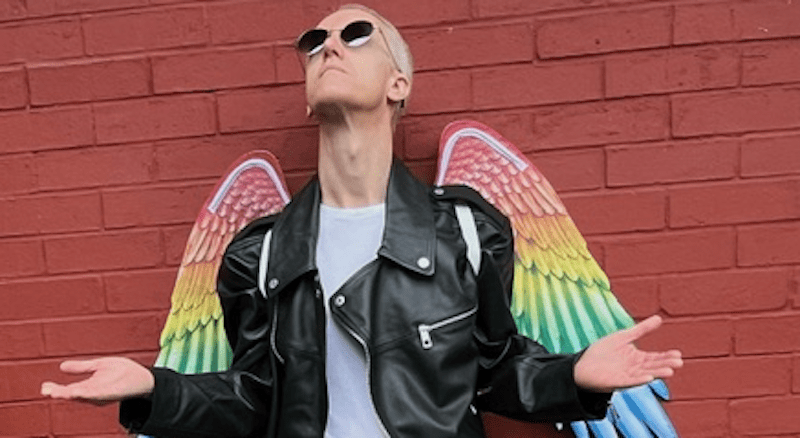
Writer: Neil Maxfield
Director: Alexander Williams
Many religions and institutions of faith have struggled with, and most often let down, the LGBTQ+ members of their congregation. Sadly, it means that many queer Christians end up leaving the church behind, a necessary step to finding the peace and happiness their faith should want for them.
For Neil Maxfield, growing up in rural Wiltshire, his voyage of self-discovery included worshipping George Michael as much as he did Jesus. At the time, the pop singer was not out as a gay man, and nor was the teenage Maxfield; while he and his best friend had “explored each other’s bodies,” as he describes in this one-man storytelling piece, he was attempting to do what was expected of him and find a girlfriend.
Some of what Maxfield describes in his summary of his life to date flirts with the mundane, from repeating conversations that go nowhere to an encounter with another gay lad at drama school who looks down on him for not being camp enough. At other times, some of his detail is uncomfortable to witness; when his first proper boyfriend turns out to be a gaslighting control freak, adept with both verbal and physical abuse, Maxfield’s depiction of some of what he was subject to feels viscerally real.
Elsewhere, though, the story is frustratingly disjointed. Strands are picked up and go nowhere, or we hear major parts of the story in passing as Maxfield recreates conversations about an event rather than relaying the event itself. At one point early on, an argument with his girlfriend is talked about with an elaborate metaphor about volcanic eruption – but it carries little weight because we have no real sense of the girlfriend’s character.
That lack of interest in providing depth to other people also affects the most persistent other character throughout Maxfield’s monologue, his Nan. While she pops up at various points, she remains opaque; when Maxfield worries about coming out to her, his concern carries little weight because we know too little about whether his fears are justified or misplaced. We also hear that she raised her grandson – although only obliquely. Maxfield reveals that his mother has died and he had been abused by his stepmother in a rare conversational prayer moment, and one that skips straight over that revelation to segue into an a cappella rendition of Don’t Let the Sun Go Down on Me.
Later, having spent years away from the Church and feeling abandoned by Christianity, Maxfield talks about having decided to return to the church. Why that decision came about is at the crux of the story Maxfield is telling, but once again, he omits the important points of progression. This is less a story of a gay man reconciling with his faith, and more a series of jumps through time from anecdote to half-told anecdote.
There is little doubt listening to Maxfield that his story is a turbulent one. More carefully structured, it could be enlightening, too. How one person has come through so many struggles, from suicide attempts to car accidents, and come out stronger because of his faith rather than in spite of it, is a tale that needs to be heard.
But for his story to land, that truth needs a stronger dramaturgical structure than is in evidence here. If Maxfield were better able to join the dots of his life, he’d find a much stronger storytelling path to take us down.
Continues until 28 April 2024
